
Thermal Management Testing for Power Modules
DETAILS
For after-sales maintenance teams, reliable power modules are essential to system uptime and long-term field performance. Thermal management testing helps identify heat-related risks early, from junction temperature instability to material fatigue under continuous operation. By understanding test data and thermal behavior, maintenance professionals can improve troubleshooting accuracy, reduce unexpected failures, and support more informed decisions on repair, replacement, and lifecycle management.
In semiconductor, power electronics, and EMS environments, heat is rarely an isolated variable. It interacts with solder joints, substrate quality, encapsulation materials, cooling hardware, load cycles, and installation conditions in the field. For maintenance personnel, this means that a power module failure cannot be judged only by electrical symptoms. A module that passes a basic continuity check may still be operating with unsafe thermal margins.
This is where thermal management testing becomes practical rather than theoretical. Independent thermal benchmarking, structured test methods, and clear reporting help maintenance teams move from reactive repair to condition-based decision-making. For organizations managing industrial drives, power converters, telecom systems, charging infrastructure, or high-density control cabinets, test-backed thermal insight can shorten fault isolation time by 20% to 40% in typical service workflows.
Why Thermal Management Testing Matters in Power Module Maintenance
Power modules operate under repeated thermal stress. In many field applications, junction temperatures can swing by 30°C to 80°C within a single duty cycle. Over weeks or months, these thermal cycles accelerate die attach fatigue, solder degradation, baseplate warpage, thermal interface breakdown, and insulation stress. For after-sales teams, the result is often intermittent failure rather than immediate shutdown.
Common field symptoms linked to poor thermal behavior
Maintenance engineers often first encounter thermal issues through indirect symptoms. These include unstable switching performance, repeated over-temperature alarms, gate driver fault reports, fan overuse, heat sink discoloration, and uneven temperature maps across identical channels. In systems above 5 kW, even a 5°C to 10°C hotspot difference between neighboring modules can indicate mounting pressure variation, interface voiding, or package aging.
- Unexpected shutdown during peak load or high ambient conditions
- Temperature drift after 500 to 2,000 operating hours
- Repeated replacement of the same module position in one cabinet
- Visible degradation of thermal pads, grease spread, or clamping surfaces
- Fan speed increase without equivalent load increase
What thermal tests reveal beyond a basic electrical check
Electrical testing confirms whether a module still switches, conducts, or isolates properly. Thermal management testing goes further by showing how efficiently heat moves from junction to case, case to heat sink, and heat sink to ambient air or liquid coolant. That matters because two modules with similar electrical readings may differ sharply in thermal resistance, hotspot formation, and long-term reliability margin.
A well-designed thermal evaluation can capture junction-to-case thermal resistance trends, transient thermal impedance, contact flatness issues, and the effect of degraded interface material. For service teams, these indicators help separate three different maintenance actions: reuse, monitor, or replace. That distinction directly affects spare inventory planning and warranty handling.
Typical decision thresholds used in maintenance reviews
Although exact limits vary by package and application, many maintenance teams use practical thresholds. A sustained case temperature increase above 8°C versus a reference unit, a thermal resistance shift above 10% to 15%, or hotspot asymmetry above 12°C under matched load are commonly treated as escalation triggers. These are not universal pass-fail rules, but they are useful screening criteria in field support.
The table below shows how common maintenance symptoms can be mapped to probable thermal causes and recommended next actions. This helps after-sales teams prioritize inspection steps instead of replacing parts based on symptom alone.
The key takeaway is that thermal management testing improves maintenance precision. Instead of treating every alarm as a component defect, teams can verify whether the root cause sits in the package, the interface layer, the cooling assembly, or the surrounding system design.
Core Thermal Tests Used for Power Modules
Different service scenarios call for different test methods. A returned module from a field failure may need a fast screening sequence in less than 2 hours, while a recurring fleet issue may justify a full laboratory benchmark over 3 to 5 days. Maintenance teams do not need to run every advanced analysis themselves, but they should understand what each method measures and when to request it.
Static thermal resistance testing
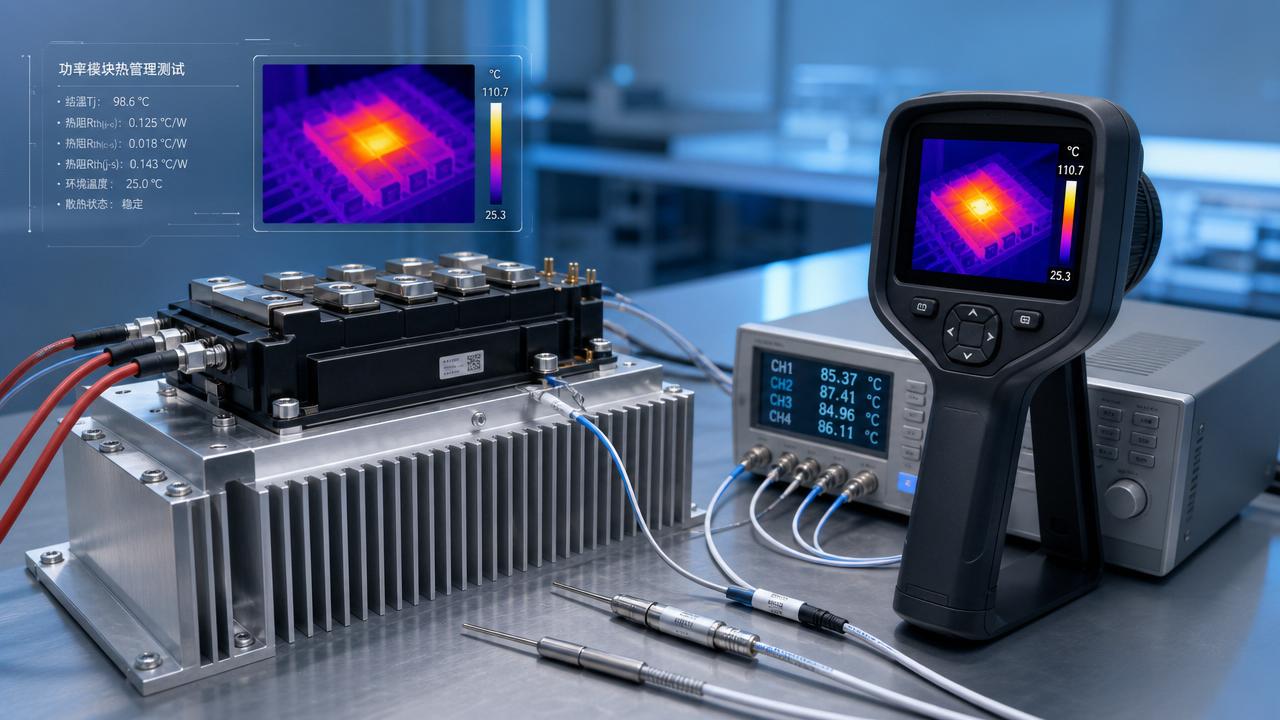
This method measures how effectively heat transfers under stable load. It is useful for comparing incoming replacement units, validating repaired assemblies, and identifying modules that run consistently hotter than baseline. Typical outputs include junction-to-case resistance, case-to-sink resistance, and temperature rise per watt. In maintenance terms, it answers a simple question: is the module dissipating heat as expected at steady state?
Transient thermal impedance analysis
Transient testing evaluates how the module responds to changing load and pulsed power. This is valuable in motor drives, inverters, and switching systems where thermal peaks occur in milliseconds or seconds rather than at steady state. A module may appear acceptable in static testing, yet show delayed heat release or abnormal temperature spikes under rapid cycling.
Infrared thermography and hotspot mapping
IR imaging is one of the most practical tools for after-sales teams because it quickly reveals non-uniform heating. Under controlled load, a thermographic image can detect edge hotspots, cold spots caused by poor contact, and thermal asymmetry between phases. When performed with emissivity correction and repeatable setup, it becomes a strong diagnostic complement to electrical results.
Thermal cycling and reliability stress screening
For lifecycle reviews and recurring failure analysis, thermal cycling tests reproduce the stress of repeated expansion and contraction. Common screening windows may range from -40°C to 125°C or from 25°C to 105°C, depending on package type and application risk. The purpose is not only to confirm immediate function, but to expose hidden weakness in interconnects, encapsulants, and attachment layers.
The following comparison helps maintenance teams decide which thermal management testing approach fits a specific after-sales objective, expected turnaround, and evidence requirement.
For most service departments, the most efficient path is layered testing. Start with IR mapping and baseline thermal resistance, then escalate to transient or cycling analysis only when failure patterns repeat or when replacement cost is high enough to justify deeper investigation.
How After-Sales Teams Can Apply Thermal Data in Daily Service Work
Thermal management testing delivers value only when results are translated into field actions. Maintenance teams need simple review logic, repeatable documentation, and decision thresholds aligned with service-level obligations. A test report that stays in engineering archives does little for uptime. A report that defines inspection steps, replace-or-reuse criteria, and escalation timing becomes operationally useful.
A practical 5-step service workflow
- Record operating context: load level, ambient temperature, duty cycle, and alarm history.
- Compare failed or suspect module against a known-good reference under the same setup.
- Inspect mounting torque, heat sink cleanliness, airflow path, and thermal interface coverage.
- Run thermal management testing appropriate to the symptom severity and return timeline.
- Classify outcome as reinstall, monitor, refurbish, or replace, then update maintenance records.
What to document during field returns and bench verification
Reliable comparison requires disciplined documentation. At minimum, service teams should capture 6 core items: module part number, operating hours, load profile, ambient range, cooling method, and mounting condition. Adding thermal images, torque sequence records, and interface material photos improves root-cause confidence and reduces repeated troubleshooting across regions or shifts.
Common maintenance mistakes that distort thermal conclusions
Several avoidable errors can make a healthy module look defective or hide a real thermal problem. These include uneven screw tightening, reused thermal grease, dust-loaded fins, incorrect IR emissivity settings, and testing at a load point far below real field conditions. In some cases, a 15-minute bench test at light load provides false confidence because the hotspot develops only after 45 to 60 minutes at 80% duty.
- Do not compare units tested under different airflow or coolant conditions.
- Do not treat case temperature alone as proof of safe junction temperature.
- Do not ignore repeated failures in one installation position.
- Do not assume all replacement modules have identical thermal behavior without verification.
Choosing Independent Thermal Validation and Benchmarking Support
When maintenance decisions affect high-value equipment, warranty exposure, or multi-site reliability, independent analysis becomes especially useful. Organizations such as SiliconCore Metrics support the semiconductor and EMS supply chain by converting complex manufacturing and thermal performance variables into standardized, decision-ready reports. For after-sales teams, this reduces ambiguity between component fault, assembly defect, and application-side thermal stress.
What to look for in a testing partner
A credible thermal testing partner should offer repeatable methodologies, transparent test conditions, and reporting that maintenance staff can actually use. The best reports do not stop at charts. They connect findings to service action, risk level, and comparison baseline. In B2B environments, that practical clarity matters as much as laboratory precision.
- Defined test setup, load conditions, and ambient controls
- Reference comparison against known-good or market-equivalent modules
- Evidence linking thermal findings to package, interface, or assembly variables
- Reporting suitable for procurement, engineering, and maintenance review
- Awareness of IPC-Class 3, ISO 9001 workflows, and electronics manufacturing context
How benchmarking supports procurement and spare planning
Thermal management testing is not only a repair tool. It also supports smarter replacement strategy. If two supplier options meet electrical requirements but one shows lower thermal resistance drift over 1,000-hour stress review, maintenance and procurement teams can justify stocking the more stable option. That can reduce repeat service events, avoid unnecessary truck rolls, and improve lifecycle cost control across 12-month to 36-month support windows.
For service organizations managing geographically distributed assets, standardized thermal reports also improve communication. A plant technician, regional support lead, and procurement manager can all work from the same acceptance criteria instead of relying on subjective heat-related observations.
Frequently asked service questions
When should a module be replaced rather than monitored?
If thermal resistance increases materially against baseline, hotspot imbalance persists after remounting, or over-temperature behavior returns within one operating cycle, replacement is usually more economical than repeated intervention. This is especially true in systems where downtime costs exceed the price of the module.
Can thermal testing help with no-fault-found returns?
Yes. Many no-fault-found cases involve intermittent thermal behavior that basic electrical checks miss. Dynamic load testing and thermography often reveal the missing evidence, especially when the issue appears only after prolonged operation or at elevated ambient temperatures above 40°C.
Is testing useful for refurbished assemblies?
Absolutely. Refurbished or reworked assemblies should be verified for contact quality, interface consistency, and temperature distribution before being returned to service. Even small variations in pad thickness or clamping sequence can alter thermal performance enough to shorten field life.
Thermal management testing gives after-sales maintenance teams a clearer way to protect uptime, control service cost, and make evidence-based replacement decisions. It turns heat from a vague suspicion into a measurable maintenance variable, whether the issue is a drifting junction temperature, aging interface material, or recurring hotspot in a specific installation slot.
For organizations that support power modules across semiconductor, industrial, and EMS-linked applications, independent benchmarking and structured thermal analysis can strengthen troubleshooting, procurement alignment, and long-term reliability planning. If you need support interpreting thermal behavior, validating returned modules, or comparing supply options, contact SCM to get a tailored evaluation plan, consult product details, and explore more reliable thermal management solutions.
Recommended News
- Heat DissipationHow to prevent overheating in automotive PCB power distributionPrevent overheating in automotive PCB power distribution with practical tips on copper layout, thermal paths, and testing. Discover how to reduce hotspots and improve reliability.
- Heat DissipationCan heat spreading intelligence identify hot spots in PCB designs?Discover how heat spreading intelligence identifies PCB hot spots before fabrication. Learn to assess thermal models, validate predictions, and choose design changes that improve reliability.
- Heat DissipationWhich heat sink materials suit high-power electronics made in Germany?Heat sink materials Germany: compare aluminum, copper, graphite, and hybrid designs for high-power electronics. Find the right balance of thermal performance, weight, cost, and manufacturability.
- Heat DissipationHow to assess a graphite materials supplier's capability for thermal partsGraphite materials supplier assessment starts with more than machining. Discover how to evaluate thermal performance, purity, precision, cleanliness, traceability, and testing for reliable thermal parts.
- Heat DissipationHow to assess a heat dissipation supplier before placing an orderHeat dissipation supplier assessment guide: verify thermal performance, materials, process control, samples, capacity, and total risk before placing an order.
- Heat DissipationHow automotive PCB material selection affects thermal reliabilityAutomotive PCB material selection shapes thermal reliability. Explore CTE, Tg, moisture resistance, stack-up design, and proven qualification strategies for demanding vehicle electronics.