
Thermal Management PCB Options for Dense Power Layouts
DETAILS
In dense power layouts, thermal stress quickly becomes a design limiter rather than a secondary concern. A well-chosen thermal management PCB approach helps control junction temperature, preserve efficiency, and reduce long-term reliability loss.
As switching frequencies rise and board space shrinks, heat paths must be designed with the same discipline as current paths. Material choice, copper strategy, stack-up symmetry, and via architecture all shape thermal behavior.
For the global semiconductor and EMS ecosystem, thermal transparency supports better engineering validation and more stable sourcing decisions. That is why thermal management PCB selection now matters across development, qualification, and sustained production.
Thermal management PCB fundamentals in dense power designs
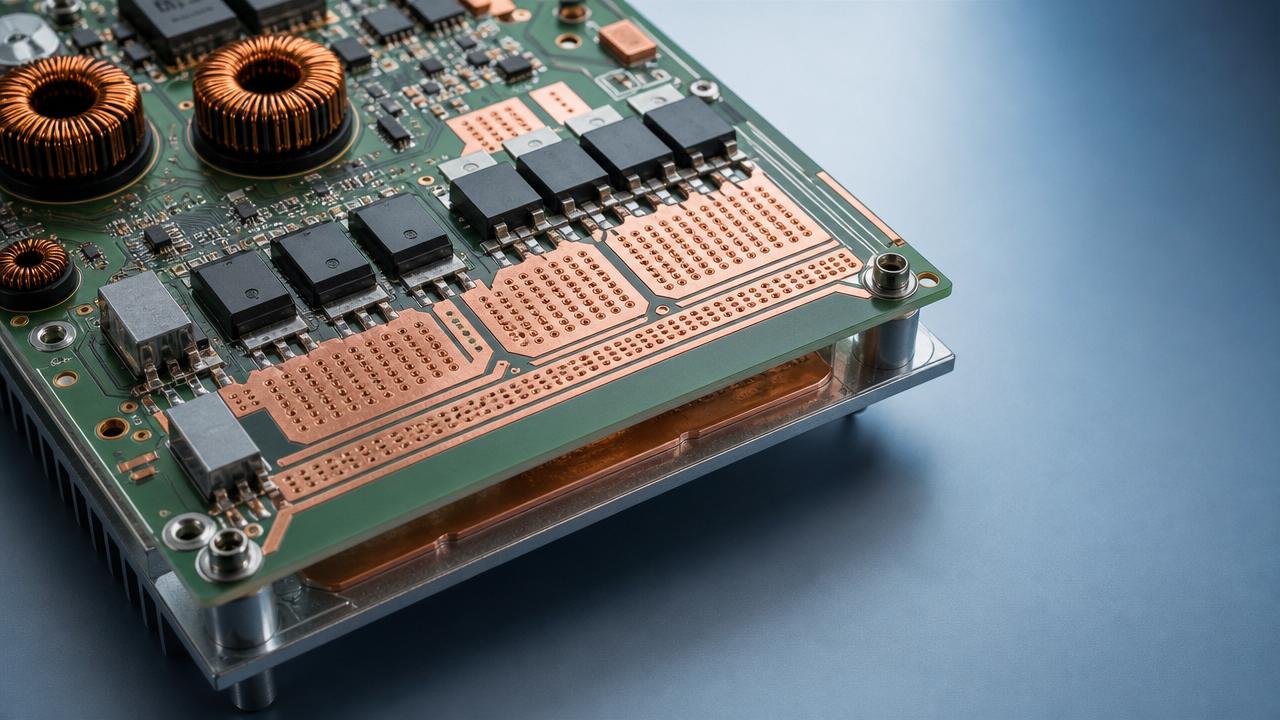
A thermal management PCB is a board structure optimized to spread, transfer, and dissipate heat from active power devices. The goal is not only lower temperature, but also predictable thermal gradients across the assembly.
In dense layouts, thermal bottlenecks often appear near MOSFETs, controllers, inductors, diodes, and embedded power stages. Local hot spots can distort electrical performance, accelerate solder fatigue, and reduce component lifetime.
A practical thermal management PCB strategy usually combines several design levers:
- Base material with suitable thermal conductivity
- Copper thickness matched to current and heat spreading needs
- Thermal vias under or near heat-generating packages
- Balanced stack-up to reduce warpage and uneven heating
- Interface planning for heat sinks, chassis, or airflow
The correct option depends on power density, enclosure limits, insulation needs, reliability targets, and manufacturing tolerance. No single thermal management PCB architecture fits every power product.
Current industry focus and design signals
Across electronics manufacturing, thermal constraints are tightening because device performance is increasing faster than available board area. More functions now share smaller footprints, raising the importance of measured thermal design.
Several signals shape current thermal management PCB decisions:
Independent technical benchmarking also matters. Thermal claims on laminate conductivity or metal-core behavior should be verified against process capability, dielectric performance, and long-cycle reliability data.
Main thermal management PCB options
The most common thermal management PCB options differ in cost, thermal path efficiency, electrical behavior, and manufacturing complexity. Selection should reflect both steady-state heat flow and transient load conditions.
Standard FR-4 with enhanced copper design
This is often the first thermal management PCB option considered. It uses conventional FR-4, but improves heat spreading through heavier copper, larger planes, and dense via fields.
It works well when thermal loads are moderate and cost pressure is high. Performance depends strongly on copper continuity, plane shape, and direct connection to thermal pads.
High-Tg or thermally enhanced laminates
These materials improve thermal robustness compared with standard FR-4. Some offer better thermal conductivity, lower expansion stress, or improved stability under repeated heating cycles.
This thermal management PCB route is useful when higher operating temperature and mechanical reliability are both important. It can support better dimensional stability in multi-layer power boards.
Metal core PCB
A metal core PCB typically uses an aluminum or copper base to draw heat away from active regions. It offers strong thermal conduction to the chassis or external cooling structure.
This thermal management PCB option is common in LED power, motor control, automotive modules, and rugged converters. Electrical isolation and layer count limits must be reviewed carefully.
Insulated metal substrate
An insulated metal substrate combines a metal base, dielectric insulation layer, and copper circuit layer. It provides an efficient downward heat path while maintaining electrical separation.
This thermal management PCB structure is attractive for compact power modules. However, dielectric thickness and conductivity directly influence thermal resistance and voltage withstand behavior.
Heavy copper multi-layer PCB
Heavy copper constructions support both current carrying capacity and thermal spreading. They are often used where power traces, bus structures, and local heat extraction must coexist.
This thermal management PCB choice can reduce resistive losses. It may also complicate etching control, fine-pitch routing, and solder joint quality if not balanced properly.
Application value across electronics programs
A strong thermal management PCB design creates value beyond lower temperature readings. It improves electrical stability, supports qualification success, and reduces unexpected field performance drift.
- Lower junction temperatures can improve semiconductor life expectancy
- Reduced hot spots help stabilize resistance, timing, and switching behavior
- Better thermal distribution may reduce board warpage during assembly
- Controlled gradients support solder joint and component reliability
- Repeatable thermal paths simplify compliance and benchmarking work
For technical data organizations such as SiliconCore Metrics, this area is especially relevant because thermal design quality intersects with materials science, process precision, and long-term reliability evidence.
When boards are assessed as engineering systems rather than commodities, thermal management PCB decisions become measurable variables. That supports cleaner comparison across fabrication partners and assembly routes.
Typical scenarios and option matching
Different power applications call for different thermal management PCB priorities. The table below shows a practical matching framework for common dense layout conditions.
Practical design recommendations and cautions
A thermal management PCB performs best when thermal design begins early, before placement and routing become fixed. Late fixes often add cost without solving the real heat path problem.
- Map major heat sources and estimate loss distribution before stack-up release.
- Place thermally coupled parts to shorten conduction paths and reduce local crowding.
- Use thermal vias with suitable diameter, pitch, and fill strategy.
- Balance copper across layers to limit warpage and uneven expansion.
- Check dielectric properties when adding metal-based thermal management PCB structures.
- Validate with simulation, thermography, and environmental stress testing.
Several cautions are often overlooked. More copper does not always equal better cooling. Isolated copper islands can trap heat, while poor via implementation can weaken both thermal and assembly performance.
Likewise, a metal core PCB may improve heat removal but complicate impedance control or layer integration. Every thermal management PCB decision should be checked against signal integrity, insulation, and manufacturability.
Next-step evaluation path
A disciplined evaluation path makes thermal management PCB selection more reliable. Start with power density, allowable temperature rise, enclosure conditions, and expected service environment.
Then compare material data, copper capability, via process limits, and thermal test evidence. Independent benchmarking is especially useful when several fabrication routes appear similar on paper.
For organizations tracking global semiconductor and EMS quality, structured thermal data improves design confidence and sourcing clarity. A thermal management PCB should be chosen as a verified engineering solution, not a nominal specification line.
When dense power layouts are evaluated through measurable thermal paths, the result is better reliability, more stable performance, and stronger alignment between design intent and manufacturing outcome.
Recommended News
- Heat DissipationHow to prevent overheating in automotive PCB power distributionPrevent overheating in automotive PCB power distribution with practical tips on copper layout, thermal paths, and testing. Discover how to reduce hotspots and improve reliability.
- Heat DissipationCan heat spreading intelligence identify hot spots in PCB designs?Discover how heat spreading intelligence identifies PCB hot spots before fabrication. Learn to assess thermal models, validate predictions, and choose design changes that improve reliability.
- Heat DissipationWhich heat sink materials suit high-power electronics made in Germany?Heat sink materials Germany: compare aluminum, copper, graphite, and hybrid designs for high-power electronics. Find the right balance of thermal performance, weight, cost, and manufacturability.
- Heat DissipationHow to assess a graphite materials supplier's capability for thermal partsGraphite materials supplier assessment starts with more than machining. Discover how to evaluate thermal performance, purity, precision, cleanliness, traceability, and testing for reliable thermal parts.
- Heat DissipationHow to assess a heat dissipation supplier before placing an orderHeat dissipation supplier assessment guide: verify thermal performance, materials, process control, samples, capacity, and total risk before placing an order.
- Heat DissipationHow automotive PCB material selection affects thermal reliabilityAutomotive PCB material selection shapes thermal reliability. Explore CTE, Tg, moisture resistance, stack-up design, and proven qualification strategies for demanding vehicle electronics.