
PCB for Automotive: Heat Dissipation Choices That Cut Failures
DETAILS
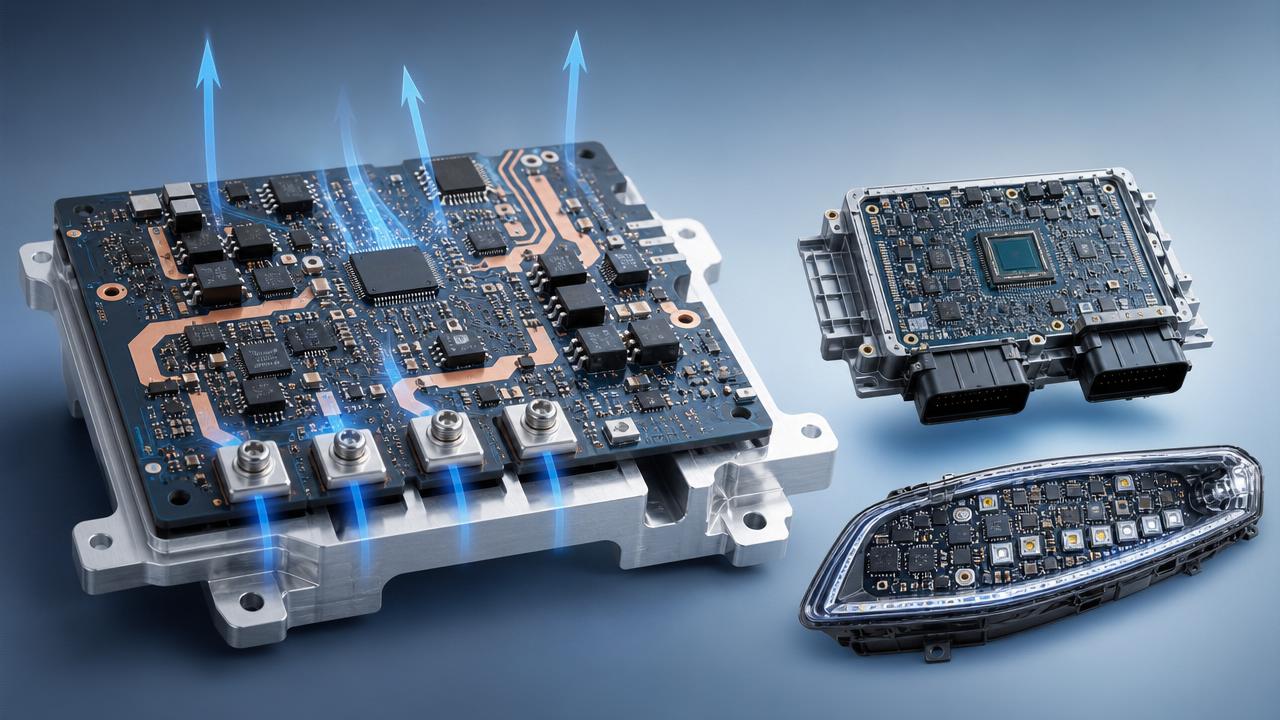
Choosing the right PCB for automotive systems now shapes reliability more than cost alone. Heat drives solder fatigue, copper drift, dielectric aging, and intermittent faults.
In vehicle electronics, thermal design choices affect warranty exposure, compliance confidence, and long-term service stability. A weak heat path can turn a functional design into a field failure.
For SCM, this topic sits at the intersection of PCB fabrication, SMT assembly, component reliability, and thermal packaging. Data-led thermal decisions reduce sourcing risk and improve performance consistency.
Why thermal decisions change by automotive scenario
Not every PCB for automotive use faces the same thermal stress. Cabin modules, power converters, lighting boards, and battery control units operate under very different heat profiles.
A board near the engine bay may face high ambient temperatures and vibration. An infotainment board may see lower ambient heat but denser processors and tighter packaging.
The right heat dissipation choice depends on four linked variables:
- Peak power density
- Ambient operating temperature
- Duty cycle and thermal cycling rate
- Mechanical constraints and enclosure airflow
This is why one stack-up cannot fit every automotive application. Thermal success comes from matching board architecture to the actual operating scene.
Scenario 1: Power control boards need direct heat paths
DC-DC converters, inverter control boards, and motor drive modules demand the most aggressive thermal planning. Here, the PCB for automotive platform must move heat fast and predictably.
Standard FR-4 can work in selected designs, but only when copper thickness, via arrays, and thermal interface management are carefully optimized. Otherwise, hotspots concentrate near MOSFETs and regulators.
Core judgment points
- Use heavy copper where current and heat overlap
- Shorten the thermal path from device pad to heat sink
- Add dense thermal vias under power packages
- Verify resin system Tg and Td margins
In these scenes, insulated metal substrate options or metal-core structures may outperform conventional multilayer boards. They can lower junction temperature and slow fatigue accumulation.
However, metal-based solutions add cost and assembly constraints. The best choice depends on whether thermal gain offsets process complexity and sourcing variability.
Scenario 2: ADAS and computing boards need balanced thermal control
ADAS controllers, vision modules, and domain computers generate sustained heat across processors, memory, and power rails. The challenge is uniform dissipation, not only single-point cooling.
A PCB for automotive computing scenes should support signal integrity and thermal stability together. High-speed routing cannot be planned separately from copper distribution.
Core judgment points
- Balance copper planes to spread heat laterally
- Avoid isolated hotspots near BGAs and PMICs
- Choose low-loss materials with stable thermal behavior
- Coordinate board design with enclosure heat flow
Very thick copper is not always ideal here. It may help conduction, yet it can complicate impedance control, warp risk, and layer registration.
Instead, optimized stack-up symmetry, plane continuity, and targeted via farms often deliver better thermal uniformity with fewer manufacturing penalties.
Scenario 3: LED lighting boards demand surface-level heat release
Headlamps, tail lamps, and daytime running lights create concentrated heat at LED packages. Optical stability falls quickly when board temperature rises beyond design assumptions.
For lighting, a PCB for automotive use case often favors aluminum-core PCB structures. These improve thermal transfer from LEDs to housing assemblies.
Core judgment points
- Check thermal resistance from LED pad to metal base
- Control dielectric thickness over the metal core
- Match board expansion behavior with housing materials
- Prevent local overheating that shifts color output
When cost pressure pushes designs back to standard FR-4, the risk is often hidden. Initial function may pass, while lumen decay and solder cracking appear later.
Scenario 4: Battery management boards need stable cycling resistance
Battery management systems work under long operating cycles, electrical noise, and continuous monitoring loads. Their thermal issue is often cumulative, not dramatic.
A PCB for automotive battery electronics should minimize repeated thermal stress on interconnects, measurement circuits, and connectors. Reliability depends on endurance over thousands of cycles.
Core judgment points
- Prioritize material stability across temperature swings
- Reduce heat concentration near shunt and balancing circuits
- Keep stack-up mechanically balanced
- Evaluate connector zones for thermal aging
In this scene, the winning design is rarely the coolest design on paper. It is the design that stays electrically and mechanically stable over repeated temperature exposure.
How heat dissipation choices differ across scenarios
Practical selection advice for a PCB for automotive project
Selecting a PCB for automotive reliability starts with thermal mapping, not material branding. Board choices should come after identifying heat generation, transfer limits, and failure sensitivity.
- Quantify worst-case power and ambient temperature together.
- Model hotspot location before finalizing stack-up.
- Compare FR-4, high-Tg, IMS, and metal-core options by thermal resistance.
- Check copper weight against etching tolerance and impedance needs.
- Evaluate thermal vias for fill quality and assembly impact.
- Validate board behavior under thermal cycling, not only steady-state testing.
SCM’s benchmarking mindset is useful here. A specification that looks strong on a datasheet may behave differently across fabricators, laminates, plating quality, and assembly windows.
Common mistakes that raise automotive PCB failure risk
Several failures come from wrong assumptions rather than wrong materials. These errors often remain hidden until thermal cycling exposes the weakness.
- Assuming thicker copper always means better heat dissipation
- Ignoring enclosure airflow and mounting contact quality
- Using thermal vias without checking voiding or solder wicking
- Selecting laminate by cost while ignoring Tg, Td, and CTE behavior
- Testing only room-temperature function for a PCB for automotive design
Another frequent mistake is separating PCB design from assembly and sourcing reality. Thermal plans fail when paste volume, coplanarity, or interface flatness are not controlled.
What to do next when evaluating heat dissipation choices
A strong PCB for automotive decision should combine thermal simulation, stack-up review, material verification, and manufacturing benchmarking. This creates a more reliable path than cost-first selection.
Start by grouping the application into its real thermal scene. Then compare materials, copper strategy, via architecture, and enclosure coupling against that scene’s failure mode.
When heat, tolerance, and lifecycle performance must align, independent data becomes valuable. SCM supports these evaluations through technical benchmarking across PCB fabrication, SMT precision, components, and thermal packaging behavior.
The result is simpler: fewer hidden thermal compromises, lower failure probability, and a PCB for automotive architecture matched to real operating conditions.
Recommended News
- Heat DissipationHow to prevent overheating in automotive PCB power distributionPrevent overheating in automotive PCB power distribution with practical tips on copper layout, thermal paths, and testing. Discover how to reduce hotspots and improve reliability.
- Heat DissipationCan heat spreading intelligence identify hot spots in PCB designs?Discover how heat spreading intelligence identifies PCB hot spots before fabrication. Learn to assess thermal models, validate predictions, and choose design changes that improve reliability.
- Heat DissipationWhich heat sink materials suit high-power electronics made in Germany?Heat sink materials Germany: compare aluminum, copper, graphite, and hybrid designs for high-power electronics. Find the right balance of thermal performance, weight, cost, and manufacturability.
- Heat DissipationHow to assess a graphite materials supplier's capability for thermal partsGraphite materials supplier assessment starts with more than machining. Discover how to evaluate thermal performance, purity, precision, cleanliness, traceability, and testing for reliable thermal parts.
- Heat DissipationHow to assess a heat dissipation supplier before placing an orderHeat dissipation supplier assessment guide: verify thermal performance, materials, process control, samples, capacity, and total risk before placing an order.
- Heat DissipationHow automotive PCB material selection affects thermal reliabilityAutomotive PCB material selection shapes thermal reliability. Explore CTE, Tg, moisture resistance, stack-up design, and proven qualification strategies for demanding vehicle electronics.