
How High Temperature PCB Fabrication Affects Thermal Reliability and Cost
DETAILS
Why “High Temperature” in PCB Fabrication Is Often Misread
In PCB sourcing, “high temperature” is frequently treated as a material label, as if selecting a high-Tg laminate automatically solves thermal reliability. That is too narrow. High temperature PCB fabrication is really a manufacturing and qualification question: how the laminate, copper stack-up, resin system, drilling quality, plating integrity, solder mask performance, and assembly exposure behave together when the board sees elevated process temperatures or long-term thermal stress in service.
That distinction matters because many field failures blamed on “bad heat resistance” are not simple cases of choosing the wrong base material. They often emerge from interaction effects: z-axis expansion stressing plated through holes, repeated reflow cycles weakening interconnect reliability, resin recession around vias, delamination after moisture exposure, or local hot spots causing uneven aging across the board. For technical evaluators, high temperature PCB fabrication intelligence means understanding those interactions early enough to separate a robust design from a board that merely passes incoming inspection.
The practical question is not whether a PCB can survive one high-temperature event. It is whether the fabrication route supports the expected thermal profile over time, under the actual duty cycle, assembly sequence, and compliance target.
Material Choice Is Only the Starting Point
When engineers discuss heat-resistant boards, they usually begin with Tg, the glass transition temperature. That is reasonable, but Tg alone is not a sufficient screening metric. A laminate may have a relatively high Tg and still perform poorly if its decomposition temperature, time-to-delamination behavior, moisture sensitivity, or coefficient of thermal expansion are not aligned with the application. In other words, a board can look strong in a datasheet summary and still become unreliable once fabrication complexity rises.
This is especially relevant in multilayer constructions, heavy copper designs, boards with dense via fields, and products assembled through multiple thermal passes. As stack-up thickness increases, thermal stress distribution becomes less forgiving. Resin-rich and resin-starved regions behave differently. Drill quality becomes more consequential. Copper balancing starts influencing not only warpage but also how heat moves through the structure during reflow and operation.
For that reason, experienced buyers and reliability teams rarely stop at “FR-4 versus high-Tg FR-4” as a decision frame. They look at the broader thermal envelope: expected peak assembly temperature, dwell time, number of rework events, ambient operating range, power density, and whether the product will be exposed to thermal shock, power cycling, or sustained elevated temperature.
Where Thermal Reliability Actually Breaks Down
The most expensive misconception in this area is assuming that high temperature capability is mainly about surface survival. In practice, the deeper reliability issues are often internal. Barrel cracking in plated through holes, corner cracking in vias, CAF-related risk in certain conditions, pad lifting, layer separation, and interlaminar weakness tend to drive long-term failure concerns more than visible discoloration or cosmetic solder mask changes.
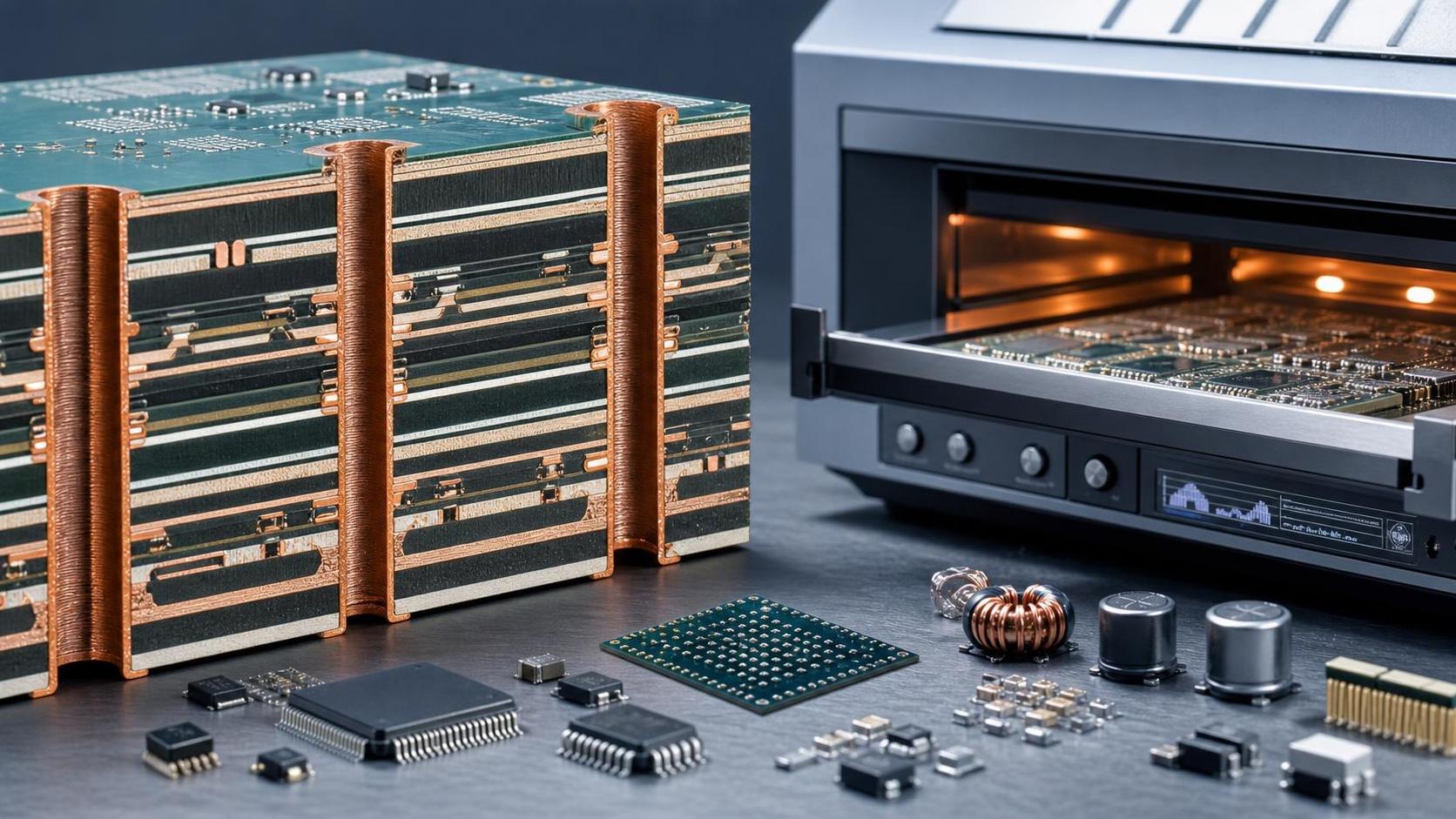
Plated through holes deserve particular attention. The copper barrel and the surrounding laminate expand differently as temperature rises. Repeated thermal cycling can fatigue that interface, especially in thicker boards or designs with unfavorable aspect ratios. If the fabrication process leaves thin copper plating, poor hole-wall preparation, or uneven deposition, the margin narrows quickly. A board may pass electrical test at shipment and still fail after enough thermal excursions in the field.
Lead-free assembly intensified this concern across the industry because reflow peaks are generally higher than legacy tin-lead processes. That shifted material and process expectations upward. It also made moisture management more important. A laminate that absorbs moisture and then experiences rapid heating can show internal damage that is not obvious immediately. For evaluators reviewing supplier claims, this is one reason thermal reliability data should be read alongside fabrication controls, not in isolation.
Fabrication Variables That Influence Cost More Than Buyers Expect
High temperature PCB fabrication costs more for reasons that go beyond premium laminate pricing. Material cost is visible on a quote. Process sensitivity is less visible, but often more important.
Higher-performance resin systems can be harder to drill cleanly, harder to desmear consistently, or less tolerant of weak process control. That can affect yield. Multilayer lamination may require tighter press parameters. Hole quality and plating uniformity may demand more conservative process windows. Registration control can become stricter when stack-ups are dense and thermal movement during processing must be tightly managed. None of this is unusual, but each constraint adds scrap risk, cycle time, or inspection burden.
Then there is the indirect cost of qualification. If the end use points toward IPC-Class 3 expectations, automotive-adjacent validation, industrial power electronics, or high-reliability communications hardware, the cost conversation is no longer just about raw board price. It includes evidence. Procurement teams often underestimate how much value sits in proven thermal cycling data, documented laminate traceability, process capability records, and consistent lot-to-lot behavior. In high temperature applications, uncertainty itself is a cost driver.
A More Useful Way to Compare Options
For technical assessment, a simple comparison framework is usually more useful than broad labels:
This is where high temperature PCB fabrication intelligence becomes more than a keyword. It is the discipline of translating thermal claims into comparable evidence. That is particularly important when sourcing across regions, where identical material names may still conceal differences in process maturity, inspection depth, or reliability reporting practices.
Standards Help, but They Do Not Eliminate Judgment
Technical evaluators often rely on IPC and ISO references to bring structure to vendor review. That is necessary, but standards are frameworks, not substitutes for engineering interpretation. IPC-Class 3, for example, signals a high-reliability manufacturing target, yet it does not by itself answer whether a specific stack-up is well matched to continuous high-temperature operation, fast thermal transients, or repeated power cycling in a compact enclosure.
The same applies to quality-system certification. ISO 9001 can confirm that a supplier operates under a documented quality management system. It does not mean every laminate option, via architecture, or thermal reliability claim has been validated equally. In thermal applications, the detail behind the certificate matters: what was tested, under which conditions, on what construction, and with what failure criteria.
That is one reason independent benchmarking has real value in the semiconductor and EMS supply chain. It helps normalize claims that otherwise arrive in different formats, with different test methods, and with different levels of disclosure.
Common Purchasing Errors
A few recurring mistakes show up in high-temperature board selection:
- Using Tg as the primary pass/fail filter without checking decomposition behavior, expansion characteristics, and assembly exposure.
- Assuming a board designed for short soldering peaks is automatically suitable for sustained elevated operating temperature.
- Focusing on laminate grade while overlooking via reliability, copper distribution, and multilayer press quality.
- Accepting “high temperature” as a generic quote description without asking how the supplier defines and validates it.
- Comparing board prices without including qualification burden, fallout risk, and the cost of inconsistent thermal performance across production lots.
None of these errors are unusual. They happen because the term sounds narrower than the engineering reality. Once temperature rises, small process weaknesses become reliability multipliers.
How to Read Cost and Reliability Together
The real trade-off is not “high reliability versus low cost.” It is whether the added cost is buying relevant margin or just a more expensive material name. Some applications genuinely need advanced thermal performance because the board is exposed to aggressive reflow profiles, dense power dissipation, outdoor industrial cycling, or long mission life with limited service access. In those cases, under-specifying the board can create latent field risk that is much more expensive than the initial quote delta.
But over-specification also happens. A product may be assigned a high-temperature construction based on caution rather than actual thermal exposure. If the operating envelope is moderate and the assembly sequence is controlled, a carefully selected standard or high-Tg system may be entirely adequate. The right answer comes from matching the board construction to the thermal profile, not from defaulting to the highest-rated option.
For sourcing and qualification teams, that means asking a disciplined set of questions: What thermal events will the PCB actually see? Are the critical risks assembly-related, field-related, or both? Which failure modes matter most in this design? What evidence connects the proposed fabrication route to those risks? Until those questions are answered, price comparisons are only partially meaningful.
A Practical Reading of High Temperature PCB Fabrication Intelligence
In technical and procurement terms, high temperature PCB fabrication intelligence is the ability to interpret heat-resistance claims in context: material data, fabrication capability, thermal cycling exposure, interconnect reliability, and standards-based evidence. That is the level where thermal reliability and cost can be judged together rather than treated as separate conversations.
For organizations working across global semiconductor and EMS supply chains, this is less about finding a universal “best” board and more about reducing ambiguity. The strongest decisions usually come from comparing like-for-like stack-ups, validating how suppliers define thermal performance, and insisting on evidence tied to the actual use case. In high-temperature PCB fabrication, that discipline is what prevents a materials discussion from turning into a field failure discussion six months later.
Recommended News
- Heat DissipationHow to prevent overheating in automotive PCB power distributionPrevent overheating in automotive PCB power distribution with practical tips on copper layout, thermal paths, and testing. Discover how to reduce hotspots and improve reliability.
- Heat DissipationCan heat spreading intelligence identify hot spots in PCB designs?Discover how heat spreading intelligence identifies PCB hot spots before fabrication. Learn to assess thermal models, validate predictions, and choose design changes that improve reliability.
- Heat DissipationWhich heat sink materials suit high-power electronics made in Germany?Heat sink materials Germany: compare aluminum, copper, graphite, and hybrid designs for high-power electronics. Find the right balance of thermal performance, weight, cost, and manufacturability.
- Heat DissipationHow to assess a graphite materials supplier's capability for thermal partsGraphite materials supplier assessment starts with more than machining. Discover how to evaluate thermal performance, purity, precision, cleanliness, traceability, and testing for reliable thermal parts.
- Heat DissipationHow to assess a heat dissipation supplier before placing an orderHeat dissipation supplier assessment guide: verify thermal performance, materials, process control, samples, capacity, and total risk before placing an order.
- Heat DissipationHow automotive PCB material selection affects thermal reliabilityAutomotive PCB material selection shapes thermal reliability. Explore CTE, Tg, moisture resistance, stack-up design, and proven qualification strategies for demanding vehicle electronics.