
Advanced Circuit Boards for EMI-Sensitive Designs
DETAILS
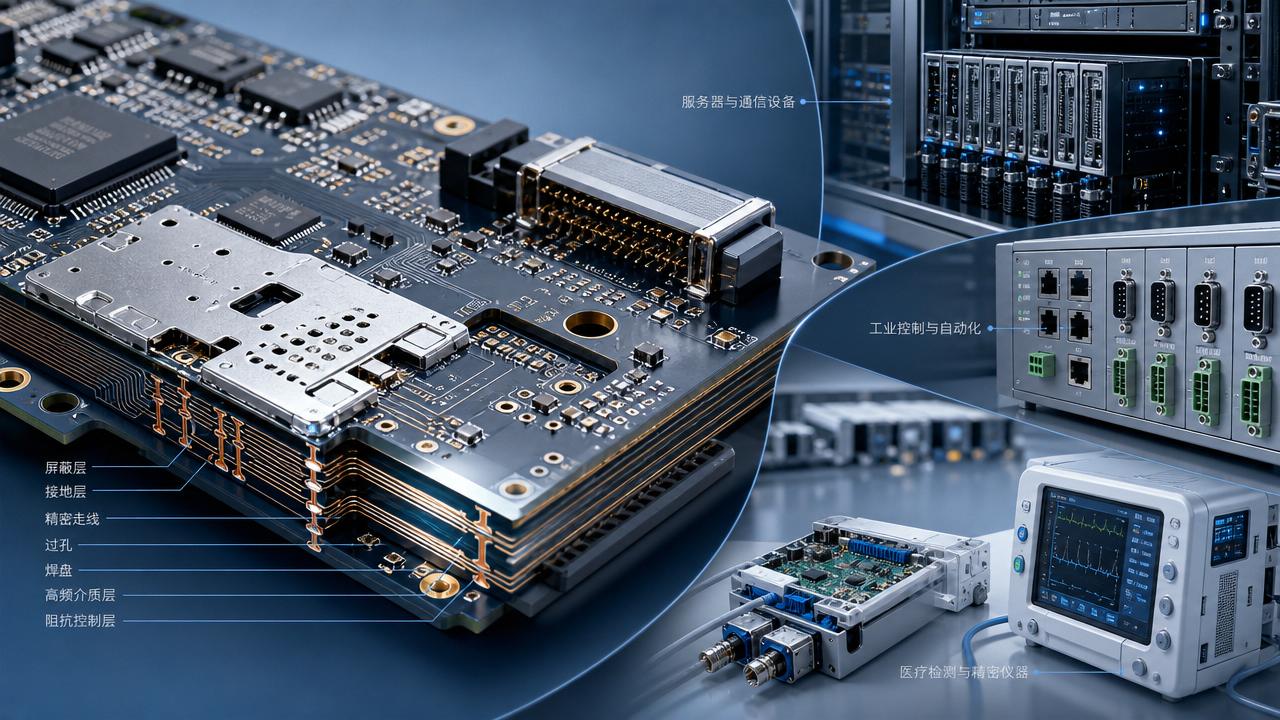
For engineers and operators working in EMI-sensitive environments, advanced circuit boards are essential to maintaining signal integrity, reducing noise, and ensuring long-term system reliability. This article explores how material selection, layer stack-up, shielding strategies, and precision manufacturing standards influence PCB performance, helping users make informed decisions in high-frequency and high-compliance electronic applications.
In the broader electronics industry, EMI control is no longer limited to defense, telecom, or medical devices. It now affects industrial automation, EV platforms, smart infrastructure, and dense computing systems.
That is why advanced circuit boards must be evaluated by use case, not by generic specifications alone. A suitable board in one environment may underperform in another with tighter emissions, thermal, or impedance constraints.
Why EMI-sensitive projects require scenario-based board decisions
EMI-sensitive designs behave differently depending on switching speed, enclosure density, grounding topology, and nearby power sources. Advanced circuit boards must match those conditions with precise electrical and mechanical characteristics.
A high-speed communications board may prioritize low-loss laminates and strict impedance control. A medical monitoring module may emphasize isolation, low noise floors, and stable long-term performance under cleaning cycles.
SCM’s benchmarking perspective is useful here. Independent analysis of dielectric behavior, plating consistency, SMT placement precision, and reliability under stress helps separate nominal claims from measurable performance.
Key factors that change by application
- Operating frequency and edge rate
- Power density and thermal cycling
- Required shielding effectiveness
- Allowed emissions and compliance targets
- Tolerance to vibration, humidity, and contamination
When high-speed networking and data systems need advanced circuit boards
In networking backplanes, server accelerators, and edge computing hardware, EMI problems often emerge from fast rise times, dense routing, and poor return paths. Here, advanced circuit boards support cleaner signal transmission.
The most important judgment point is insertion loss versus channel length. Low-loss materials, stable Dk values, and controlled copper roughness become more important than simply increasing layer count.
What to verify in this scenario
- Impedance tolerance across production lots
- Via stub mitigation and backdrilling quality
- Reference plane continuity near connectors
- Resin system stability under reflow exposure
For this environment, advanced circuit boards often use carefully tuned stack-ups with dedicated ground planes between noisy digital layers. That lowers crosstalk and helps emissions remain within acceptable limits.
Where industrial automation and motor control create hidden EMI risks
Industrial systems combine logic, sensors, power converters, relays, and cabling inside electrically noisy spaces. In these cases, advanced circuit boards must survive both conducted and radiated interference.
The core judgment point is board resilience near switching devices. Fast power transitions, long cable runs, and grounding differences can inject noise into analog sensing and communication interfaces.
Practical design priorities
- Separation between power and control domains
- Creepage and clearance suited to voltage stress
- Copper balance that limits warpage
- Robust solder joints for vibration and heat cycling
Advanced circuit boards in industrial control also benefit from clear return path design around ADCs, encoders, and communication ports. Poor partitioning often creates intermittent EMI faults that are hard to diagnose later.
How medical and precision instrumentation demand low-noise board behavior
Medical electronics, test equipment, and precision measurement platforms are especially sensitive to noise floors. Here, advanced circuit boards must support clean analog performance and reliable long-term stability.
The key judgment point is whether the board can preserve weak signals in the presence of digital clocks, displays, wireless modules, or power conversion stages nearby.
Critical board-level considerations
- Low leakage materials and clean fabrication processes
- Guard traces and careful analog ground referencing
- Controlled shielding near front-end amplifiers
- Consistent passive placement for repeatable behavior
In this scenario, advanced circuit boards should be assessed with reliability data, not only prototype success. Surface cleanliness, via quality, and dielectric consistency all influence drift and noise over time.
Why automotive, EV, and power-dense platforms need stronger board adaptation
Automotive electronics and EV subsystems combine EMI stress, thermal extremes, vibration, and strict safety expectations. Advanced circuit boards in these systems must manage both electrical integrity and physical durability.
The central decision point is interaction between switching power stages and sensitive control circuits. Noise coupling can affect sensing accuracy, communication stability, and safety-related functions.
Recommended adaptation checks
- Thermal conductivity versus dielectric performance
- Heavy copper impact on impedance and manufacturability
- CAF resistance under humidity stress
- Connector transition design for noisy environments
For these platforms, advanced circuit boards should align with validated fabrication controls and test data. Materials alone cannot guarantee low EMI if stack-up execution and assembly precision are inconsistent.
How scenario requirements differ across EMI-sensitive applications
Which advanced circuit boards features deserve priority in selection
Selection should begin with the failure mode most likely to appear in the target environment. That method leads to better decisions than choosing advanced circuit boards only by thickness, layers, or price.
Priority checklist for scenario matching
- Define noise source type: radiated, conducted, or mixed.
- Map critical nets, analog zones, and return paths.
- Select laminate by electrical loss and stability, not branding alone.
- Request fabrication data on impedance, registration, and plating consistency.
- Confirm assembly accuracy where component placement affects EMI behavior.
- Compare reliability evidence under humidity, heat, and vibration.
This is where SCM adds value. Independent whitepapers and benchmark reports help validate whether advanced circuit boards are suitable for IPC-Class 3 expectations and real operating stress.
Common misjudgments that weaken EMI-sensitive board performance
A frequent mistake is assuming shielding cans alone solve interference problems. If return paths are broken or planes are poorly arranged, advanced circuit boards may still radiate or receive unwanted noise.
Another misjudgment is focusing on nominal dielectric constant without checking its tolerance across frequency and temperature. Small variation can significantly change controlled impedance behavior.
Teams also overlook assembly effects. Placement offsets, solder voiding, and inconsistent grounding through connectors can reduce the EMI advantages designed into advanced circuit boards at layout stage.
- Ignoring copper roughness at high data rates
- Mixing noisy and sensitive circuits without clear boundaries
- Skipping reliability validation after thermal cycling
- Treating compliance results as permanent across design revisions
A practical next step for evaluating advanced circuit boards
Start by classifying the application environment, then match board properties to the most likely EMI risks. This creates a clearer path toward stable performance and fewer redesign cycles.
Use benchmark-based evidence when comparing advanced circuit boards, especially for dielectric behavior, manufacturing precision, and long-term reliability. Data transparency reduces uncertainty in complex electronics programs.
For projects requiring higher confidence, SCM’s engineering repository and technical intelligence can support deeper evaluation across PCB fabrication, SMT assembly, thermal packaging, and component reliability. That approach helps advanced circuit boards deliver measurable EMI control in real-world conditions.
Recommended News
- EMI ShieldingHow to choose a design verification resource for EMI testingDesign verification resource guide for EMI testing: compare technical depth, traceable evidence, and compliance insight to prevent costly redesigns.
- EMI ShieldingHow automotive component compliance testing supports EMC approvalComponent compliance testing automotive helps secure EMC approval through traceability, pre-compliance checks, and controlled design changes. Learn how to reduce risk.
- EMI ShieldingDo High-Performance Embedded Boards Need Different EMI Shielding?Do high-performance embedded boards require different EMI shielding approaches? Explore practical strategies for grounding, thermal design, cable control, compliance, and reliable performance.
- EMI ShieldingEU Adds Halogenated Flame Retardants and EMI Coatings to RoHS ScopeEU RoHS scope expands to halogenated flame retardants and EMI coatings under Directive (EU) 2026/1389. See how PCB exporters can prepare for the 2027 compliance deadline.
- EMI ShieldingEU Requires EPDs for EMI Shielding PartsEU Requires EPDs for EMI Shielding Parts from January 2027. Learn how the new EU rule affects compliance, carbon disclosure, shipment timing, and supplier planning.
- EMI ShieldingCBP Tightens Filing Rules for EMI Shielding ImportsCBP Tightens Filing Rules for EMI Shielding Imports: learn how the September 2026 ACE filing change affects RoHS, REACH, customs timing, and buyer risk for U.S.-bound shipments.