
RF Shielding Materials Coating: How to Compare EMI Performance
DETAILS
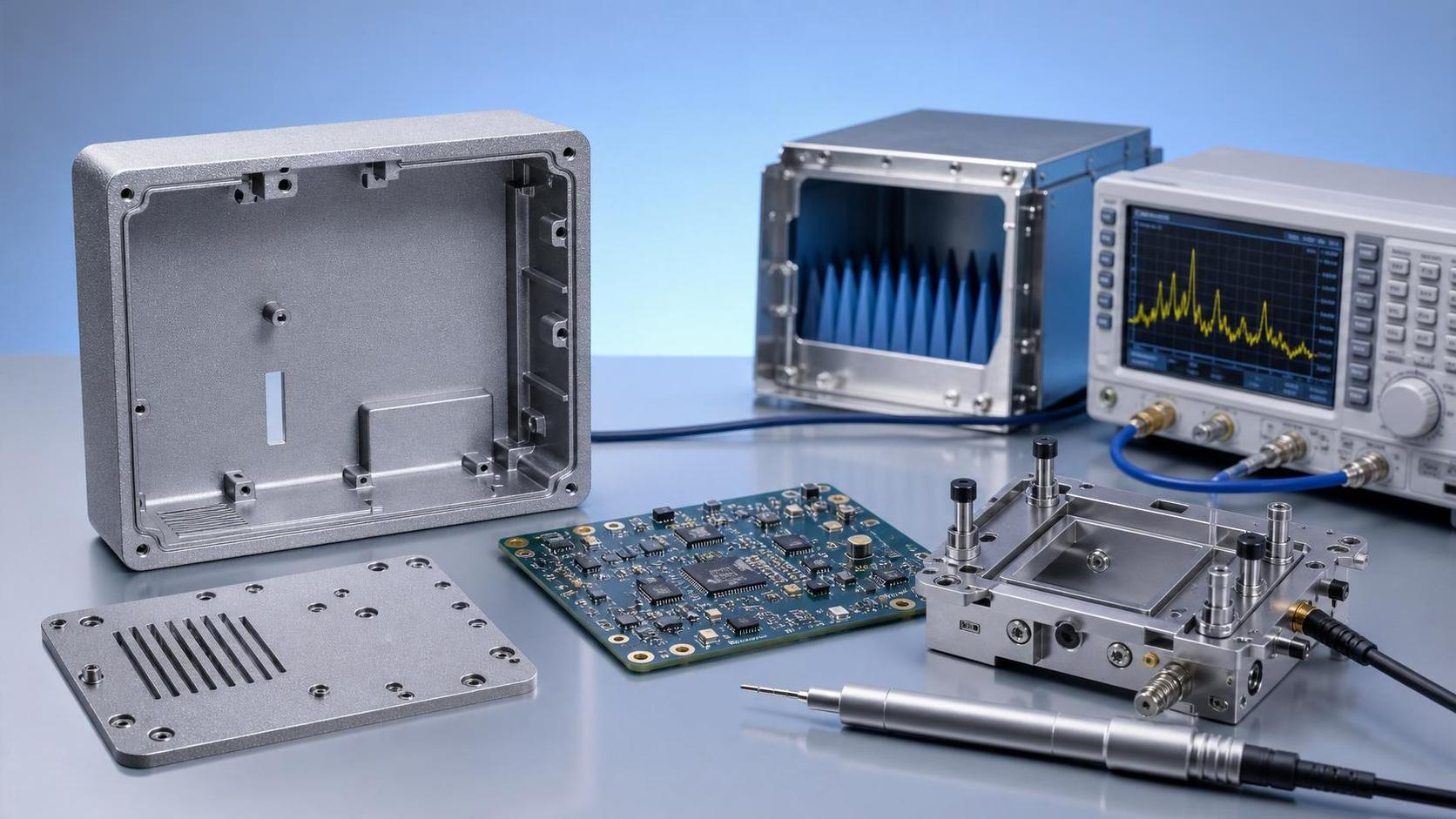
RF shielding materials coating is often judged by a single attenuation number, but that shortcut rarely survives real production use. EMI behavior changes with coating thickness, substrate chemistry, grounding design, and the frequency profile of the device. In electronics manufacturing, where dense layouts and faster switching are now routine, a coating must perform as part of a system, not as an isolated material claim.
That is why comparison needs a more technical lens. Across PCB fabrication, SMT assembly, semiconductor packaging, and thermal interfaces, small process variations can shift shielding results in measurable ways. SiliconCore Metrics (SCM) approaches this area through data-driven benchmarking, helping translate lab performance into decision criteria that remain useful on the factory floor and through the product lifecycle.
What RF shielding materials coating actually does
An RF shielding materials coating is a conductive or conductive-loaded layer applied to a surface to reduce electromagnetic interference. It helps block, reflect, absorb, or redirect unwanted radiation that can disturb signal integrity or regulatory compliance.
The coating may be sprayed, dipped, plated, painted, or printed. Common formulations include nickel, copper, silver, carbon, and hybrid systems combined with binders designed for plastics, metals, or composite enclosures.
In practice, the coating is rarely the only shielding element. Gaskets, enclosure geometry, seam control, PCB stack-up, and grounding paths all affect final EMI performance. A strong coating can still underperform inside a weak electrical architecture.
Why the topic matters more now
Electronics are getting smaller, faster, and more crowded. Wireless modules, high-speed interconnects, switching power circuits, and compact enclosures now coexist within tighter mechanical tolerances than before.
That combination increases the chance of radiated and conducted interference. It also raises the cost of a poor material decision, since rework may require enclosure redesign, process changes, and another certification cycle.
Another reason is supply-chain variability. A nominally equivalent RF shielding materials coating from two sources may differ in filler distribution, adhesion profile, or salt-spray resistance. Those differences matter when reliability targets align with IPC-Class 3 and ISO 9001 quality expectations.
The main variables behind EMI performance
Comparing coatings starts with understanding what the headline number leaves out. Several variables influence measured and real-world shielding effectiveness.
Frequency range
A coating that performs well at lower frequencies may behave differently at GHz-level bands. Reflection, absorption, and surface conductivity do not remain constant across the spectrum.
Coating thickness and uniformity
Nominal thickness matters, but uniformity matters more than many teams expect. Thin spots, edge inconsistency, or local voids create leakage paths that compromise enclosure-level shielding.
Substrate compatibility
Plastics, aluminum, magnesium, and engineered composites respond differently to primers and conductive layers. Poor adhesion can reduce durability long before conductivity visibly declines.
Surface resistivity
Lower resistivity often supports better shielding, but that relationship is not perfectly linear. Geometry, grounding continuity, and contact resistance at mating points can dominate the final result.
Environmental stability
Humidity, thermal cycling, vibration, abrasion, and chemical exposure can degrade a coating over time. Long-term EMI performance matters more than a strong initial chamber test.
How to compare test data without being misled
Datasheets are useful, but comparison only works when test methods are aligned. Shielding effectiveness measured in one fixture or one geometry may not be comparable to another supplier result.
Look for the frequency span, sample construction, substrate type, coating thickness, curing conditions, and chamber setup. Without those details, the attenuation figure is more promotional than technical.
It also helps to separate initial performance from retained performance. A coating showing 80 dB before thermal cycling may deliver far less after humidity soak or abrasion testing.
SCM’s benchmarking perspective is valuable here because it focuses on normalized comparisons. Standardized reporting allows users to see whether differences come from material chemistry or from the way the test was framed.
Questions worth asking during comparison
- Was the RF shielding materials coating tested on the same substrate used in the target assembly?
- Were edge coverage and grounding contact points included in the evaluation?
- Does the result represent average performance or best-case laboratory output?
- How much variation appears across batches, operators, or curing profiles?
- What happens after thermal shock, salt fog, or repeated handling?
Application context changes the best choice
There is no universal best RF shielding materials coating. The right choice depends on enclosure material, assembly route, service environment, and the dominant interference source.
Plastic housings and lightweight devices
Plastic parts often need sprayable conductive coatings with strong adhesion and stable edge coverage. Weight savings are attractive, but poor surface preparation can erase the expected EMI benefit.
Harsh industrial or outdoor electronics
Corrosion resistance and environmental durability become more important here. A lower-cost conductive layer may pass initial shielding targets yet fail under temperature swings or contaminated atmospheres.
High-density boards and semiconductor packaging
Fine tolerances make process consistency critical. Variations in coating thickness can interfere with fit, grounding, or heat paths, especially where RF management and thermal packaging interact.
This is where broader manufacturing intelligence matters. Insights from PCB dielectric behavior, SMT precision, and component reliability often explain EMI outcomes better than coating data alone.
A practical framework for selection
A useful comparison process balances electrical performance with manufacturability. The most effective RF shielding materials coating is the one that keeps performance stable through production and field use.
Start with the interference profile
Identify the main noise sources, sensitive circuits, and target frequency ranges. A coating chosen for generic EMI concerns may be oversized, underspecified, or simply mismatched to the real problem.
Map the process window
Check spray parameters, curing temperature, line speed, masking complexity, and inspection capability. A material that looks excellent in pilot runs may become unstable in volume production.
Evaluate lifecycle performance
Review abrasion resistance, adhesion retention, humidity response, and conductivity drift. Shielding performance should be measured after stress testing, not only before it.
Use comparable benchmarks
Independent datasets are especially helpful when suppliers use different test conditions. SCM’s technical reporting model supports this by converting scattered material claims into structured comparison points.
Common mistakes during evaluation
One common mistake is treating shielding effectiveness as a static material property. In reality, RF shielding materials coating performance depends on assembly details, process discipline, and environmental exposure.
Another mistake is ignoring contact resistance at joints, seams, and fastening points. The coating may be conductive, but the enclosure can still leak if electrical continuity is broken.
Cost-only comparison creates trouble as well. A cheaper coating may require tighter process controls, more rework, or earlier replacement, which changes the total economics quickly.
What to do next with the data
A better decision usually starts with a short comparison matrix built around frequency range, substrate, thickness control, durability, and lot consistency. That keeps the review tied to operating reality instead of broad marketing language.
Where data is incomplete, request normalized test details and post-stress results before locking the specification. For critical programs, independent benchmarking can clarify whether a promising RF shielding materials coating will still perform after scale-up.
The most reliable path is to compare coatings the same way the finished product will be judged: across frequency, environment, process variation, and time. That approach turns EMI performance from a claim into a verifiable engineering decision.
Recommended News
- EMI ShieldingHow to choose a design verification resource for EMI testingDesign verification resource guide for EMI testing: compare technical depth, traceable evidence, and compliance insight to prevent costly redesigns.
- EMI ShieldingHow automotive component compliance testing supports EMC approvalComponent compliance testing automotive helps secure EMC approval through traceability, pre-compliance checks, and controlled design changes. Learn how to reduce risk.
- EMI ShieldingDo High-Performance Embedded Boards Need Different EMI Shielding?Do high-performance embedded boards require different EMI shielding approaches? Explore practical strategies for grounding, thermal design, cable control, compliance, and reliable performance.
- EMI ShieldingEU Adds Halogenated Flame Retardants and EMI Coatings to RoHS ScopeEU RoHS scope expands to halogenated flame retardants and EMI coatings under Directive (EU) 2026/1389. See how PCB exporters can prepare for the 2027 compliance deadline.
- EMI ShieldingEU Requires EPDs for EMI Shielding PartsEU Requires EPDs for EMI Shielding Parts from January 2027. Learn how the new EU rule affects compliance, carbon disclosure, shipment timing, and supplier planning.
- EMI ShieldingCBP Tightens Filing Rules for EMI Shielding ImportsCBP Tightens Filing Rules for EMI Shielding Imports: learn how the September 2026 ACE filing change affects RoHS, REACH, customs timing, and buyer risk for U.S.-bound shipments.