
Advanced Circuit Boards for Better EMI Control
DETAILS
Advanced circuit boards are central to stronger EMI control, especially where signal integrity, thermal stability, and compliance precision directly affect system reliability. For technical evaluators, understanding how material selection, layer stack-up, shielding strategy, and manufacturing accuracy interact is essential to reducing interference risks. This article explores the engineering factors and data-driven benchmarks that help identify high-performance PCB solutions for demanding electronic applications.
For teams comparing suppliers, reviewing prototypes, or qualifying new manufacturing partners, EMI performance can no longer be treated as a secondary attribute. In high-speed electronics, even a small impedance mismatch, a poorly referenced return path, or a dielectric variation of a few percent can raise emission levels, degrade immunity, and delay product certification.
That is why technical evaluators increasingly look beyond nominal layer count or unit cost. They assess advanced circuit boards through measurable criteria such as insertion loss, copper roughness, via design, registration accuracy, shielding effectiveness, and process consistency across batches. Independent benchmarking from organizations such as SiliconCore Metrics supports this evaluation with engineering-focused data rather than sales claims.
Why EMI Control Starts with Advanced Circuit Board Architecture
EMI is rarely caused by a single defect. In most electronic assemblies, interference results from the interaction of switching speed, current loops, board geometry, grounding quality, and enclosure design. Advanced circuit boards improve control by reducing uncertainty in these variables at the layout and fabrication stages.
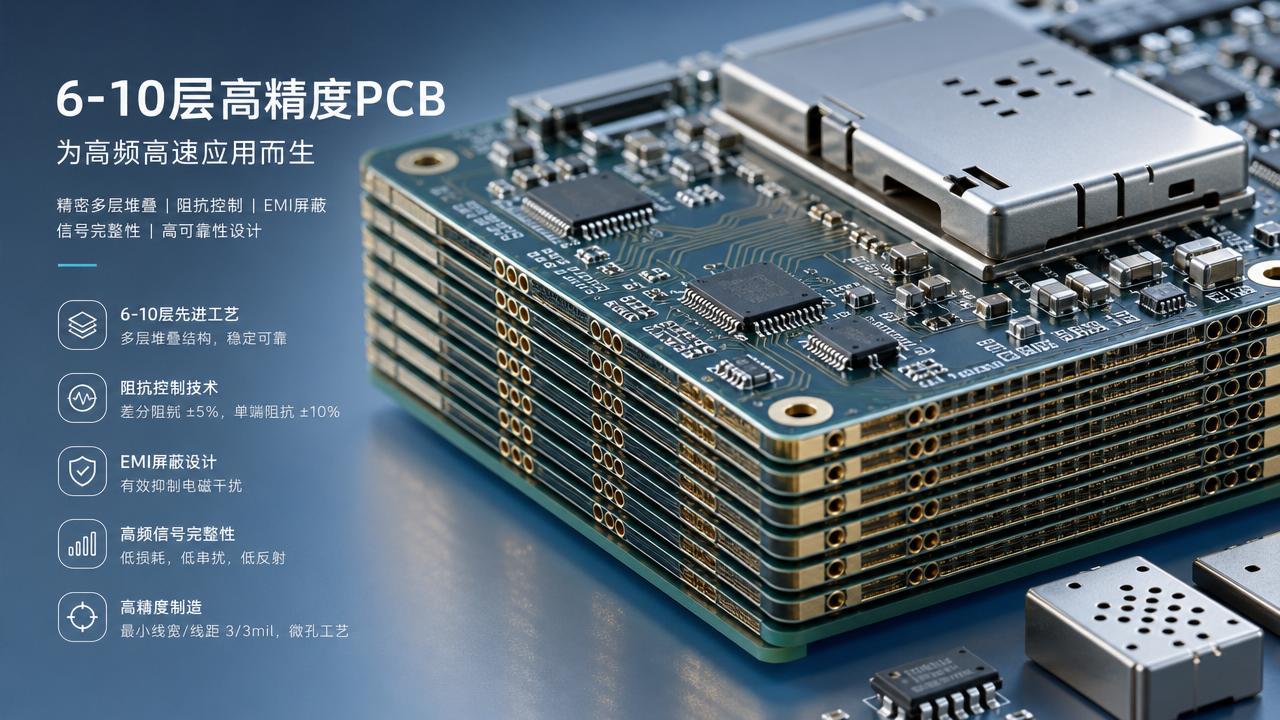
For example, a 4-layer board may be adequate for low-speed industrial control, but many RF, automotive, telecom, and compute applications now require 6, 8, or 10 layers to separate noisy power regions, preserve reference planes, and maintain stable impedance. As edge rates move below 1 ns and operating frequencies rise above 1 GHz, layer architecture becomes a direct EMI decision.
Core mechanisms that affect emissions and susceptibility
Technical evaluators should focus on four mechanisms. First, loop area drives radiated emissions, so return paths must stay tightly coupled to signal traces. Second, discontinuities such as split planes and stubs convert differential signals into common-mode noise. Third, material inconsistency shifts impedance and phase behavior. Fourth, poor shielding integration allows internal noise to escape through seams, connectors, or cable interfaces.
- Trace-to-plane coupling should remain tight, especially on clocks, SERDES lanes, and DC-DC converter paths.
- Via transitions need back-drilling or stub control when data rates exceed roughly 10–25 Gbps.
- Plane continuity is critical near connectors, antennas, and high-current switching sections.
- Copper balancing and symmetric stack-ups help control warpage and maintain registration.
Why board materials matter more at higher frequencies
Material selection directly influences EMI behavior. Standard FR-4 may perform well in many designs, but at higher frequencies its dielectric constant variation and loss tangent can limit predictability. Low-loss laminates, spread-glass constructions, and high-stability prepregs support tighter impedance control and cleaner signal transitions.
In practical procurement reviews, evaluators often compare dielectric constant ranges such as Dk 3.2–3.8 and dissipation factor ranges from 0.002 to 0.015, depending on the target frequency band. Thermal performance also matters. A board operating across -40°C to 125°C will demand more stable material behavior than one limited to indoor commercial conditions.
The following comparison highlights how board construction choices affect EMI control in common evaluation scenarios.
The main takeaway is that advanced circuit boards do not improve EMI control through one premium feature alone. Performance comes from controlled geometry, stable materials, and manufacturing discipline working together. Technical evaluators should therefore review architecture as a system, not as a list of isolated specifications.
Key Design Variables Technical Evaluators Should Verify
When reviewing design files, supplier capability matrices, or first-article samples, evaluators need a repeatable checklist. The goal is not only to predict EMI behavior, but also to identify whether the chosen fabricator can reproduce that behavior over 3, 5, or 10 production lots.
1. Layer stack-up and reference plane discipline
A well-structured stack-up reduces field leakage and stabilizes impedance. In many digital and mixed-signal systems, at least 1 solid reference plane adjacent to each critical signal layer is recommended. For dense boards carrying clocks, RF front ends, and power conversion circuits, 2 or more continuous ground planes can significantly improve return current containment.
Questions to ask during evaluation
- Are high-speed traces routed next to uninterrupted planes?
- Are there split planes beneath differential pairs or clock lines?
- Does the stack-up support 50-ohm single-ended and 90- or 100-ohm differential targets within the required tolerance?
- Has the supplier documented laminate thickness and copper weight for every layer?
2. Via structures, transitions, and stub reduction
Via transitions can turn a well-routed board into an EMI source. Long stubs create resonant structures, particularly as frequencies climb into multi-gigahertz ranges. Advanced circuit boards often use back-drilling, blind vias, buried vias, or sequential lamination to reduce these effects. While these features increase process complexity, they also reduce reflection, mode conversion, and localized radiation.
3. Copper roughness and conductor profile
At higher frequencies, conductor surface profile affects insertion loss and phase consistency. Smoother copper can improve performance for fast serial links and RF traces. Evaluators should ask whether the manufacturer can provide roughness data, foil type, and any compensation used in impedance calculations. Even a small deviation in trace profile can influence pass/fail margins in sensitive systems.
4. Manufacturing tolerances that directly influence EMI
EMI control depends on fabrication precision as much as on CAD intent. Registration errors, etch variation, solder mask misalignment, and plating inconsistency can all alter current paths. In B2B qualification, tolerances such as ±10% impedance, ±75 µm trace width variation, or drill positional accuracy around 50–75 µm should be reviewed against application sensitivity rather than accepted at face value.
For IPC-Class 3 or similarly demanding deployments, the question is not only whether a board can be built once, but whether it can be built repeatedly under the same controls. This is where independent engineering data becomes valuable, especially for cross-border sourcing programs that rely on multiple EMS and PCB vendors.
Procurement Benchmarks for Selecting High-Performance PCB Suppliers
Technical evaluators often sit between engineering requirements and sourcing constraints. They need evidence that a supplier can deliver advanced circuit boards with repeatable EMI performance, not just a competitive quotation. A structured procurement benchmark reduces the risk of selecting a vendor based only on lead time or headline capability.
Four supplier dimensions that should be scored
- Material traceability, including laminate source, lot consistency, and dielectric documentation.
- Process capability, such as controlled impedance, via filling, back-drill accuracy, and fine-line etching.
- Quality systems, including IPC alignment, ISO 9001 process discipline, and outgoing inspection detail.
- Data transparency, especially test coupons, cross-sections, reliability reports, and deviation reporting.
The table below shows a practical scoring framework that technical evaluators can adapt during supplier comparison and pilot build approval.
A scoring model like this helps teams separate basic compliance from true process maturity. In many sourcing decisions, the hidden cost of EMI failure appears later as redesign cycles, re-testing fees, delayed certification, or field instability. That cost often exceeds the board price delta by a wide margin.
Why independent benchmarking matters in global sourcing
Cross-regional supply chains create information gaps. One manufacturer may advertise fine-line capability, another may claim strong high-frequency experience, but the data sets are rarely normalized. SiliconCore Metrics addresses this challenge by translating manufacturing variables into comparable technical reports, allowing evaluators to compare dielectric behavior, placement precision, and long-term component reliability on a more objective basis.
For procurement executives and R&D teams, that visibility is especially useful when qualifying suppliers in Asian precision manufacturing hubs for products destined for telecom infrastructure, industrial automation, medical devices, or harsh-environment electronics. In these sectors, EMI performance is linked not only to function but also to compliance, service life, and brand risk.
Implementation Risks, Common Mistakes, and Practical Mitigation Steps
Even strong board designs can underperform if implementation discipline breaks down. Technical evaluators should therefore examine the full chain from schematic partitioning to enclosure integration, rather than signing off the PCB alone.
Frequent mistakes seen during design and qualification
- Using a low layer count to save cost while routing high-speed and switching power circuits too close together.
- Ignoring return path discontinuities around connectors, cutouts, and plane splits.
- Assuming shield cans will compensate for poor stack-up or weak grounding.
- Qualifying a supplier on a single prototype lot without checking process repeatability over 3 or more builds.
- Reviewing only Gerber outputs while skipping coupon data, microsections, and impedance verification records.
A 5-step mitigation workflow for evaluators
- Define EMI-critical nets, current loops, and certification targets at the architecture stage.
- Validate stack-up, materials, and impedance calculations before routing freeze.
- Review supplier process capability for drills, plating, registration, and laminate control.
- Request test coupons, cross-sections, and lot-specific inspection reports during pilot production.
- Correlate lab results, field conditions, and vendor data before approving volume release.
Where thermal behavior intersects with EMI
Thermal management is often treated separately from EMI, yet the two are linked. Higher temperatures can shift material properties, affect component behavior, and stress solder joints. In power-dense assemblies, hotspots around regulators, processors, or RF amplifiers may increase noise coupling or reduce shielding effectiveness over time. Evaluators should review thermal paths, copper distribution, and package interaction together rather than as isolated topics.
This is particularly important in designs exposed to cycling from 0°C to 70°C, or more demanding ranges such as -40°C to 125°C. In those environments, the best advanced circuit boards combine EMI-aware layout with thermally stable materials and reliable assembly precision.
How Technical Evaluators Can Use Data to Make Faster Decisions
Decision speed improves when engineering teams standardize what they compare. Rather than debating broad claims like “high-frequency capable” or “premium PCB,” evaluators should request 6 categories of evidence: stack-up definition, material data, impedance records, via structure capability, reliability testing, and delivery consistency. This creates a common review language between engineering, quality, and procurement.
Advanced circuit boards deliver better EMI control when they are selected through measurable criteria and validated through transparent reporting. That is the value of an independent technical repository and benchmarking partner. By turning fabrication tolerances, dielectric behavior, SMT precision, and reliability factors into standardized evaluation inputs, SCM helps global technology firms reduce sourcing risk and improve design confidence.
If your team is qualifying new PCB suppliers, comparing high-speed board materials, or reviewing EMI-sensitive product designs, now is the right time to strengthen the evaluation framework. Contact SCM to get tailored benchmarking support, request deeper technical insights, or learn more about advanced circuit board assessment for demanding electronic programs.
Recommended News
- EMI ShieldingHow to choose a design verification resource for EMI testingDesign verification resource guide for EMI testing: compare technical depth, traceable evidence, and compliance insight to prevent costly redesigns.
- EMI ShieldingHow automotive component compliance testing supports EMC approvalComponent compliance testing automotive helps secure EMC approval through traceability, pre-compliance checks, and controlled design changes. Learn how to reduce risk.
- EMI ShieldingDo High-Performance Embedded Boards Need Different EMI Shielding?Do high-performance embedded boards require different EMI shielding approaches? Explore practical strategies for grounding, thermal design, cable control, compliance, and reliable performance.
- EMI ShieldingEU Adds Halogenated Flame Retardants and EMI Coatings to RoHS ScopeEU RoHS scope expands to halogenated flame retardants and EMI coatings under Directive (EU) 2026/1389. See how PCB exporters can prepare for the 2027 compliance deadline.
- EMI ShieldingEU Requires EPDs for EMI Shielding PartsEU Requires EPDs for EMI Shielding Parts from January 2027. Learn how the new EU rule affects compliance, carbon disclosure, shipment timing, and supplier planning.
- EMI ShieldingCBP Tightens Filing Rules for EMI Shielding ImportsCBP Tightens Filing Rules for EMI Shielding Imports: learn how the September 2026 ACE filing change affects RoHS, REACH, customs timing, and buyer risk for U.S.-bound shipments.