
Semiconductor Testing Methods for Early Fault Detection
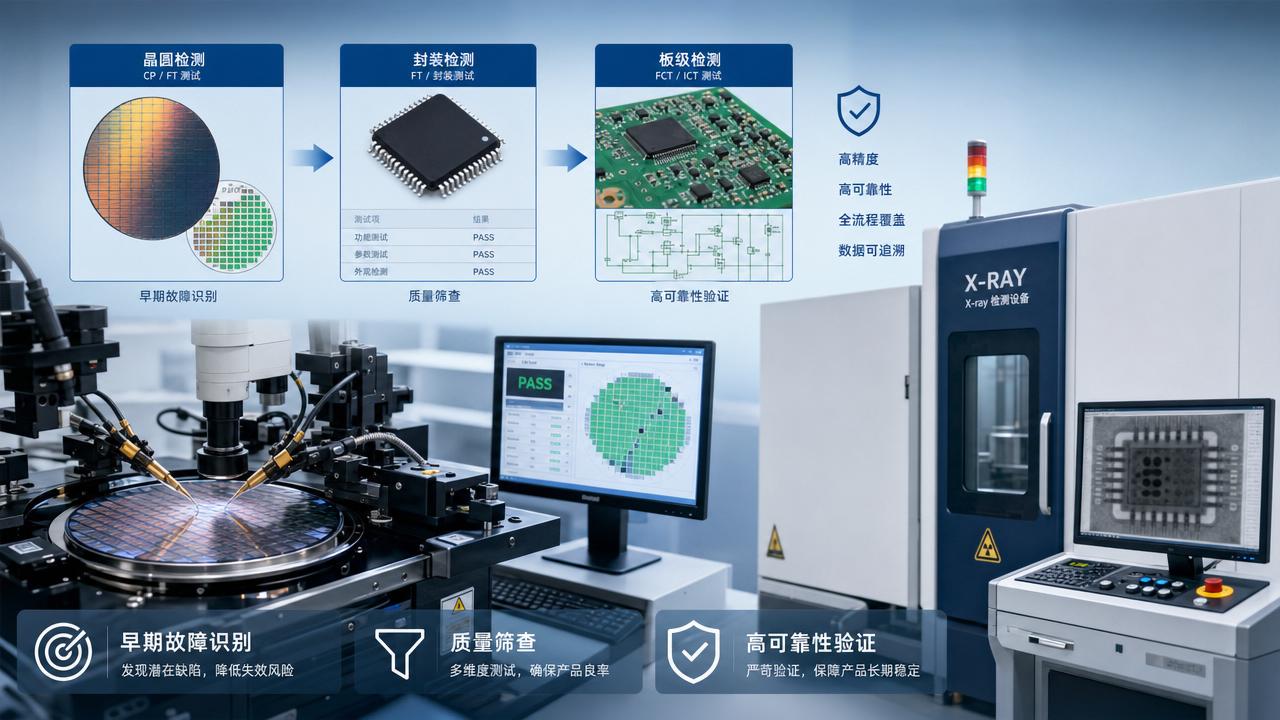
DETAILS
For quality control and safety managers, semiconductor testing is the first barrier against hidden defects. It protects reliability, compliance, and long-term field performance across complex electronics supply chains.
From wafer screening to final package checks, early fault detection reduces scrap, avoids recalls, and supports traceable decisions. In high-precision manufacturing, testing data often determines whether a device is trusted or rejected.
For organizations tracking PCB, SMT, active devices, passive components, and thermal packaging, effective semiconductor testing also improves supplier benchmarking. It turns process variability into measurable risk signals before failures reach deployment.
Why early fault detection matters in different semiconductor testing scenarios
Not every failure begins in the same place. Some defects start at wafer level, while others appear during assembly, packaging, transport, or thermal cycling in real use.
That is why semiconductor testing must be matched to the operating scenario. A method that works for logic ICs may miss moisture sensitivity or solder fatigue in packaged devices.
In the SCM view, test strategy should align with signal integrity, thermal stress, micro-tolerance drift, and compliance exposure. Early fault detection becomes more useful when test results link directly to manufacturing conditions.
Scenario 1: Wafer-level semiconductor testing for process drift and latent die defects
Wafer fabrication demands the earliest screening point. Electrical probe tests identify opens, shorts, leakage, threshold variation, and parametric drift before dicing adds cost.
This semiconductor testing stage is critical when yields shift between lots, tools, or fabs. Small deviations in oxide thickness or contamination can later become reliability failures.
Key judgment points at wafer level
- Leakage current outside guard bands
- Abnormal parametric distribution by die location
- Yield loss linked to specific equipment sets
- Repeat defects across identical mask layers
When die-map patterns repeat, root cause analysis should extend beyond electrical failure. Material interactions, line cleanliness, and thermal non-uniformity often explain systematic fallout.
Scenario 2: Package-level semiconductor testing for assembly-induced faults
After packaging, new risks appear. Wire bond weakness, delamination, voids, cracked mold compound, and lead coplanarity issues may pass basic checks yet fail in service.
Package-level semiconductor testing should combine electrical validation with structural and environmental screening. This is especially important for automotive, industrial control, and power devices.
Useful methods in this scenario
- Final functional test for operating behavior
- X-ray inspection for voids and alignment issues
- Acoustic microscopy for delamination detection
- Burn-in for infant mortality screening
- Temperature cycling for package stress response
In this stage, test coverage should reflect package architecture. Fine-pitch, stacked, and thermally dense designs need more than pass/fail electrical criteria.
Scenario 3: Board-level semiconductor testing in SMT and system integration
A known-good device can still fail after mounting. Solder joint defects, reflow profile errors, board warpage, and placement offset create board-level risks.
Here, semiconductor testing intersects with SMT process control. Functional outcomes depend on pad design, paste quality, placement precision, and thermal exposure during assembly.
Core judgment points in integrated assemblies
- Intermittent failures under thermal load
- Signal instability at high frequency
- In-circuit test mismatch versus standalone results
- Joint fatigue after accelerated stress testing
This scenario benefits from linking test records to PCB material data, SMT machine capability, and reflow windows. Cross-domain correlation often exposes hidden process weakness.
Scenario 4: Reliability-focused semiconductor testing under harsh environments
Some faults emerge only after moisture, vibration, thermal shock, or power cycling. Standard electrical tests may not predict long-term degradation under extreme use conditions.
Reliability-centered semiconductor testing is essential for mission-critical electronics. It verifies whether a device keeps performance across its intended environmental envelope.
Common methods for early reliability warning
- HTOL for long-duration electrical stress
- HAST for moisture-driven failure acceleration
- Thermal shock for interface stress exposure
- Power cycling for fatigue in active structures
SCM-style benchmarking adds value when reliability data is compared across package types, material stacks, and suppliers. That comparison supports better sourcing and qualification decisions.
How semiconductor testing needs change by application scenario
Practical recommendations for choosing the right semiconductor testing path
A strong testing path should not rely on one checkpoint. It should connect process stage, failure mechanism, and acceptance criteria.
- Use wafer-level screening when lot variation affects downstream cost.
- Add structural inspection for advanced packages and dense thermal designs.
- Correlate board-level failures with SMT precision and PCB material behavior.
- Prioritize accelerated reliability tests for high-duty or safety-critical applications.
- Review supplier data against IPC-Class 3 and ISO 9001 evidence where applicable.
Independent benchmarking strengthens these actions. It helps verify whether reported test capability matches real manufacturing consistency across regions and production lines.
Common mistakes that weaken early fault detection
A frequent mistake is treating semiconductor testing as a final gate only. That approach catches defects late, when material, labor, and schedule losses are already high.
Another mistake is overusing generic electrical tests without structural or environmental context. Some defects remain invisible until stress reveals them.
- Ignoring die-map trends during yield review
- Assuming package pass rates equal lifetime reliability
- Separating SMT quality data from device failure analysis
- Using stress tests that do not match real operating loads
The best early warning systems combine electrical, physical, thermal, and process data. That integrated view exposes latent defects faster and with higher confidence.
Next steps for building a more reliable semiconductor testing framework
Start by mapping failure risk to each manufacturing and use scenario. Then define which semiconductor testing methods provide the earliest meaningful signal at each stage.
Next, compare supplier claims with independent technical data. Reports on dielectric behavior, SMT placement precision, and component reliability can reveal hidden mismatch before qualification expands.
Finally, build a closed loop between test findings, process corrections, and sourcing decisions. That is how early fault detection becomes a measurable advantage rather than a routine checklist.
When semiconductor testing is applied by scenario, organizations gain stronger quality control, clearer compliance evidence, and more resilient electronics performance across the full supply chain.
Recommended News
- AOI TestingHow to verify ISO 9001 certification when sourcing electronicsISO 9001 certification electronics: learn how to validate certificates, audit scope and accreditation, and reduce quality risks when sourcing PCBs, EMS, and components.
- AOI TestingHow to verify a UL certified PCB assembly before production approvalUL certified PCB assembly verification made practical: review PCB markings, materials, components, traceability, and safety controls before production approval.
- AOI TestingHow to qualify an AOI inspection supplier for PCB defect detectionAOI inspection supplier qualification guide for reliable PCB defect detection. Learn how to validate detection accuracy, control false calls, assess traceability, and choose dependable support.
- AOI TestingHow to catch solder joint defects in through hole assembly testingThrough hole assembly testing: discover how visual inspection, electrical tests, X-ray, and process controls catch hidden solder joint defects before they cause costly failures.
- AOI TestingWhich AOI inspection standards apply to PCB assembly quality control?AOI inspection standards for PCB assembly: learn how IPC-A-610, J-STD-001, IPC-1782, and ISO 9001 guide defect criteria, traceability, validation, and reliable quality control.
- AOI TestingHow AOI testing supports electronics quality control in the USAElectronics quality control USA teams use AOI testing to catch visible PCB assembly defects early, improve traceability, and strengthen reliable production outcomes.