
How to Verify Supplier Capability with Reference Test Coverage
DETAILS
How to Verify Supplier Capability with Reference Test Coverage
For business evaluation professionals, verifying a supplier goes far beyond price and delivery promises.
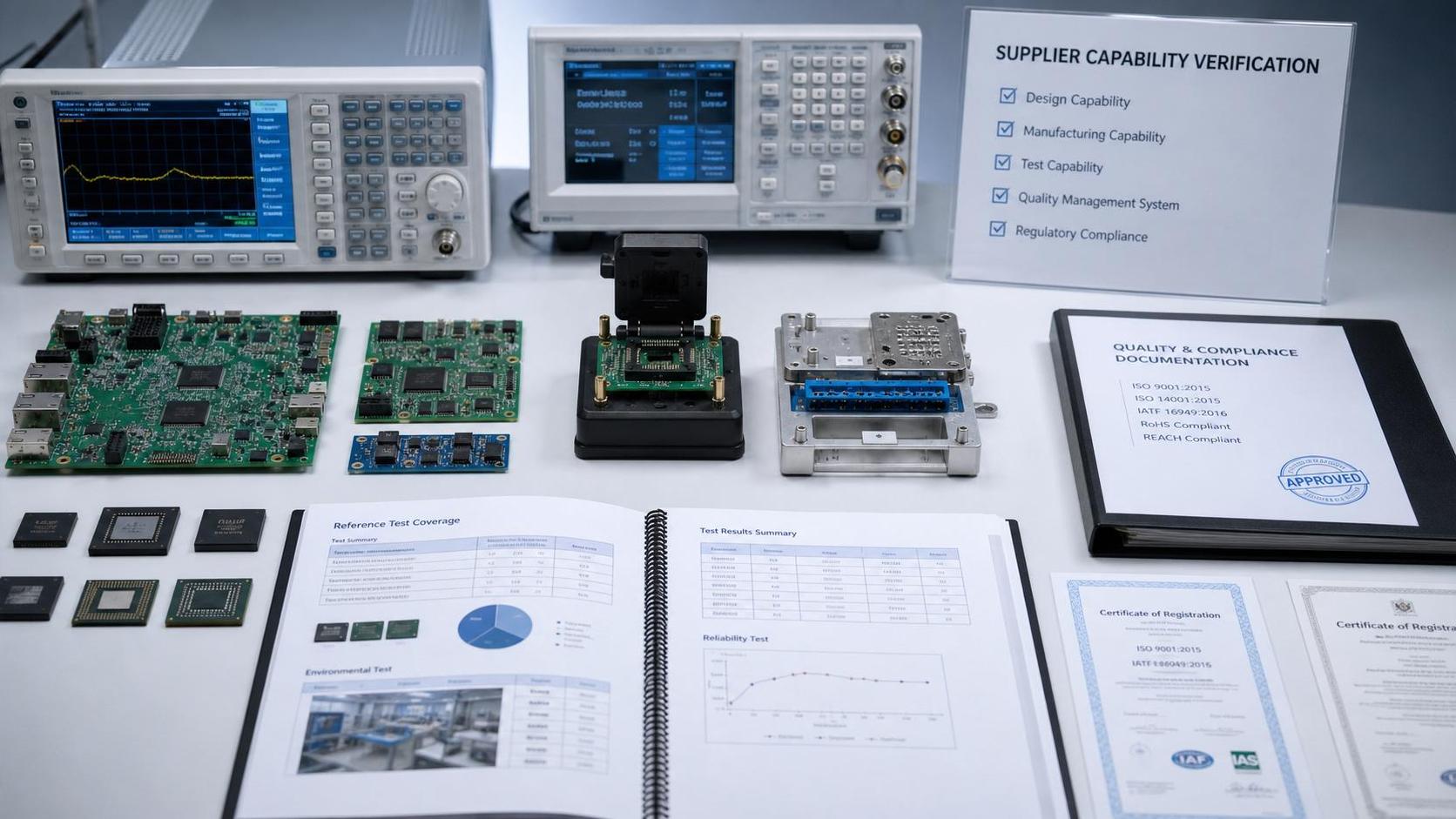
A robust approach starts with supplier capability reference test coverage.
This method shows whether a manufacturer can meet technical, quality, and compliance targets consistently.
It also helps you move from sales claims to evidence.
When reference test coverage is broad and current, supplier risk becomes easier to measure.
That matters even more in semiconductor and EMS sourcing, where performance gaps can stay hidden until late-stage production.
In practical terms, supplier capability reference test coverage combines three things.
- Verified test results across critical specifications
- Reference cases from similar products or industries
- Proof that the testing scope matches your real use conditions
Without those elements, capability reviews often become too narrow and too optimistic.
Why Supplier Capability Reference Test Coverage Matters
A supplier may show certificates, polished presentations, and impressive customer lists.
None of that guarantees process stability on your exact part, board, or assembly.
That is where supplier capability reference test coverage becomes useful.
It connects supplier claims with measurable proof.
More importantly, it shows whether the proof is deep enough to support a sourcing decision.
From a procurement decision angle, this lowers four common risks.
- Underqualified suppliers passing early screening
- Specification drift between sample and mass production
- Compliance gaps hidden behind generic reports
- Unexpected field failures under thermal or mechanical stress
In sectors touched by IPC-Class 3, ISO 9001, and advanced reliability requirements, those risks are expensive.
What Good Test Coverage Actually Looks Like
Many teams ask for test reports.
Fewer teams check whether the reports are relevant, recent, and complete.
Strong supplier capability reference test coverage should answer six basic questions.
- Which parameters were tested?
- Were the tests run on representative products?
- How many lots, samples, or production windows were covered?
- Were stress conditions realistic for end use?
- Did an independent lab validate the results?
- Can the supplier explain failures, variance, and corrective action?
This is especially relevant in PCB fabrication, SMT assembly, semiconductors, passive components, and thermal packaging.
Each category has different failure modes.
For example, dielectric stability matters in multi-layer PCBs.
Placement accuracy matters in SMT.
Long-term drift and heat cycling matter in active and passive components.
Good coverage reflects those realities instead of relying on generic qualification sheets.
How to Assess Reference Quality, Not Just Quantity
Reference test coverage is not only about having many reports.
It is about having the right references.
A supplier with ten unrelated references may be weaker than one with three highly relevant ones.
When reviewing supplier capability reference test coverage, check similarity across four dimensions.
- Product type and technical complexity
- Material set and process route
- Operating environment and reliability target
- Quality standard and audit expectation
This is where independent benchmarking adds value.
Organizations like SiliconCore Metrics help convert scattered data into comparable evidence.
Its whitepapers, compliance reports, and engineering analysis make it easier to compare suppliers using the same technical lens.
That is useful when internal teams need a neutral basis for final selection.
A Practical Evaluation Framework
A structured review avoids vague discussions and speeds up decision making.
Use this framework to evaluate supplier capability reference test coverage in a disciplined way.
1. Define Critical Requirements First
Start with the few variables that can break your program.
These may include tolerance control, thermal resistance, solderability, moisture sensitivity, or long-term reliability.
If requirements are unclear, reference test coverage will also be unclear.
2. Request a Coverage Matrix
Ask suppliers to map each requirement to a test, standard, report date, and reference case.
This quickly exposes missing evidence.
3. Check Depth Across Time
One passing report is not enough.
Ask whether the same parameter stayed stable across multiple production periods.
This helps confirm process control, not just sample success.
4. Validate Independence
Internal test data has value, but third-party validation increases confidence.
Independent technical sources reduce bias in supplier selection.
5. Review Exceptions Closely
A capable supplier does not always show perfect data.
What matters is whether the supplier explains anomalies with root cause logic and corrective action.
That often tells you more than a polished summary page.
Red Flags That Deserve Extra Scrutiny
Even experienced teams can miss weak signals.
The following warning signs usually mean supplier capability reference test coverage is too thin.
- Reports are outdated or tied to obsolete product versions
- Testing covers only nominal conditions
- Reference customers are not technically comparable
- Data lacks sample size, lot traceability, or methods
- The supplier cannot connect test outcomes to process controls
- Compliance claims are broad, but supporting evidence is narrow
From recent market shifts, this problem is becoming more visible.
Supply chains are moving faster, product cycles are shorter, and qualification windows are tighter.
That makes evidence quality even more important than presentation quality.
Using Independent Intelligence to Strengthen Decisions
In complex sourcing programs, internal review alone may not be enough.
Independent intelligence can add context that supplier documents often miss.
SiliconCore Metrics focuses on exactly that gap.
Its analysts benchmark dielectric constants, SMT precision, reliability behavior, and compliance performance across the semiconductor and EMS supply chain.
That gives decision makers a cleaner way to test supplier narratives against neutral technical data.
This also means supplier capability reference test coverage can be reviewed against broader industry norms.
When a report looks strong on its own, but weak against peer benchmarks, the decision becomes clearer.
Final Decision Checklist
Before approving a supplier, run a final check.
The strongest sourcing decisions are rarely based on one report or one factory visit.
They are built on layered evidence.
That is why supplier capability reference test coverage should be part of every serious qualification workflow.
When you review the right tests, the right references, and the right benchmarks, supplier selection becomes far more defensible.
Use that evidence to narrow risk early, compare suppliers fairly, and choose partners that can deliver under real operating conditions.
Recommended News
- AOI TestingHow to verify ISO 9001 certification when sourcing electronicsISO 9001 certification electronics: learn how to validate certificates, audit scope and accreditation, and reduce quality risks when sourcing PCBs, EMS, and components.
- AOI TestingHow to verify a UL certified PCB assembly before production approvalUL certified PCB assembly verification made practical: review PCB markings, materials, components, traceability, and safety controls before production approval.
- AOI TestingHow to qualify an AOI inspection supplier for PCB defect detectionAOI inspection supplier qualification guide for reliable PCB defect detection. Learn how to validate detection accuracy, control false calls, assess traceability, and choose dependable support.
- AOI TestingHow to catch solder joint defects in through hole assembly testingThrough hole assembly testing: discover how visual inspection, electrical tests, X-ray, and process controls catch hidden solder joint defects before they cause costly failures.
- AOI TestingWhich AOI inspection standards apply to PCB assembly quality control?AOI inspection standards for PCB assembly: learn how IPC-A-610, J-STD-001, IPC-1782, and ISO 9001 guide defect criteria, traceability, validation, and reliable quality control.
- AOI TestingHow AOI testing supports electronics quality control in the USAElectronics quality control USA teams use AOI testing to catch visible PCB assembly defects early, improve traceability, and strengthen reliable production outcomes.