
Microwave Drying Machine Commercial: Common Efficiency Problems to Fix
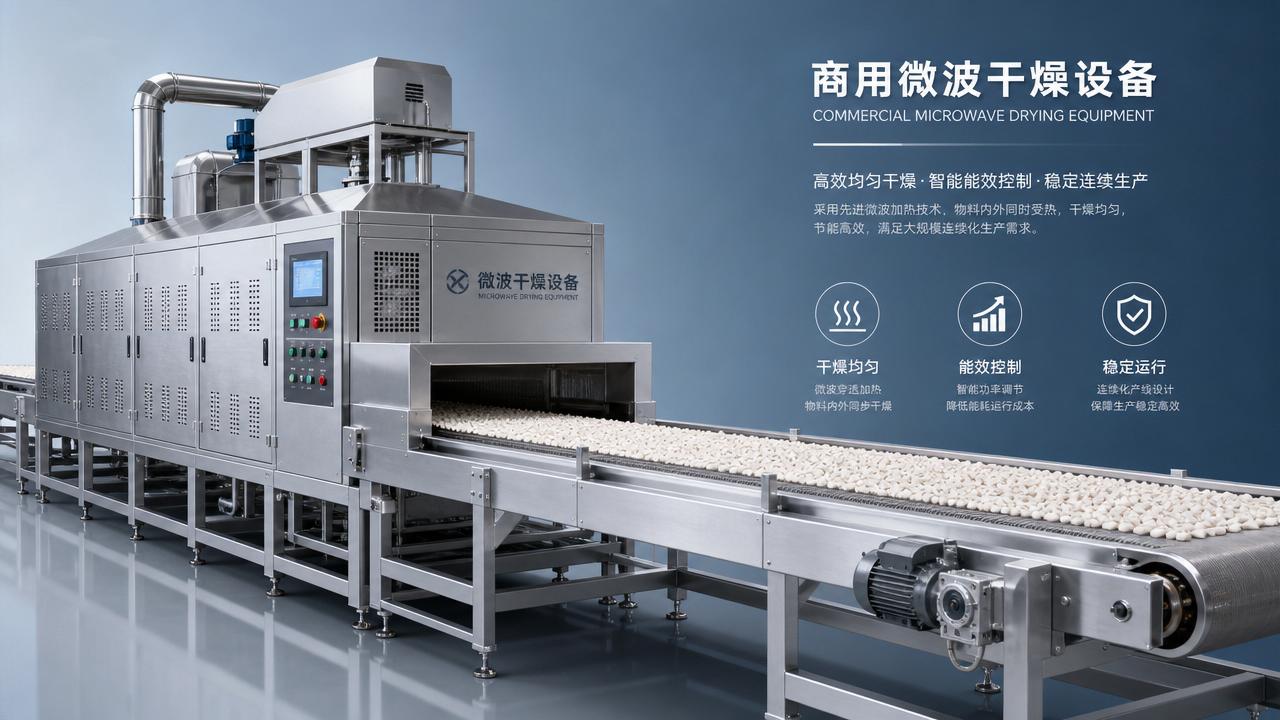
DETAILS
Why microwave drying efficiency problems rarely look the same on every line
In a microwave drying machine commercial setting, small losses rarely stay small for long.
A slight moisture imbalance can raise scrap, slow downstream handling, and create avoidable maintenance stops.
The harder part is that poor efficiency often hides behind acceptable daily output.
One plant sees rising energy draw.
Another sees inconsistent drying across product batches.
A third line runs fast but experiences repeated magnetron, conveyor, or cooling failures.
That is why the right fix depends on operating context, not only on nameplate power.
Across technical manufacturing environments, including electronics packaging and thermal process control, data discipline matters.
This fits the broader SCM approach of evaluating process behavior through measurable performance, reliability, and compliance conditions.
For any microwave drying machine commercial review, the useful questions are simple.
Where is efficiency being lost, under which load pattern, and what operating variable is actually causing it?
Actual operating conditions change what “efficient” really means
The same microwave drying machine commercial unit can perform very differently across products and schedules.
Moisture content, part geometry, belt loading, ambient temperature, and changeover frequency all shape the result.
In continuous production, stability usually matters more than peak speed.
In mixed-batch work, adaptability matters more than rated capacity.
Where the dried material supports sensitive assemblies or coated parts, thermal uniformity becomes the main decision point.
A useful comparison is below.
This is where many microwave drying machine commercial decisions go wrong.
Teams compare machines by power rating while the real bottleneck sits in feed consistency or process control.
When output is high but drying stays uneven
Uneven drying is one of the most common efficiency complaints in microwave drying machine commercial use.
It often appears in lines processing variable load densities or irregular product shapes.
The obvious reaction is to increase power.
In practice, that can make hot spots worse.
A better starting point is load presentation.
If product thickness varies too much across the belt, microwave absorption will not remain consistent.
If spacing is too tight, vapor removal becomes uneven even when cavity power is stable.
In applications connected to coatings, substrates, or packaged electronic materials, this matters even more.
Residual moisture can compromise adhesion, insulation behavior, or later thermal cycling reliability.
The practical fixes usually include:
- Standardizing feed thickness before the drying zone.
- Reducing belt crowding instead of extending total power.
- Checking waveguide cleanliness and cavity reflectivity.
- Verifying whether exhaust flow removes moisture evenly across the chamber.
Where repeatability is critical, moisture mapping across multiple belt positions gives more value than a single outlet reading.
When energy bills rise before anyone notices a process problem
Another typical microwave drying machine commercial issue is declining energy efficiency without obvious quality failure.
The line still ships product, so the loss gets normalized.
This usually happens in mature operations with fixed recipes and limited process review.
Magnetron aging, poor cooling, cavity contamination, and weak door sealing can all reduce effective energy transfer.
The machine may draw the same power while delivering less usable drying performance.
In real facilities, the warning signs are subtle.
Cycle time extends slightly.
Operators compensate by increasing dwell time.
Ventilation is adjusted informally rather than through documented settings.
A data-based review, similar to the benchmark logic used in advanced manufacturing analysis, is more reliable.
Track power draw, output moisture, line speed, cooling performance, and maintenance intervals together.
That combination reveals whether the microwave drying machine commercial line is losing efficiency electrically, thermally, or mechanically.
Where the energy loss often hides
- Cooling systems scaled for old production volumes.
- Inconsistent incoming moisture from upstream storage or washing steps.
- Deferred replacement of worn microwave generation components.
- Recipe settings copied across materials with different dielectric behavior.
Fast changeovers create a different efficiency problem
Not every microwave drying machine commercial line runs one product all day.
In mixed production, downtime often comes from setup uncertainty rather than hardware failure.
One material dries well at moderate exposure.
The next requires slower movement and stronger vapor extraction.
Using one average recipe across both may protect throughput reports, but it rarely protects efficiency.
This is common in operations handling adhesives, polymers, coated substrates, molded components, or specialty packaging materials.
The more varied the dielectric response, the less useful a single “best” setting becomes.
The practical answer is not endless fine-tuning on the floor.
It is a controlled recipe library tied to actual material behavior.
At minimum, each recipe should document target moisture, belt speed, power band, airflow setting, and acceptable outlet variation.
That discipline reduces trial-and-error and helps the microwave drying machine commercial process stay predictable over time.
Different applications call for different decision priorities
In actual use, the right improvement path depends on what the dried product must do next.
If the next step is assembly, surface consistency may matter most.
If the next step is storage, residual moisture stability may matter more.
If the line supports technical manufacturing, traceability and repeatable process windows become part of efficiency itself.
This is also why broad claims in a microwave drying machine commercial pitch should be tested against site conditions.
Rated efficiency on a clean trial line does not automatically translate to stable plant performance.
The misjudgments that keep recurring
Several mistakes appear across otherwise capable microwave drying machine commercial operations.
- Treating similar products as if they absorb microwave energy the same way.
- Reviewing output speed without checking moisture variation at multiple points.
- Focusing on machine purchase cost while ignoring service intervals and utility constraints.
- Assuming downtime comes from hardware when upstream feed instability is the true cause.
- Using pass-or-fail inspection instead of trend data for ongoing optimization.
The recurring lesson is straightforward.
A microwave drying machine commercial process performs best when the line is evaluated as a system.
That means material behavior, utility stability, maintenance quality, and downstream tolerance all belong in the same review.
What to do next before losses become routine
The most useful next step is to define the operating scenario before choosing the fix.
Map where the microwave drying machine commercial line struggles most.
Is it moisture consistency, energy intensity, changeover speed, or unplanned stoppage?
Then compare that issue against material type, feed variation, thermal sensitivity, and maintenance history.
Where process quality affects engineered components or compliance-driven production, a benchmark mindset is especially valuable.
The same evidence-based discipline seen in SCM technical reporting works well here too.
Build a short evaluation sheet, verify critical parameters, and track changes against actual output rather than assumptions.
That is usually the fastest way to fix efficiency problems before they become part of normal production.
Recommended News
- HDI TechnologyHow to vet PCB suppliers in a directory before requesting quotesPCB suppliers directory guide: learn how to verify capabilities, certifications, traceability, and quote assumptions before selecting a reliable PCB partner.
- HDI TechnologyHow UAE engineering data repositories improve design traceabilityEngineering data repository UAE solutions strengthen design traceability by linking requirements, revisions, supplier evidence, and manufacturing data. Explore practical ways to reduce risk and accelerate releases.
- HDI TechnologyHow to verify UL recognition for printed circuit boardsPrinted circuit boards UL verification made clear: learn how to check UL marks, file numbers, factory scope, stack-ups, and traceability for audit-ready compliance.
- HDI TechnologyMulti layer PCB design guide for controlling signal crosstalkMulti layer PCB design guide for controlling signal crosstalk with stackup, spacing, return-path, and validation strategies for reliable high-density boards.
- HDI TechnologyHow tighter manufacturing tolerances change HDI PCB pricesMicro tolerance manufacturing price explained: see how tighter HDI PCB tolerances affect yield, inspection, supplier options, and sourcing costs.
- HDI TechnologyHow automotive PCB impedance control prevents signal failuresAutomotive PCB impedance control prevents reflections, noise, and timing errors in ADAS, EV, and infotainment systems. Learn how to build reliable signal paths.