
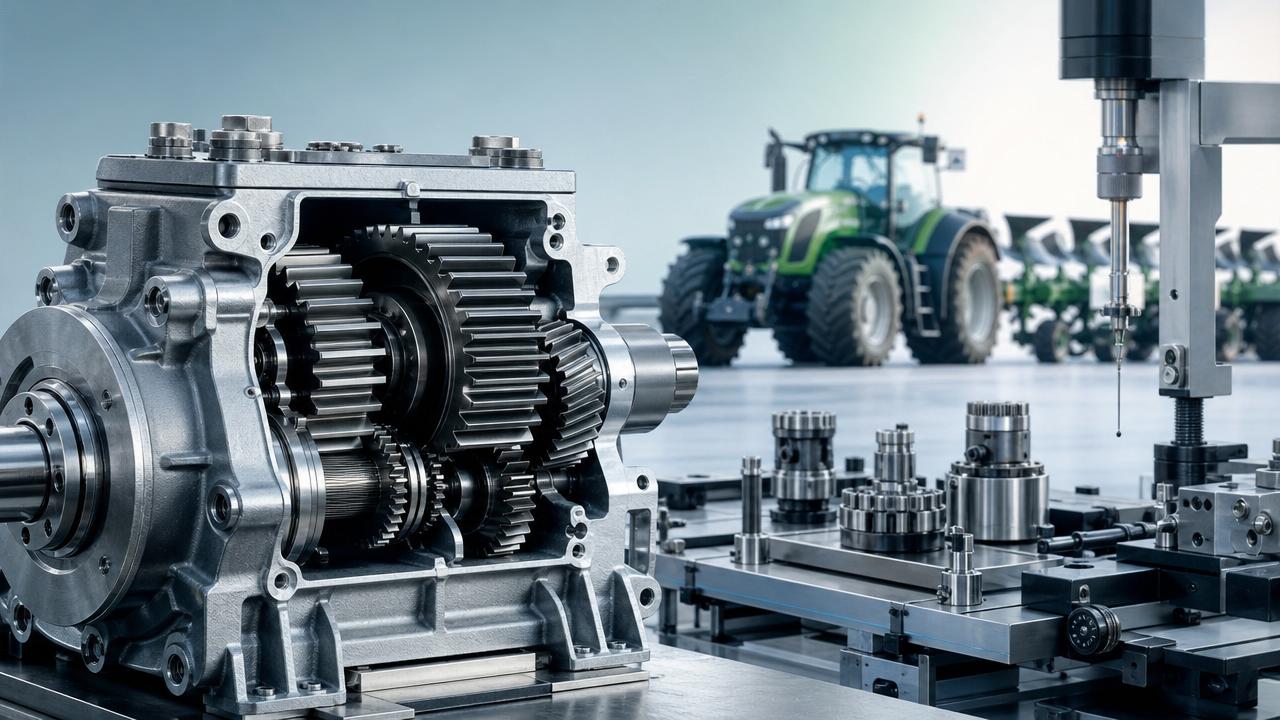
How to Choose an Agricultural Gearbox Manufacturer
Choosing the right agricultural gearbox manufacturer is a strategic decision that directly affects equipment reliability, lifecycle cost, and field performance.
For enterprise decision makers, the challenge is not only comparing price, but also verifying engineering capability, material quality, tolerance control, testing standards, and supply stability.
This guide outlines the key evaluation criteria to help you identify manufacturers that can deliver durable gearbox solutions for demanding agricultural machinery applications.
What Buyers Really Need to Know Before Selecting a Manufacturer
When decision makers search for an agricultural gearbox manufacturer, they are usually not looking for a basic product definition.
They want to reduce procurement risk, avoid field failures, control warranty exposure, and secure a supplier capable of supporting long production cycles.
The most useful evaluation therefore focuses on measurable manufacturing capability, documented quality control, application knowledge, and dependable commercial execution.
General promises such as “high quality” or “competitive price” are not enough for machinery brands, OEMs, and large equipment distributors.
A stronger decision framework connects gearbox performance with total cost of ownership, equipment uptime, parts availability, and brand reputation in the field.
Start With Application Fit, Not Catalog Availability
Agricultural gearboxes operate in harsh environments, including dust, mud, vibration, shock loads, moisture, fertilizer exposure, and irregular maintenance conditions.
Because of this, a catalog match based only on ratio, shaft size, or housing shape can create hidden operational risk.
The right manufacturer should understand the machinery category, whether the gearbox is used in rotary cutters, seeders, harvesters, sprayers, or feed mixers.
Ask how the manufacturer evaluates torque peaks, duty cycles, input speed variation, lubrication behavior, and seasonal operating patterns.
A capable supplier can explain why a gearbox design fits the application, not simply confirm that a similar model exists.
For enterprise buyers, this application discussion is often the first sign of whether the supplier is a commodity trader or an engineering partner.
Evaluate Engineering Capability and Design Control
An agricultural gearbox manufacturer should have clear engineering ownership over gear geometry, bearing selection, housing design, sealing systems, and lubrication strategy.
Decision makers should verify whether the supplier can provide drawings, material specifications, tolerance data, and design revision control.
Design control is especially important when equipment platforms remain in production for many years and spare parts must remain interchangeable.
Manufacturers with stronger engineering systems can support customization, redesign legacy units, and improve durability without disrupting assembly compatibility.
Ask whether they use CAD modeling, finite element analysis, gear contact analysis, or empirical load testing during development.
Even if your project does not require advanced simulation, these capabilities indicate disciplined product development and lower technical uncertainty.
Check Materials, Heat Treatment, and Gear Manufacturing Quality
Gearbox durability depends heavily on material consistency, tooth accuracy, surface hardness, core toughness, and proper heat treatment control.
Low-cost gears may appear acceptable during installation but fail prematurely under repeated shock loads or poor lubrication conditions.
Buyers should request information about steel grades, carburizing or induction hardening processes, hardness ranges, and inspection methods.
For critical applications, ask whether the manufacturer performs metallographic inspection, case depth verification, magnetic particle testing, or gear accuracy measurement.
Housing material also matters because poor casting quality can cause oil leakage, bearing misalignment, vibration, and reduced service life.
A reliable agricultural gearbox manufacturer should be able to document both incoming material control and in-process verification.
Assess Tolerance Control and Assembly Discipline
Gearbox performance is not determined by individual parts alone; it depends on how accurately those parts are assembled.
Bearing preload, shaft alignment, backlash, gear contact pattern, seal installation, and fastener torque all influence operating reliability.
Enterprise buyers should ask how the manufacturer controls assembly repeatability across batches, shifts, and production locations.
Look for documented assembly instructions, calibrated tools, inspection records, and operators trained for gearbox-specific quality requirements.
It is also useful to ask whether contact patterns are checked under load or only visually during assembly.
Small assembly deviations can create noise, heat generation, premature bearing failure, oil leakage, and customer dissatisfaction after delivery.
Review Testing Standards Before Discussing Price
Testing is one of the clearest differences between a basic supplier and a dependable manufacturing partner.
A serious manufacturer should perform functional testing, leakage testing, noise checks, temperature monitoring, and rotational smoothness verification.
For higher-risk programs, request evidence of endurance testing, overload testing, salt spray testing, vibration testing, or environmental exposure testing.
The purpose is not to demand every possible test, but to confirm whether validation matches the gearbox’s operating risk.
Ask how test results are recorded, what acceptance limits are used, and how failures are analyzed and corrected.
A supplier that can discuss failure modes openly is usually more valuable than one that claims problems never occur.
Compare Total Cost of Ownership, Not Unit Price Alone
For enterprise decision makers, the cheapest gearbox is rarely the lowest-cost option over the equipment lifecycle.
Field failures can create warranty claims, dealer dissatisfaction, downtime penalties, emergency logistics costs, and damage to equipment brand perception.
When comparing manufacturers, calculate the impact of failure rate, service interval, spare parts availability, and installation consistency.
A slightly higher unit price may be justified if the manufacturer reduces failure risk and improves delivery reliability.
Procurement teams should combine commercial analysis with engineering risk scoring instead of treating the gearbox as a simple purchased component.
This approach is especially important for OEMs selling machinery into remote regions where service access is limited.
Verify Quality Systems and Traceability
Certifications alone do not guarantee product quality, but they provide a useful starting point for supplier evaluation.
Look for ISO 9001 certification, documented inspection procedures, calibrated measurement equipment, corrective action processes, and batch-level traceability.
Traceability is critical when a defect appears in the field and the buyer must identify affected production lots quickly.
Ask whether components can be traced back to material batches, heat treatment records, machining dates, and assembly operators.
Also review how the manufacturer handles nonconforming materials, customer complaints, engineering changes, and supplier quality issues.
A mature quality system reduces uncertainty and supports faster containment when problems occur during mass production.
Examine Supply Capacity and Delivery Stability
A manufacturer may have excellent technical capability but still create business risk if capacity and delivery discipline are weak.
Enterprise buyers should evaluate production scale, lead times, inventory practices, supplier network stability, and responsiveness during peak agricultural seasons.
Agricultural machinery demand is often seasonal, so late gearbox delivery can delay complete equipment shipments and revenue recognition.
Ask how the manufacturer manages forecast changes, safety stock, raw material procurement, and urgent replacement orders.
It is also important to understand whether key processes are performed in-house or outsourced to uncontrolled subcontractors.
Stable delivery performance becomes a strategic advantage when competitors face shortages or inconsistent component quality.
Consider Customization and Long-Term Product Support
Many machinery manufacturers require more than standard gearboxes, especially when optimizing space, weight, power transmission, or mounting configuration.
A qualified agricultural gearbox manufacturer should support ratio changes, shaft modifications, housing adaptations, sealing upgrades, and lubrication improvements.
However, customization should be managed through formal engineering change control, prototype validation, and production approval procedures.
Decision makers should avoid suppliers that accept customization requests casually without documenting risks, tolerances, and compatibility requirements.
Long-term support also matters because agricultural equipment often remains in service for decades.
Ask whether the manufacturer can maintain drawings, tooling, spare parts, and replacement compatibility throughout the expected machinery lifecycle.
Use Supplier Audits to Validate Claims
Website descriptions and sales presentations are useful, but they should not replace direct verification for strategic sourcing decisions.
A supplier audit should review machining equipment, heat treatment control, inspection capability, warehouse conditions, assembly lines, and final testing areas.
During the audit, observe whether production records are complete, operators follow written procedures, and measurement tools are properly calibrated.
Ask to see examples of corrective action reports, customer complaint handling, and recent process improvement projects.
If an on-site audit is not possible, request video walkthroughs, third-party inspection reports, sample test records, and live technical meetings.
The goal is to confirm that the supplier’s actual operations match the capability promised during commercial discussions.
Ask the Right Questions Before Awarding Business
A structured question list helps decision makers compare suppliers fairly and identify gaps before committing to production orders.
Ask which applications the gearbox has served, what failure data is available, and what design improvements were made from field feedback.
Request details about gear materials, heat treatment suppliers, bearing brands, seal specifications, lubrication recommendations, and housing inspection methods.
Commercial questions should cover lead time, minimum order quantity, price validity, packaging standards, warranty terms, and spare parts support.
Quality questions should cover traceability, inspection frequency, test procedures, acceptance criteria, and the process for handling nonconforming products.
Strong manufacturers will answer these questions clearly, while weaker suppliers may avoid details or rely on vague assurances.
Red Flags That Should Slow Down Your Decision
Several warning signs suggest that a supplier may not be suitable for enterprise-level agricultural gearbox sourcing.
Be cautious if the manufacturer cannot provide drawings, material specifications, inspection records, or clear answers about heat treatment control.
Another red flag is a quotation that is significantly lower than competitors without a credible explanation of process efficiency.
Poor communication during sampling, delayed technical responses, inconsistent documentation, and resistance to audits can indicate future operational problems.
Also be careful when a supplier claims to manufacture everything but cannot show evidence of key production processes.
Choosing slowly during qualification is often less expensive than managing urgent failures after production launch.
How to Build a Practical Supplier Scorecard
A scorecard helps procurement, engineering, and management teams make a balanced decision rather than relying on price alone.
Useful categories include engineering capability, material control, machining accuracy, assembly quality, testing depth, delivery reliability, and after-sales support.
Assign higher weight to the factors most connected to your equipment risk, not to the easiest metrics to collect.
For example, a gearbox used in heavy-duty tillage equipment may require stronger validation and material control weighting.
A gearbox used in cost-sensitive light equipment may require balanced attention to price, standardization, and supply continuity.
The best scorecard creates internal alignment and makes supplier selection defensible to both technical and commercial stakeholders.
When a Manufacturer Becomes a Strategic Partner
The strongest supplier relationships go beyond purchase orders and become part of product competitiveness.
A strategic agricultural gearbox manufacturer can help reduce noise, extend service intervals, improve sealing, simplify assembly, and lower warranty exposure.
They may also support design-for-manufacturing improvements that reduce cost without weakening performance or durability.
For enterprise buyers, this partnership value is especially important when launching new machinery platforms or entering demanding markets.
A supplier that shares technical feedback early can prevent costly redesigns after tooling, certification, or dealer commitments are already complete.
The right partner helps the buyer move from reactive sourcing to proactive performance management.
Conclusion: Choose for Reliability, Evidence, and Long-Term Value
Selecting an agricultural gearbox manufacturer should be treated as a strategic sourcing decision, not a routine price comparison.
The best choice is usually the supplier that combines application knowledge, controlled manufacturing, transparent testing, stable delivery, and responsive technical support.
Decision makers should prioritize evidence: drawings, test data, traceability records, audit findings, field performance history, and clear corrective action processes.
Price remains important, but it should be evaluated alongside lifecycle cost, warranty exposure, uptime, and customer satisfaction.
By using a structured evaluation process, enterprises can reduce supply risk and secure gearboxes that perform reliably in demanding agricultural conditions.