
How do stacked microvias affect an HDI PCB fabrication quote?
DETAILS
Stacked microvias can raise an HDI PCB fabrication quote by adding processing steps, tightening manufacturing tolerances, and increasing the cost of meeting yield and reliability requirements. The largest price change often occurs when the design requires another sequential buildup stage or moves beyond a fabricator’s established process capability. Counting microvias alone will not explain the premium.
For procurement teams, the first distinction is whether stacking changes the board’s manufacturing sequence or adds difficulty within an existing sequence. Stacked and staggered designs can require the same number of buildup stages. In that case, the price difference may come primarily from copper filling, surface preparation, registration control, inspection, and expected scrap. A useful PCB technology quotation makes those assumptions visible.
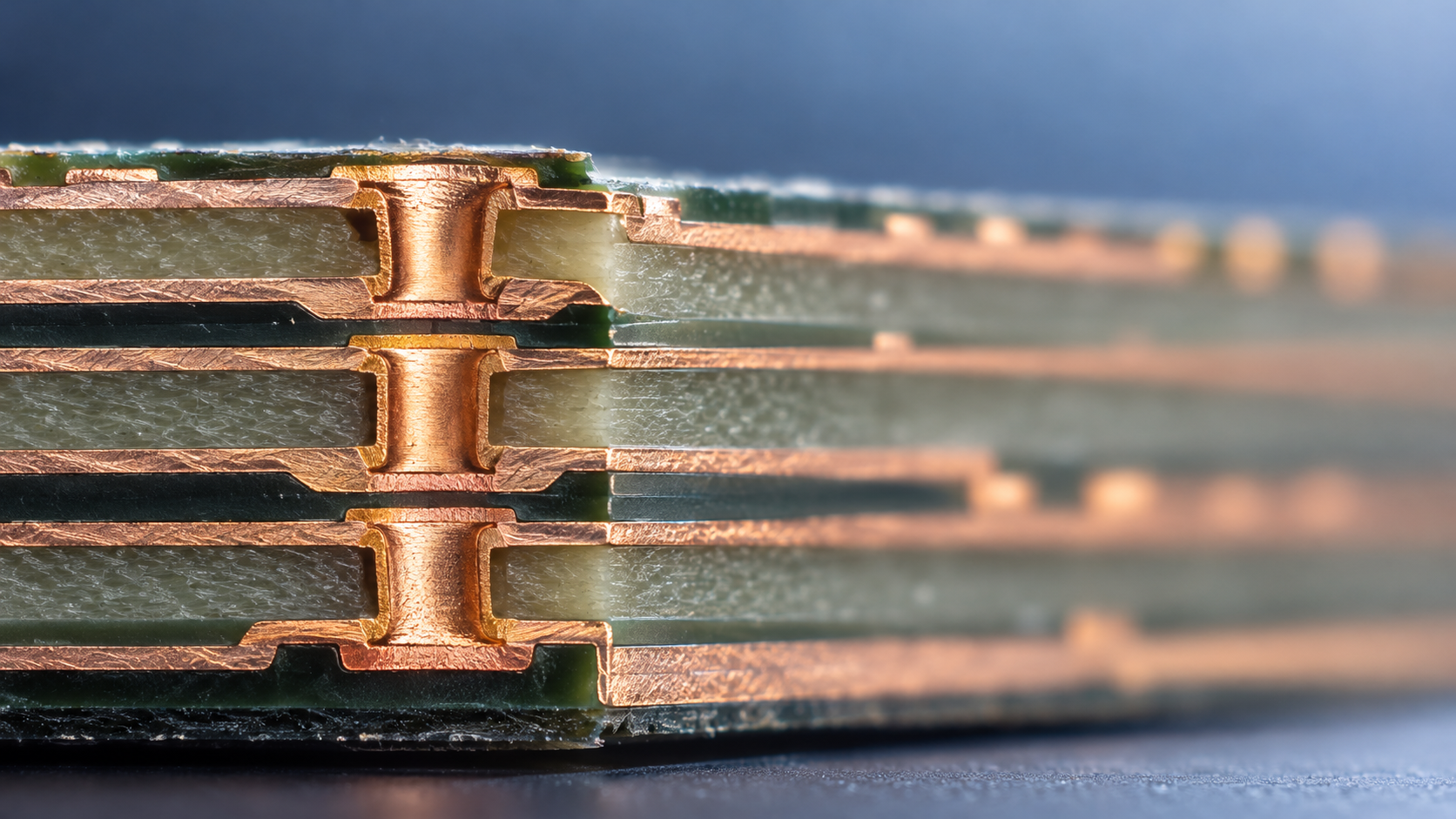
Start with the layer connections behind the price. Stacked microvias sit directly above one another across successive dielectric layers, creating a compact vertical connection. Staggered microvias place those connections at different lateral positions, with routing between them. Stacking can preserve routing space under dense components, but it also makes the integrity of the interfaces within the vertical connection especially important.
The commercial question is therefore specific: what does the proposed connection structure require this factory to do? Two boards with identical layer counts can follow different process routes. Conversely, two different via arrangements may share much of the same route. Asking suppliers to identify the sequential buildup stages and via formation sequence is more informative than asking for a generic “HDI surcharge.”
Where the additional fabrication cost comes from
Sequential lamination is a major cost driver when the design requires it. Building successive dielectric and copper layers can involve repeated lamination, drilling, metallization, imaging, and associated checks. Each additional stage consumes equipment capacity and extends the manufacturing route. It also puts more accumulated manufacturing value at risk if a defect appears late in production.
However, replacing stacked microvias with staggered ones does not automatically eliminate a lamination cycle. If both designs connect through the same successive buildup layers using the same basic sequence, the cycle count may remain unchanged. Ask the supplier which operation disappears under the proposed redesign. A claim of substantial savings should be supported by a changed process route, an improved yield expectation, or another identifiable manufacturing benefit.
Copper filling is another source of cost. In a stacked structure, the lower microvia needs a suitable filled and prepared surface to support the next connection. Achieving that condition depends on controlled plating and surface preparation. Fill quality, void control, and the resulting surface geometry affect whether the next microvia can be formed and connected reliably.
These requirements can add plating time, process control, and planarization work where required by the manufacturing method. Yet copper filling is not exclusive to stacked microvias: a staggered or via-in-pad design may also require filled structures. Procurement should compare the actual fill and surface requirements in each proposal before attributing the entire filling charge to stacking.
Registration becomes more demanding as the design leaves less margin between a laser-drilled opening and its intended landing feature. Small capture pads, thin dielectric layers, material movement during processing, and the alignment of successive layers interact. A design near a supplier’s capability boundary may require more restrictive production controls or carry a higher scrap allowance than a design comfortably inside that boundary.
Inspection and qualification can also affect the quote. Cross-sections provide information about geometry and interfaces; electrical testing checks connectivity under the specified test conditions. Where the application requires evidence of performance through assembly or thermal exposure, additional testing may be appropriate. The supplier’s price should distinguish routine production acceptance from initial qualification and any recurring reliability testing.
Why the same drawing can produce very different bids
A supplier with an established process for the specified stack may price it differently from a supplier that needs engineering development, additional trials, or outside processing. That difference can reflect manufacturing fit. A lower quote becomes harder to assess when the supplier has not clearly accepted the via structure, material system, tolerances, and verification requirements shown in the RFQ.
Yield assumptions matter because the delivered boards must absorb the cost of unsuccessful production. Stacked structures can add defect opportunities at buried interfaces, particularly when several demanding features occur together. The effect depends on stack geometry, materials, process control, and the factory’s experience with that construction. There is no defensible universal percentage premium for stacked microvias across all HDI boards.
Order quantity changes how these costs appear. Engineering review, tooling, test development, and qualification may be concentrated in an initial charge or spread across the unit price. A prototype quote can therefore look expensive even when the planned production route is viable. A low prototype price, in turn, does not establish the supplier’s ability to sustain yield and delivery at production volume.
Request separate prices for initial engineering, qualification, and recurring fabrication where these distinctions are material. Compare suppliers at the same order quantities and delivery conditions. Also establish whether the quoted lead time starts at purchase order receipt, engineering approval, or completion of material procurement. A compressed schedule can carry a premium independent of the via design.
Give suppliers enough information to price the same board
An RFQ described only as “HDI, stacked microvias” leaves too much room for interpretation. The fabrication package should show where each microvia begins and ends, which connections are stacked, and whether any stack lands on a buried via. An explicit layer-pair map prevents suppliers from estimating different constructions under the same description.
The following details have a direct bearing on quotation accuracy:
- Stackup and materials: layer arrangement, dielectric thicknesses, copper requirements, finished thickness, and any permitted material substitutions.
- Via geometry: microvia opening and landing dimensions, layer spans, number of stacked levels, and relevant capture-pad requirements.
- Filling and surface requirements: specified fill material, cap or surface condition, and planarity needs where component attachment is involved.
- Acceptance and verification: applicable specification and revision, product class where relevant, coupon requirements, electrical testing, and agreed qualification conditions.
- Commercial basis: order quantities, expected repeat demand, delivery requirements, and whether the price covers bare-board fabrication alone.
Dimensions should be defined clearly enough to distinguish design targets from finished acceptance limits. A nominal laser opening, for example, does not by itself describe the finished geometry throughout the microvia. When a supplier proposes a dimensional change, engineering should establish its effect on routing, electrical performance, and acceptance before procurement treats the proposal as an equivalent bid.
Standards references also need precision. Specifying an IPC performance class can establish important requirements, but it does not by itself demonstrate that a particular stacked structure will survive the product’s assembly and service conditions. Likewise, an ISO 9001 certificate concerns the supplier’s quality management system; it does not qualify a microvia stack. The quotation should identify the actual construction and evidence covered by the offer.
Compare reliability evidence alongside unit price
Microvia interface defects can be difficult to judge from a room-temperature continuity result alone. A connection may pass an initial electrical check yet become intermittent or open after thermal stress. For applications with demanding assembly profiles or service conditions, the acceptance plan should address that possibility through an appropriate combination of process qualification, representative coupons, and agreed testing.
The evidence needs to be relevant to the proposed construction. Experience with a simpler microvia arrangement does not automatically establish capability for a taller stack, different dielectric system, or stack placed over a buried via. Ask how closely the supplier’s supporting qualification matches the quoted board, and which differences require additional evaluation.
This does not justify attaching every available test to every purchase. Qualification has a cost, consumes samples, and can extend the schedule. Engineering and procurement should agree on testing that addresses the product’s expected stresses and consequences of failure. The quote can then show which costs occur at introduction and which recur with each production lot.
For a meaningful bid comparison, resolve three questions before ranking unit prices: has each supplier accepted the same construction; does each offer include the same acceptance and test scope; and are proposed deviations visible? A supplier may have a legitimate lower-cost process, but that advantage should be distinguishable from omitted testing, relaxed dimensions, substituted materials, or an unapproved change to the via arrangement.
When a redesign is likely to reduce the quote
The strongest opportunities appear when engineering can remove a buildup stage, reduce the number of stacked levels, or bring critical dimensions further inside the supplier’s established capability. These changes can affect several cost drivers together. Their value depends on whether the board can still meet component escape, routing density, electrical, and mechanical requirements.
Changing to staggered microvias deserves a priced comparison when there is enough lateral space. The arrangement may ease manufacturing constraints, but it can consume routing area or require a larger layout. If the redesign adds layers or increases board size, those costs may offset the fabrication savings. Procurement needs the price of the complete alternative construction.
Selective use is another option. A board may need stacked microvias only beneath its most demanding component. Engineering can assess whether other regions can use less demanding connections while retaining the required stack where density makes it necessary. The savings depend on which operations and constraints remain after the change; reducing the number of stacked locations may have limited value if the same processing sequence is still required.
A practical commercial review asks the fabricator to price the released design and one or two technically acceptable alternatives, with the process differences stated explicitly. Compare recurring unit cost, initial charges, qualification scope, and delivery implications on the same volume basis. This gives engineering a concrete reason to change the layout—or evidence that the proposed change offers too little benefit.
Where stacking is necessary, the purchasing decision turns on whether the quoted premium buys a controlled, supportable manufacturing route. A stronger offer explains the buildup sequence, accepts the required geometry, identifies relevant qualification evidence, and separates recurring costs from introduction costs. If those points are missing, the next step is a focused engineering review of the quote before price negotiation locks in assumptions that production cannot reliably meet.
Recommended News
- HDI TechnologyTPCA Show 2026 Opens as Taiwan PCB Output Tops NT$1 TrillionTPCA Show 2026 spotlights Taiwan’s PCB output forecast of NT$1.1365 trillion. Explore AI-driven growth, IC substrate demand and a potential 2027 materials shortfall.
- HDI TechnologyHow do stacked microvias affect an HDI PCB fabrication quote?PCB technology quotation insights: Learn how stacked microvias affect HDI fabrication costs, compare supplier bids, and uncover savings without compromising reliability.
- HDI TechnologyHow to vet PCB suppliers in a directory before requesting quotesPCB suppliers directory guide: learn how to verify capabilities, certifications, traceability, and quote assumptions before selecting a reliable PCB partner.
- HDI TechnologyHow UAE engineering data repositories improve design traceabilityEngineering data repository UAE solutions strengthen design traceability by linking requirements, revisions, supplier evidence, and manufacturing data. Explore practical ways to reduce risk and accelerate releases.
- HDI TechnologyHow to verify UL recognition for printed circuit boardsPrinted circuit boards UL verification made clear: learn how to check UL marks, file numbers, factory scope, stack-ups, and traceability for audit-ready compliance.
- HDI TechnologyMulti layer PCB design guide for controlling signal crosstalkMulti layer PCB design guide for controlling signal crosstalk with stackup, spacing, return-path, and validation strategies for reliable high-density boards.