
HDI Technology vs Standard PCB: Key Tradeoffs
DETAILS
Choosing between HDI technology and standard PCB affects circuit board assembly, thermal management compliance, and long-term product reliability. For engineers, buyers, and quality teams evaluating electronic parts, circuit components, and SMT compliance, understanding the tradeoffs in density, cost, soldering techniques, SMT soldering, reflow soldering, and pick and place specifications is essential before selecting the right manufacturing path.
Why the HDI vs Standard PCB Decision Matters in Real Procurement
In many electronics programs, the board stack-up decision is made too late. Teams approve a compact layout, add tighter routing, then discover that a standard PCB can no longer support the line width, via structure, or component escape required for assembly yield. At that point, a shift to HDI technology may solve the density issue, but it also changes fabrication complexity, lead time, inspection scope, and unit economics.
For information researchers and technical evaluators, the core question is not whether HDI is better in absolute terms. The right question is whether the electrical, thermal, and packaging demands of the product justify the added process requirements of laser microvias, sequential lamination, and finer trace geometry. In many projects, the performance gain is real. In others, standard PCB remains the more stable and cost-controlled choice.
For procurement teams and financial approvers, this decision typically involves 3 linked variables: fabrication cost, assembly risk, and lifecycle reliability. A lower board price does not always mean lower system cost if signal integrity problems, solder bridging, or field failures appear after volume ramp. Conversely, using HDI in a design that does not need it can push costs up without a measurable return.
SiliconCore Metrics supports this stage with independent benchmarking across PCB fabrication, SMT assembly, and component reliability. That matters when teams compare Asian high-precision manufacturing sources, review IPC-Class 3 expectations, and validate whether a board choice aligns with actual manufacturing capability rather than marketing claims.
What different stakeholders usually need to know
- Engineers want routing density, impedance control, via reliability, and thermal path clarity before layout freeze.
- Buyers need realistic lead time ranges such as 2–4 weeks for standard builds versus longer cycles when HDI includes sequential lamination and tighter process controls.
- Quality and safety teams focus on inspection coverage, rework limitations, solder joint access, and long-term reliability in thermal cycling or harsh environments.
- Project managers need a practical decision path that balances prototype speed, design risk, and scale-up feasibility across small, medium, and high-volume production.
How HDI Technology Differs from a Standard PCB
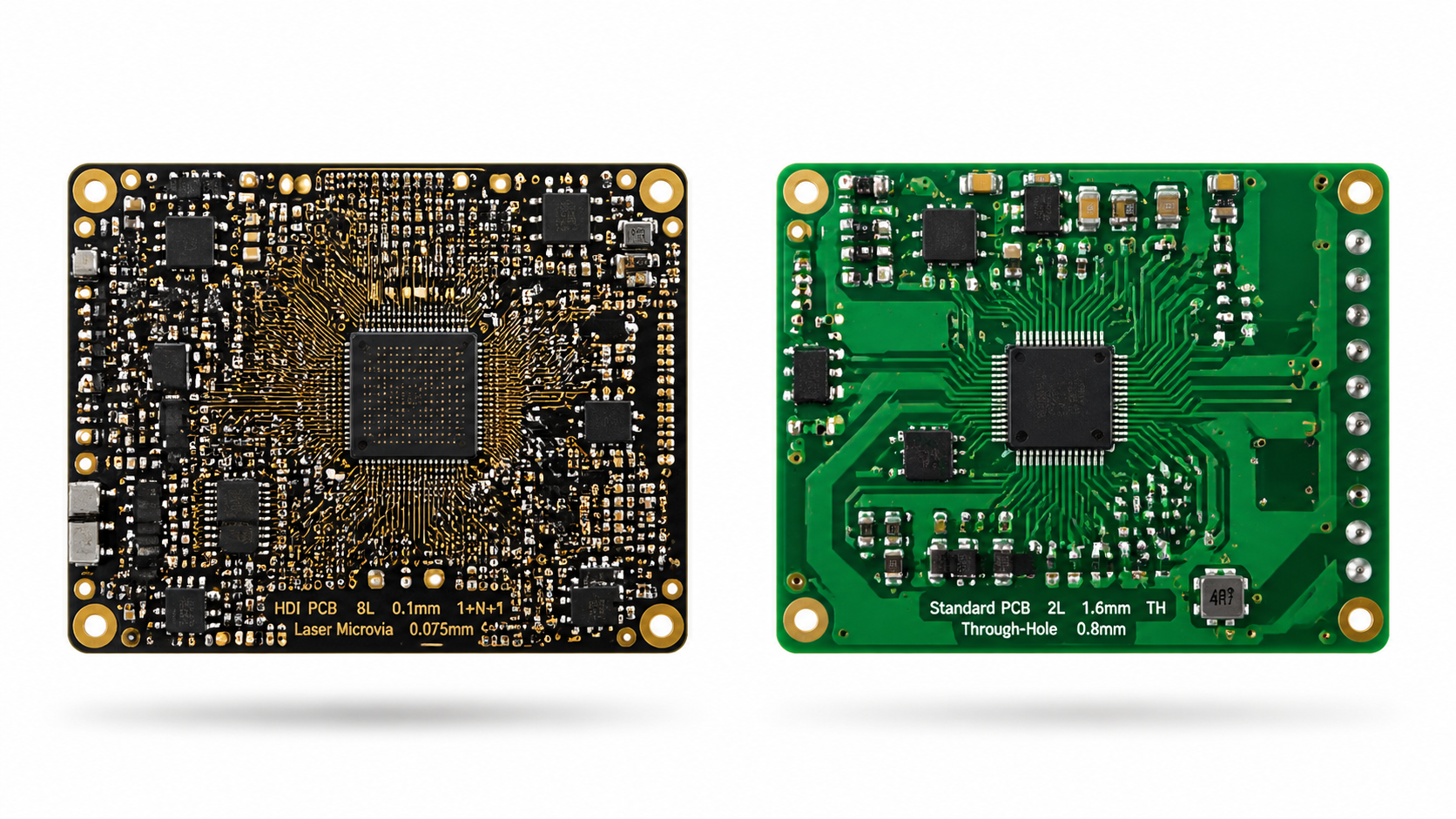
A standard PCB typically uses conventional mechanically drilled vias, larger design rules, and a fabrication sequence that is easier to scale across many suppliers. It is widely used for industrial controls, power boards, consumer devices with moderate complexity, and products where assembly access and repairability still matter. Standard PCB structures are often sufficient when component pitch, layer count, and signal speed remain within common manufacturing windows.
HDI technology is designed for higher interconnect density. It commonly uses microvias, blind or buried vias, finer line and space capability, and layer-by-layer build-up strategies. These structures help designers break out high pin-count packages, shorten electrical paths, and reduce board size. In practice, HDI is frequently evaluated for compact communication modules, advanced computing boards, wearables, medical electronics, and complex automotive electronics where space and electrical performance are tightly linked.
The manufacturing difference goes beyond geometry. HDI requires more controlled lamination cycles, tighter registration, and closer attention to dielectric consistency, copper balance, and plating quality. Once microvia stacking or staggered via structures enter the design, process capability must be verified supplier by supplier. This is where independent data on fabrication tolerances and SMT placement precision becomes more valuable than generic capability brochures.
The table below summarizes the practical tradeoffs that most design and sourcing teams compare during early selection. It focuses on manufacturability, electrical behavior, assembly implications, and cost exposure rather than only textbook definitions.
The most important takeaway is this: HDI technology improves design freedom, but it narrows the manufacturing window. Standard PCB reduces process complexity, but it can force larger form factors or weaker electrical routing decisions. Neither option is automatically correct without reference to package pitch, layer strategy, thermal density, and expected production scale.
A simple rule-of-thumb before layout finalization
If your board must support ultra-compact placement, dense BGA fan-out, or high-speed paths where via stubs and routing length materially affect performance, HDI deserves early evaluation. If the product has moderate density, a manageable board outline, and serviceability requirements, a standard PCB often provides the stronger total-cost position.
Which Technical Tradeoffs Matter Most for Engineers and Quality Teams?
The technical comparison between HDI technology and standard PCB should be organized around 4 core dimensions: signal integrity, thermal behavior, assembly process compatibility, and reliability under stress. These are the dimensions that most directly affect qualification, yield, and field performance. Looking only at board thickness or layer count is rarely enough.
For signal integrity, HDI often provides an advantage because shorter interconnect paths and optimized via usage can reduce discontinuities. In higher-speed designs, this can simplify routing for memory, RF sections, and fine-pitch processors. However, that benefit depends on stack-up discipline, dielectric consistency, and controlled impedance execution. Without robust fabrication control, theoretical electrical gains may not appear in production.
For thermal management, the answer is more nuanced. HDI can help compact high-function designs fit into smaller spaces, but thermal density then rises. Heat spreading, copper distribution, via-in-pad decisions, and thermal interface strategy become more critical. A standard PCB with a larger outline may sometimes deliver a better thermal margin simply because it gives the design more area, more separation, and easier heat routing.
From an assembly perspective, soldering techniques must match board architecture. Reflow soldering profiles, stencil design, pad geometry, and pick and place accuracy all become more sensitive as density increases. For operators and manufacturing engineers, tighter spacing means less tolerance for paste variation, head alignment drift, or placement offset during SMT soldering.
Technical checkpoints before approving HDI
- Confirm whether the package escape truly requires microvias or whether a larger board outline can maintain standard fabrication rules.
- Review whether the assembly line can sustain fine-pitch placement accuracy and consistent reflow soldering across prototype and mass production lots.
- Check thermal simulations or empirical measurements at 3 stages: prototype, pre-production, and post-environmental stress validation.
- Validate inspection coverage, especially when dense component populations reduce optical visibility or limit rework access.
Where independent benchmarking helps
SCM’s analytical model is useful when design teams need neutral evidence on dielectric behavior, SMT placement precision, or long-term component reliability under temperature and stress exposure. That is especially relevant in cross-border supply chains where one supplier may claim HDI readiness while another offers stronger consistency in standard PCB execution. The better choice is the one with measurable control over micro-tolerances, not the most aggressive capability sheet.
When Is HDI Worth the Cost, and When Is Standard PCB Smarter?
Cost discussions often fail because teams compare only bare board pricing. In reality, total cost includes NPI iteration risk, assembly yield, inspection time, rework losses, qualification delay, and service impact after shipment. For a low-to-medium complexity product, standard PCB may deliver a better financial outcome even if the board is physically larger. For a highly integrated product, HDI may reduce enclosure size, lower connector count, or simplify electrical architecture enough to offset the fabrication premium.
Typical cost exposure rises in 3 situations: sequential lamination increases, microvia structures become stacked rather than staggered, and early prototypes are released before DFM review is complete. In these cases, the first-pass yield can become the hidden budget issue. Finance teams should therefore ask not only “What is the unit price?” but also “What is the cost of design immaturity?”
Lead time is another practical differentiator. A conventional standard PCB for common specifications may fit a 7–15 business day fabrication window, while HDI boards with more advanced structures can require longer planning and verification cycles depending on stack-up complexity, inspection requirements, and supplier loading. That gap can directly affect launch schedules when projects are already on compressed timelines.
The following selection table helps procurement, project, and commercial teams translate technical requirements into a sourcing decision that is easier to defend internally.
This comparison shows why the lower-cost option at the PCB level may not be the lower-risk option at the program level. The strongest decisions come from linking form factor, production phase, SMT capability, and service expectations into one approval model.
A practical 4-step sourcing approach
- Screen the electrical and package requirements before layout lock rather than after a density problem appears.
- Compare at least 3 supplier capability dimensions: fabrication tolerance, SMT line control, and inspection discipline.
- Estimate total cost across prototype, pilot, and production rather than using one bare board quote.
- Document whether the chosen board type supports the required compliance level, repair strategy, and target product life.
What Standards, Compliance, and Quality Checks Should Be Reviewed?
For quality managers, auditors, and project owners, the board decision is inseparable from compliance. HDI technology and standard PCB both can be aligned with recognized manufacturing frameworks, but the verification effort differs. The denser the design and the finer the process window, the more important it becomes to standardize incoming review, process control, and outgoing inspection criteria.
In practical sourcing, teams frequently review IPC workmanship expectations, supplier quality management under ISO 9001, stack-up documentation, solderability control, and traceability across fabrication and SMT assembly stages. For higher-reliability applications, the documentation burden usually expands to include process records, lot-level checks, and environment-related validation such as thermal cycling or humidity exposure according to the product category.
A disciplined review generally covers 5 checkpoints: material declaration, stack-up and dielectric confirmation, via structure validation, SMT process compatibility, and reliability test scope. If even one of these is weak, the chosen board architecture may pass prototype builds but create instability during production or field use.
The table below can be used as a cross-functional checklist when engineering, procurement, and quality teams need a common language for approving HDI or standard PCB sources.
A checklist like this is especially useful when suppliers are geographically dispersed and internal teams need comparable evidence. SCM’s role as an independent repository and technical think tank is valuable here because procurement can rely on standardized benchmarking rather than fragmented vendor narratives.
Common quality risks that are often underestimated
- Assuming microvia capability is stable across all layer combinations without reviewing actual process control records.
- Approving dense layouts before confirming that AOI, X-ray, and rework access are adequate for the package mix.
- Treating thermal performance as a simulation-only issue instead of validating it under realistic operating cycles.
- Using the same incoming inspection logic for HDI and standard PCB even though defect modes and risk concentration differ.
FAQ: Common Questions Before Choosing HDI Technology or Standard PCB
How do I know if my design truly needs HDI technology?
Start with package pitch, routing congestion, board outline limit, and signal-speed sensitivity. If a larger board or additional standard layers can solve the escape routing without compromising product size or performance, a standard PCB may be enough. If the design still fails layout closure after those adjustments, HDI becomes a practical candidate rather than a fashionable upgrade.
Is HDI always better for high-performance electronics?
Not always. HDI can improve routing efficiency and support tighter packaging, but it also raises process sensitivity. In some industrial or power-oriented systems, a larger standard PCB may deliver more thermal headroom, easier maintenance, and lower total cost. High performance should be defined by the full system outcome, not by board complexity alone.
What should procurement ask suppliers before requesting a quote?
Ask for confirmation of achievable stack-up, via structure capability, SMT line readiness for fine-pitch assemblies, typical fabrication lead time, inspection method, and relevant quality documentation. It is also wise to request whether the quote assumes prototype quantity, pilot quantity, or volume production, because cost and yield assumptions can change meaningfully across these phases.
How does board choice affect after-sales service and maintenance?
Standard PCB often supports easier fault localization and repair because spacing is less constrained and component access is better. HDI designs may be appropriate where service is handled by module replacement rather than board-level repair. Maintenance teams should be involved early if the product is expected to remain in field service for several years.
Why Work with SCM When Evaluating HDI Technology vs Standard PCB?
When engineering, sourcing, and quality teams disagree on board architecture, the missing element is often neutral technical evidence. SiliconCore Metrics provides that evidence through independent benchmarking across PCB fabrication, SMT assembly, active and passive component reliability, and thermal packaging trends. This helps organizations compare options using measurable manufacturing parameters rather than assumptions.
SCM is especially relevant for global companies that source from Asian high-precision manufacturing hubs while reporting to international R&D, compliance, and procurement stakeholders. Our value is not limited to a board recommendation. We help connect dielectric behavior, placement precision, reliability expectations, and supply chain transparency into one evaluation path that supports sound purchasing and technical decisions.
If your team is comparing HDI technology and standard PCB for a new program, we can support 6 practical discussion points: stack-up review, manufacturability risk, SMT compatibility, compliance expectations, typical lead time assumptions, and supplier benchmark logic. That can reduce redesign cycles and make internal approvals easier for engineering, purchasing, quality, and finance at the same time.
Contact SCM to discuss parameter confirmation, board selection strategy, expected delivery windows, sample evaluation scope, compliance requirements, or quote-stage technical questions. If needed, we can also help structure an evidence-based comparison framework for prototype, pilot, and volume manufacturing so your team can choose the right path with fewer assumptions and clearer accountability.
- PCB
- HDI technology
- PCB fabrication
- SMT assembly
- thermal packaging
- signal integrity
- IPC-Class 3
- EMS
- thermal management
- micro-tolerances
- high-precision manufacturing
- SMT placement
- environmental stress
- ISO 9001
- component reliability
- SMT process
- PCB suppliers
- passive component reliability
- thermal management compliance
- SMT compliance
- circuit board assembly
- pick and place specifications
- reflow soldering
- SMT soldering
- soldering techniques
- electronic parts
- circuit components
- high-performance
- PCB supplier
Recommended News
- HDI TechnologyHow to vet PCB suppliers in a directory before requesting quotesPCB suppliers directory guide: learn how to verify capabilities, certifications, traceability, and quote assumptions before selecting a reliable PCB partner.
- HDI TechnologyHow UAE engineering data repositories improve design traceabilityEngineering data repository UAE solutions strengthen design traceability by linking requirements, revisions, supplier evidence, and manufacturing data. Explore practical ways to reduce risk and accelerate releases.
- HDI TechnologyHow to verify UL recognition for printed circuit boardsPrinted circuit boards UL verification made clear: learn how to check UL marks, file numbers, factory scope, stack-ups, and traceability for audit-ready compliance.
- HDI TechnologyMulti layer PCB design guide for controlling signal crosstalkMulti layer PCB design guide for controlling signal crosstalk with stackup, spacing, return-path, and validation strategies for reliable high-density boards.
- HDI TechnologyHow tighter manufacturing tolerances change HDI PCB pricesMicro tolerance manufacturing price explained: see how tighter HDI PCB tolerances affect yield, inspection, supplier options, and sourcing costs.
- HDI TechnologyHow automotive PCB impedance control prevents signal failuresAutomotive PCB impedance control prevents reflections, noise, and timing errors in ADAS, EV, and infotainment systems. Learn how to build reliable signal paths.