
Ginseng Root Extract Wholesale: Quality Checks Before Ordering
DETAILS
Ginseng Root Extract Wholesale: Quality Checks Before Ordering
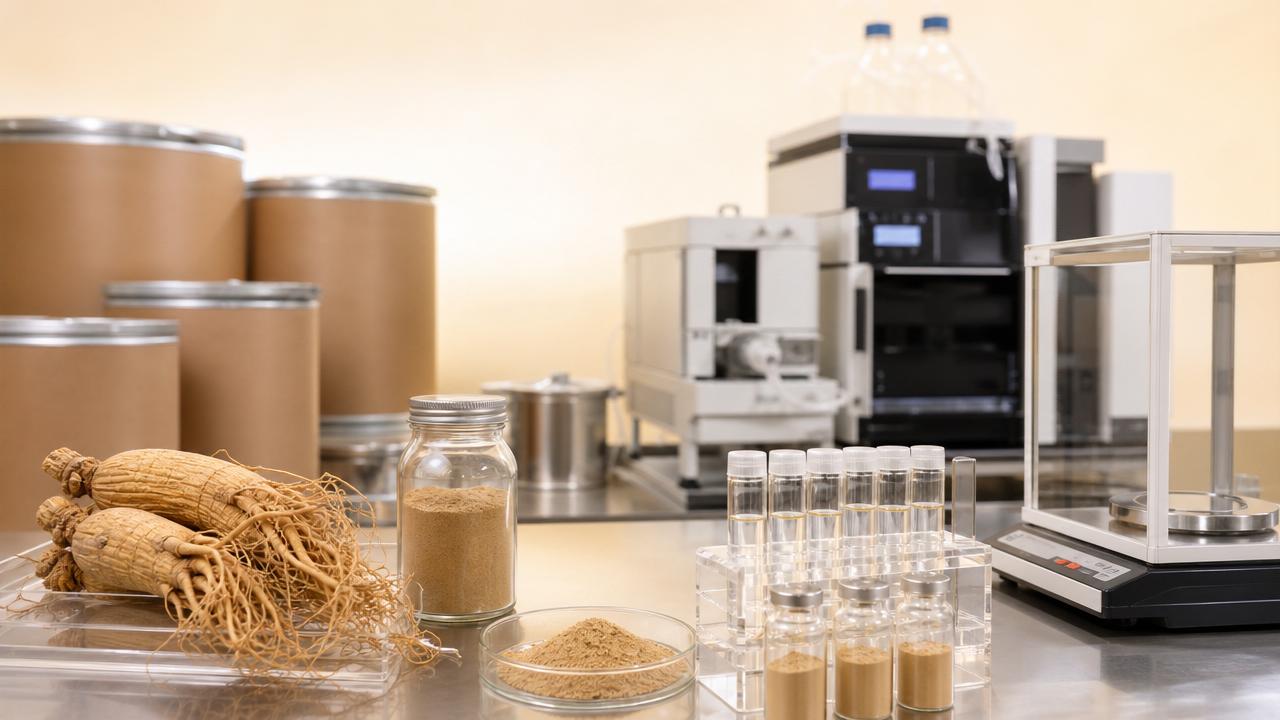
Before committing to ginseng root extract wholesale, procurement teams need more than a competitive quote. They need verified quality and traceable sourcing.
Active compound standardization, contaminant testing, and supplier audit readiness can directly affect product safety, regulatory acceptance, and supply continuity.
This guide outlines the quality checks buyers should complete before placing a bulk order and helps reduce sourcing and compliance risk.
What Buyers Are Really Trying to Confirm
Most procurement searches for ginseng root extract wholesale are not about basic product definitions. Buyers want to know whether a supplier is safe to engage.
The core question is practical: can this supplier deliver consistent extract quality, valid documents, stable pricing, and compliant bulk shipments over time?
For purchasing teams, the lowest unit price rarely represents the lowest landed risk. One failed batch can trigger recalls, rejected customs clearance, or production delays.
A reliable supplier should prove quality before asking for a purchase order. The evidence should be technical, current, and consistent across documents.
Your evaluation should focus on four areas: identity, potency, purity, and supplier control. These determine whether the extract matches your specification.
Start With Botanical Identity and Source Traceability
The first quality check is confirming the exact botanical identity. Ginseng products may come from Panax ginseng, Panax quinquefolius, or other related species.
Each species has different market positioning, active compound profiles, and regulatory implications. Procurement teams should never accept vague descriptions such as “natural ginseng extract.”
Ask the supplier to state the Latin binomial, plant part used, country of origin, harvest period, and extraction location on formal documents.
For ginseng root extract wholesale orders, root age is especially important. Four-year, five-year, and six-year roots may differ in cost and ginsenoside profile.
Traceability should connect the farm, raw material batch, extraction batch, and finished powder batch. Broken traceability makes complaints and recalls difficult.
Useful documents include raw material purchase records, batch manufacturing records, origin certificates, and internal lot coding procedures.
If the supplier claims organic, wildcrafted, or pesticide-controlled sourcing, request certification and testing that specifically matches the quoted batch.
Check Active Compound Standardization Before Comparing Prices
Ginseng root extract is commonly standardized by total ginsenosides. However, “10% ginsenosides” does not always mean the same thing across suppliers.
Procurement teams should confirm the test method, marker compounds, calculation basis, and whether results are reported by HPLC or another validated method.
Some suppliers report total ginsenosides using broader colorimetric methods, which may inflate values compared with more selective chromatographic testing.
Ask whether the specification covers individual ginsenosides such as Rb1, Rg1, Re, Rc, Rd, or Rg3, depending on product positioning.
If your finished product depends on a specific efficacy claim or formulation profile, individual marker control is more valuable than a broad total number.
When comparing quotations, align the extract ratio, ginsenoside percentage, carrier content, moisture level, and mesh size before judging price competitiveness.
A cheaper quote may reflect lower active content, higher excipient use, older stock, or weaker analytical control rather than true purchasing advantage.
Require Batch-Specific COA, Not Generic Marketing Documents
A certificate of analysis is useful only when it is batch-specific, recent, and linked to the exact material being offered for shipment.
Generic COAs are common in herbal extract trading. They may show typical results, not the actual results for your intended batch.
The COA should include batch number, manufacturing date, expiry or retest date, test methods, specification limits, actual results, and authorized signatures.
Important parameters include appearance, odor, taste, identification, assay, moisture, ash, particle size, bulk density, and solvent residue.
Microbial testing should cover total plate count, yeast and mold, E. coli, Salmonella, and sometimes Staphylococcus aureus, depending on destination market.
For procurement approval, compare the COA with your internal specification. Any mismatch should be resolved before deposit payment or shipment booking.
If possible, require a pre-shipment sample from the same batch. Testing a random showroom sample provides limited purchasing protection.
Prioritize Contaminant Testing for Commercial Risk Control
Herbal extracts can carry contamination risks from soil, water, storage, processing, or adulteration. These risks must be managed before bulk ordering.
Heavy metals are a key concern. Lead, arsenic, cadmium, and mercury limits should match the target market and finished product category.
Pesticide residue testing is also important, especially for products sold into North America, Europe, Japan, or premium wellness channels.
Ask whether testing follows recognized methods and whether results are issued by an independent accredited laboratory, not only the supplier’s internal lab.
Aflatoxins and other mycotoxins may be relevant when raw roots are stored in humid conditions or handled through uncontrolled supply chains.
Residual solvents should match the extraction process. Ethanol and water extraction may pose different concerns from processes using stronger solvents.
Procurement teams should define acceptable contaminant limits in the purchase specification, rather than relying on the supplier’s default standards.
Confirm Extraction Method, Carriers, and Processing Aids
The extraction process influences composition, solubility, sensory profile, and regulatory acceptance. Buyers should understand how the extract is produced.
Common options include water extraction, ethanol extraction, or hydroalcoholic extraction. Each approach can produce different ginsenoside profiles and impurity patterns.
Ask for the extraction solvent, concentration steps, drying method, and whether the product is spray-dried, vacuum-dried, or otherwise processed.
Carriers and excipients matter. Maltodextrin, starch, or other carriers can affect assay calculations, labeling, formulation, and customer claims.
If the product is marketed as pure ginseng root extract, any carrier should be clearly disclosed and accepted before contracting.
Processing aids should also be reviewed for allergen, GMO, vegan, halal, kosher, or clean-label requirements relevant to your product channel.
For beverage, capsule, tablet, or gummy applications, request application guidance on solubility, taste impact, flowability, and heat stability.
Evaluate Supplier Manufacturing Controls, Not Just Trading Ability
Many wholesale offers come from traders, distributors, or brokers. Some are capable, but procurement teams must know who controls manufacturing.
Ask whether the quoted supplier owns the extraction facility, contracts production, or sources from multiple factories depending on price and availability.
Supplier stability depends on process control. A trading company without strong manufacturer oversight may struggle to guarantee repeatable batches.
Useful quality system evidence includes GMP certification, ISO 9001, HACCP, ISO 22000, or other certifications relevant to dietary ingredients.
Certificates should be checked for scope, issuing body, address, validity period, and whether they cover herbal extraction specifically.
Request a basic supplier questionnaire covering change control, deviation handling, complaint response, recall procedure, calibration, cleaning validation, and document retention.
For strategic ginseng root extract wholesale contracts, a remote or onsite audit can prevent quality failures that documents alone cannot reveal.
Match Documentation to Your Target Market
Regulatory expectations vary by country and product category. A supplier acceptable for one market may be unsuitable for another.
Before ordering, confirm whether the ingredient will be used in dietary supplements, foods, beverages, cosmetics, traditional medicine, or functional products.
Each application may require different documents, claims limitations, contaminant thresholds, labeling rules, and import requirements.
Common supporting documents include specification sheet, COA, safety data sheet, allergen statement, GMO statement, flow chart, and manufacturing process summary.
Additional documents may include organic certificate, halal certificate, kosher certificate, residual solvent report, heavy metal report, and pesticide screening report.
For export shipments, confirm commercial invoice descriptions, HS code alignment, packing list details, country of origin, and customs documentation readiness.
Procurement should involve regulatory, quality, and logistics teams before finalizing the first bulk order, especially for new markets or premium claims.
Use Samples Correctly Before Approving Bulk Orders
Sampling is not only a formality. It is the bridge between supplier claims and your internal production reality.
Request a representative sample with the same specification, batch type, carrier system, and intended packaging as the wholesale product.
Evaluate appearance, color, odor, taste, particle behavior, flowability, and solubility under conditions similar to your manufacturing process.
If the extract will enter capsules, tablets, gummies, or drinks, conduct pilot trials before confirming a large purchase commitment.
Independent third-party testing is strongly recommended for first orders. It verifies identity, assay, microbiology, heavy metals, and pesticide risk.
Compare third-party results with the supplier’s COA. Significant gaps should trigger investigation, retesting, or rejection before shipment.
Keep a retained sample from approved lots. This provides reference material for future disputes, stability checks, and sensory comparisons.
Review Packaging, Storage, and Shelf-Life Controls
Bulk herbal extracts can degrade through moisture, heat, oxygen, light, or poor handling. Packaging should protect the specification until use.
Common packaging includes double polyethylene bags inside fiber drums. However, barrier properties should match the product’s hygroscopic behavior.
Ask for standard net weight, drum dimensions, palletization plan, and whether the supplier supports nitrogen flushing or enhanced moisture protection.
Storage conditions should be clear and realistic. “Store in a cool, dry place” may not be enough for sensitive or high-value extracts.
Shelf life should be supported by stability data or retained batch history, not simply printed as a default two-year claim.
Check whether the supplier defines retest periods, opening precautions, and handling guidance after drums are partially used in production.
Packaging failures can create hidden costs through caking, assay drift, microbial concerns, or unusable material during manufacturing.
Build Commercial Terms Around Quality Protection
Procurement quality control should be reflected in the purchase contract. Otherwise, technical expectations may be difficult to enforce.
Your purchase order should reference the approved specification, batch documents, testing requirements, packaging format, and agreed delivery conditions.
Define whether payment depends on pre-shipment document approval, third-party test results, or inspection confirmation before final release.
Clarify responsibility for failed tests, replacement goods, refunds, return logistics, and investigation timelines if the batch does not meet specification.
For recurring ginseng root extract wholesale orders, consider a quality agreement covering change notification and minimum documentation requirements.
Suppliers should notify you before changes in raw material origin, extraction site, assay method, carrier, packaging, or subcontracted production.
Commercial leverage is strongest before payment. Use that stage to secure transparency, not after a quality dispute has already occurred.
Red Flags That Should Delay or Stop an Order
Certain warning signs should trigger deeper review before procurement approves a supplier, even if pricing and delivery look attractive.
Be cautious when a supplier refuses batch-specific documents, avoids test method details, or cannot connect the sample to a production batch.
Unusually broad specifications, inconsistent assay claims, missing contaminant reports, or certificates with mismatched company names require further verification.
Very low pricing can indicate diluted extract, outdated inventory, substituted botanical material, or inadequate testing investment.
Pressure tactics are another concern. Reliable suppliers should allow time for document review, sample testing, and internal approval.
If communication becomes vague when you ask technical questions, the supplier may lack direct control over production or quality systems.
Procurement teams should document all red flags and require corrective evidence before moving from quotation to confirmed order.
A Practical Pre-Order Checklist for Procurement Teams
Before issuing a purchase order, use a structured checklist. It keeps price discussions aligned with quality, compliance, and operational needs.
- Confirm botanical species, plant part, origin, root age, and full batch traceability.
- Verify ginsenoside standardization, test method, individual markers, and extract ratio.
- Request batch-specific COA and compare every parameter with your specification.
- Review heavy metals, pesticides, microbiology, mycotoxins, and residual solvent results.
- Confirm extraction process, carrier content, allergens, GMO status, and certification claims.
- Assess manufacturer certifications, audit readiness, and quality management procedures.
- Test a representative sample through internal trials and independent laboratory analysis.
- Agree on packaging, shelf life, storage conditions, documentation, and dispute terms.
This checklist helps procurement teams move from supplier promises to evidence-based approval. It also creates a repeatable process for future sourcing projects.
Conclusion: Choose Evidence Over Promises
Successful ginseng root extract wholesale sourcing depends on disciplined verification. Price matters, but quality evidence determines long-term purchasing security.
The best suppliers provide traceable sourcing, validated assays, contaminant control, clear documentation, and manufacturing transparency before the order is placed.
Procurement teams should compare offers only after specifications are aligned. Otherwise, the cheapest quote may hide the greatest operational risk.
By applying these checks before ordering, buyers can reduce compliance problems, protect finished product quality, and build more reliable supplier relationships.
Recommended News
- HDI TechnologyHow to vet PCB suppliers in a directory before requesting quotesPCB suppliers directory guide: learn how to verify capabilities, certifications, traceability, and quote assumptions before selecting a reliable PCB partner.
- HDI TechnologyHow UAE engineering data repositories improve design traceabilityEngineering data repository UAE solutions strengthen design traceability by linking requirements, revisions, supplier evidence, and manufacturing data. Explore practical ways to reduce risk and accelerate releases.
- HDI TechnologyHow to verify UL recognition for printed circuit boardsPrinted circuit boards UL verification made clear: learn how to check UL marks, file numbers, factory scope, stack-ups, and traceability for audit-ready compliance.
- HDI TechnologyMulti layer PCB design guide for controlling signal crosstalkMulti layer PCB design guide for controlling signal crosstalk with stackup, spacing, return-path, and validation strategies for reliable high-density boards.
- HDI TechnologyHow tighter manufacturing tolerances change HDI PCB pricesMicro tolerance manufacturing price explained: see how tighter HDI PCB tolerances affect yield, inspection, supplier options, and sourcing costs.
- HDI TechnologyHow automotive PCB impedance control prevents signal failuresAutomotive PCB impedance control prevents reflections, noise, and timing errors in ADAS, EV, and infotainment systems. Learn how to build reliable signal paths.