
Fish Oil Extraction Machine Cost Factors to Check
DETAILS
Fish Oil Extraction Machine Cost Factors to Check
Understanding the true cost of a fish oil extraction machine goes beyond the quoted equipment price.
Capacity, extraction technology, material quality, automation, energy use, compliance, and after-sales service all shape long-term return.
A structured review helps compare suppliers, estimate total ownership cost, and avoid hidden reliability risks.
What Does the Base Price of a Fish Oil Extraction Machine Include?
The base price usually covers the main extraction unit, core mechanical parts, control cabinet, and standard installation accessories.
However, the quoted scope can vary widely between suppliers and production regions.
A low price for a fish oil extraction machine may exclude pumps, filtration units, heating systems, or oil storage tanks.
These missing items can significantly increase the final project cost after contract signing.
Check whether the price includes design drawings, electrical layout, commissioning, packaging, and export documentation.
For imported equipment, customs duties, inland transport, insurance, and port handling fees should also be calculated.
- Confirm the exact machine configuration.
- Ask for a detailed bill of materials.
- Separate optional systems from standard supply.
- Review installation and training charges.
A reliable fish oil extraction machine quotation should make each cost item transparent and measurable.
How Does Processing Capacity Affect Machine Cost?
Capacity is one of the strongest price drivers for a fish oil extraction machine.
Higher throughput requires larger reactors, stronger motors, larger heat exchangers, and more advanced material handling systems.
Small units may process pilot batches or specialty fish by-products.
Industrial systems are designed for continuous or semi-continuous production with higher daily output.
The lowest upfront cost is not always the most economical choice.
If the machine runs near maximum capacity every day, wear, downtime, and cleaning pressure can increase.
Selecting a fish oil extraction machine with moderate capacity reserve often improves production stability.
Capacity planning should consider raw material seasonality, moisture content, oil yield, and future expansion.
A machine sized only for current demand may become a bottleneck within a short period.
Capacity Questions to Ask
- What is the hourly raw material input?
- What is the expected oil recovery rate?
- Is the output measured by wet or dry feedstock?
- Can the system support future line expansion?
Which Extraction Technology Changes the Price Most?
Different extraction methods create different cost structures, operating requirements, and product quality outcomes.
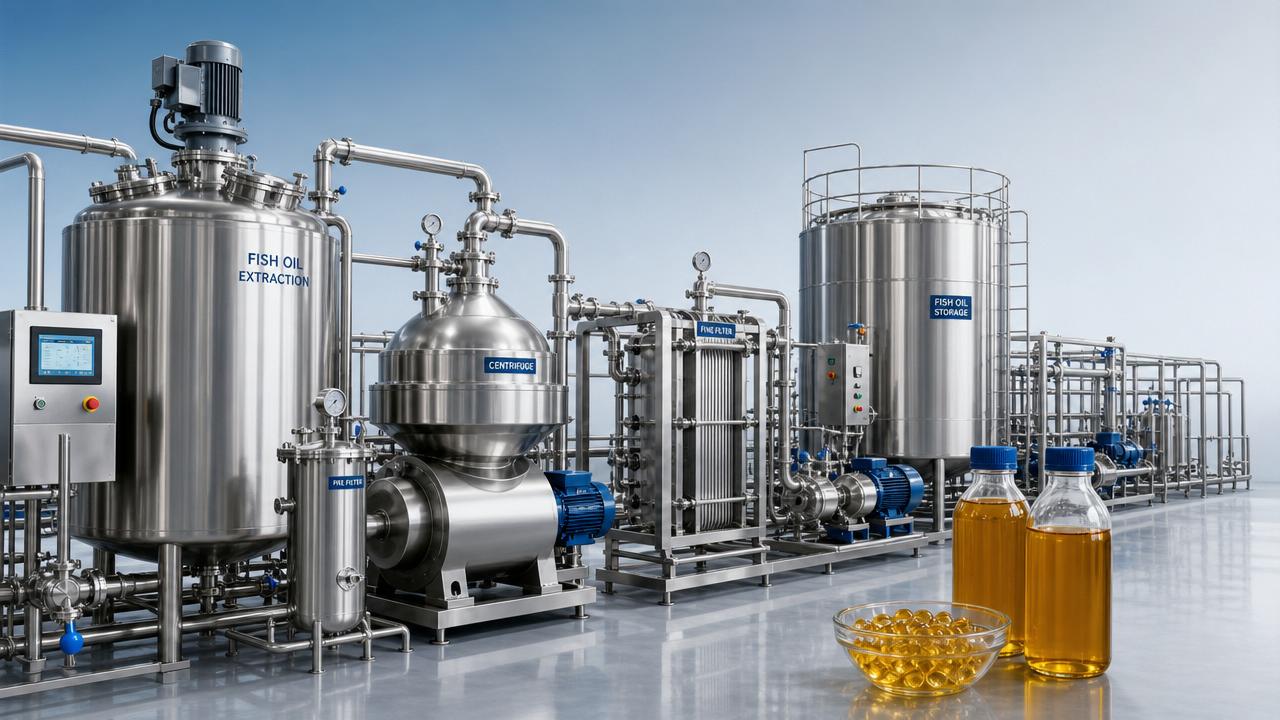
A fish oil extraction machine may use cooking and pressing, centrifugation, enzymatic processing, solvent extraction, or hybrid systems.
Mechanical pressing is often simpler and easier to maintain.
It can be suitable for basic fish meal and crude fish oil production.
Centrifugal separation improves oil clarity and can reduce impurity levels.
It usually adds cost through precision rotating parts and tighter maintenance needs.
Enzymatic extraction may support higher nutritional quality and milder processing conditions.
Yet enzyme cost, temperature control, and process validation must be included in the budget.
Solvent-based systems may achieve strong yield performance but require strict safety and environmental controls.
The best fish oil extraction machine is not defined by technology alone.
It should match product grade, regulatory requirements, raw material characteristics, and operating skill level.
Why Do Materials and Fabrication Standards Matter?
Fish oil processing involves heat, moisture, salt, organic residue, and frequent cleaning.
These conditions can accelerate corrosion if materials are poorly selected.
Food-contact components should normally use suitable stainless steel, commonly 304 or 316 depending on process exposure.
A fish oil extraction machine built with thinner steel may cost less initially.
But it may deform, leak, or require earlier replacement under heavy industrial use.
Welding quality, surface finish, sealing design, and cleanability should be examined carefully.
Poor welds can trap residue and increase contamination risk.
From a technical benchmarking perspective, fabrication quality should be reviewed like any precision manufacturing process.
Clear tolerances, inspection records, and material certificates improve purchasing confidence.
A durable fish oil extraction machine reduces unplanned maintenance and protects product consistency.
How Much Do Automation and Control Systems Add?
Automation can increase upfront cost, but it may lower labor demand and improve repeatability.
A basic fish oil extraction machine may use manual valves, simple temperature controls, and local switches.
Advanced systems may include PLC controls, touchscreens, sensors, data logging, and alarm functions.
Automation becomes more valuable when quality targets are strict or production runs are long.
It can control cooking temperature, pressing pressure, centrifuge speed, residence time, and cleaning cycles.
Better control helps protect omega-3 content and reduce oxidation risk during processing.
However, automation should not be purchased blindly.
Spare parts availability, software language, electrical standards, and remote support should be verified.
An automated fish oil extraction machine also needs trained operators and clear maintenance routines.
What Operating Costs Should Be Calculated Before Purchase?
Operating cost determines whether an attractive purchase price remains economical over several years.
Energy consumption is especially important because fish oil extraction often needs heating, pressing, pumping, and separation.
Steam, electricity, water, compressed air, and cleaning chemicals should be included in the cost model.
A fish oil extraction machine with heat recovery may cost more but reduce utility expenses.
Consumables also matter.
Filters, seals, bearings, gaskets, enzymes, solvents, and lubricants can add recurring cost.
Downtime is another hidden expense.
If critical spare parts are hard to source, production losses may exceed the savings from a cheaper machine.
A practical cost review should compare at least three years of ownership.
Cost Comparison Table
Which Compliance and Quality Requirements Influence Price?
Compliance requirements can add engineering cost, documentation work, and inspection steps.
A fish oil extraction machine for food, nutraceutical, or pharmaceutical-adjacent use may need stricter sanitary design.
Relevant requirements may include food-contact material rules, HACCP planning, CE marking, GMP expectations, or local safety codes.
Electrical compliance is also important when equipment crosses borders.
Voltage, frequency, grounding, control cabinet design, and emergency-stop systems must match the installation environment.
Documentation should include manuals, maintenance schedules, certificates, wiring diagrams, and commissioning reports.
For high-value oil products, traceability and process records support quality audits.
A compliant fish oil extraction machine may appear more expensive at first.
Yet it can reduce approval delays, product rejection, and retrofit expenses.
What Supplier Risks Can Increase Total Cost?
Supplier capability affects delivery, installation success, and long-term equipment performance.
A fish oil extraction machine should be evaluated through technical evidence, not only catalog descriptions.
Request case references, test videos, factory inspection records, and sample processing results where possible.
Check whether the supplier understands fish species, by-product handling, moisture variation, and oil oxidation control.
After-sales support is equally important.
Warranty length, spare parts lead time, installation guidance, and troubleshooting response should be written into the agreement.
SiliconCore Metrics approaches equipment assessment through independent benchmarking and data transparency.
The same discipline used in electronics supply-chain evaluation applies to industrial equipment decisions.
Measured performance, material proof, process stability, and lifecycle support should outweigh unsupported claims.
FAQ: Quick Answers Before Comparing Options
Conclusion: How to Make a Confident Cost Decision
A fish oil extraction machine should be assessed through total cost, not only purchase price.
Capacity, technology, fabrication quality, automation, utilities, compliance, and service all influence real value.
Before comparing offers, build a checklist with measurable specifications and operating assumptions.
Ask suppliers to confirm the same scope, performance data, warranty terms, and spare parts plan.
This approach makes the fish oil extraction machine decision clearer, more auditable, and easier to defend.
For stronger evaluation, request technical documentation, lifecycle cost estimates, and verified performance references before final selection.
Recommended News
- HDI TechnologyHow to vet PCB suppliers in a directory before requesting quotesPCB suppliers directory guide: learn how to verify capabilities, certifications, traceability, and quote assumptions before selecting a reliable PCB partner.
- HDI TechnologyHow UAE engineering data repositories improve design traceabilityEngineering data repository UAE solutions strengthen design traceability by linking requirements, revisions, supplier evidence, and manufacturing data. Explore practical ways to reduce risk and accelerate releases.
- HDI TechnologyHow to verify UL recognition for printed circuit boardsPrinted circuit boards UL verification made clear: learn how to check UL marks, file numbers, factory scope, stack-ups, and traceability for audit-ready compliance.
- HDI TechnologyMulti layer PCB design guide for controlling signal crosstalkMulti layer PCB design guide for controlling signal crosstalk with stackup, spacing, return-path, and validation strategies for reliable high-density boards.
- HDI TechnologyHow tighter manufacturing tolerances change HDI PCB pricesMicro tolerance manufacturing price explained: see how tighter HDI PCB tolerances affect yield, inspection, supplier options, and sourcing costs.
- HDI TechnologyHow automotive PCB impedance control prevents signal failuresAutomotive PCB impedance control prevents reflections, noise, and timing errors in ADAS, EV, and infotainment systems. Learn how to build reliable signal paths.