
Enclosed Belt Conveyor Safety: Key Design Checks
DETAILS
An enclosed belt conveyor can improve dust control, product protection, and operational efficiency, but only when safety-critical design details are verified early.
Across modern industrial plants, the risk is shifting from visible machinery hazards to hidden access, guarding, inspection, and maintenance weaknesses.
This change matters in food, electronics, chemicals, mining, recycling, and precision manufacturing, where uptime and contamination control now move together.
Why Enclosed Belt Conveyor Safety Is Becoming a Higher Priority
The enclosed belt conveyor is no longer viewed only as a dust-control upgrade or cleaner material transfer option.
It is increasingly assessed as a safety system that must manage moving parts, access behavior, confined spaces, and cleaning routines.
This shift reflects stronger regulatory attention, tighter environmental expectations, and rising pressure to reduce unplanned stoppages.
In high-reliability operations, one unguarded nip point can create a severe incident and stop an entire production line.
A poorly designed enclosed belt conveyor can also trap residue, hide belt damage, or make safe inspection unnecessarily difficult.
For semiconductor and EMS-linked facilities, material handling reliability supports traceability, cleanliness, and stable process control.
Even when conveyors handle packaging, powders, trays, waste, or bulk media, safety design affects downstream quality risk.
Trend Signals: Safer Conveyors Are Moving Toward Verifiable Design
Several signals show that enclosed belt conveyor safety is becoming more data-driven and audit-oriented.
First, inspections increasingly focus on how workers actually interact with covers, doors, tools, and emergency stops.
Second, digital maintenance records are making recurring faults easier to identify across equipment families.
Third, buyers expect machinery documentation to show compliance evidence, not only general declarations or brochure claims.
The enclosed belt conveyor market is therefore moving toward measurable design checks, repeatable audits, and lifecycle safety reviews.
Forces Driving Better Enclosed Belt Conveyor Design
The forces behind safer conveyor design are practical, not theoretical.
Facilities need cleaner production, lower dust escape, better energy use, and reduced manual intervention.
However, each improvement can create a new hazard if design validation is weak.
- Dust containment: An enclosed belt conveyor reduces airborne particles, but accumulated dust can create fire or sanitation risks.
- Product protection: Covered transfer protects material, but inspection visibility can become limited.
- Labor efficiency: Fewer manual transfers reduce handling, but maintenance tasks may become more concentrated.
- Automation growth: Sensor-based monitoring improves uptime, but false alarms can normalize unsafe bypass behavior.
- Regulatory scrutiny: Guarding, lockout, and access documentation must match real equipment conditions.
These drivers make the enclosed belt conveyor a strategic design choice rather than a simple mechanical purchase.
Guarding Gaps Remain the First Design Check
Guarding is the most visible safety layer, yet it is often weakened by small installation details.
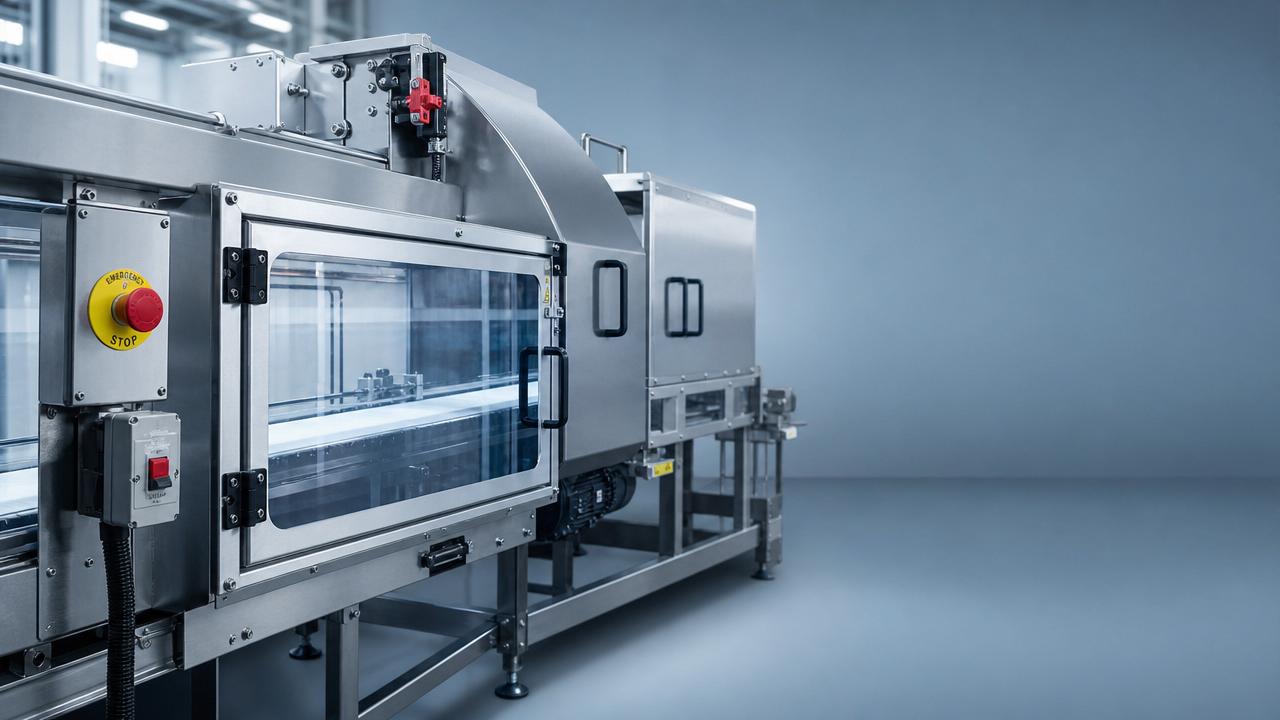
An enclosed belt conveyor should prevent access to nip points, pulleys, return rollers, and moving belt edges.
The check should include all normal and abnormal operating positions, not only the front inspection side.
Common failures include oversized openings, removable panels without tools, and gaps created around supports or transitions.
Special attention is needed near loading zones, discharge chutes, belt cleaners, take-up units, and transfer interfaces.
If the enclosed belt conveyor connects to upstream or downstream machines, interface guarding must be reviewed as one system.
Practical guarding questions
- Can fingers, tools, or clothing reach moving parts during operation?
- Are guards secure after vibration, cleaning, and repeated removal?
- Do openings meet applicable machine guarding distance requirements?
- Are return-side hazards guarded as carefully as feed-side hazards?
Access Doors Need More Than Convenient Placement
Inspection doors are necessary, but they can become the weakest point in an enclosed belt conveyor.
A door placed for convenience may expose moving components or encourage inspection while the belt is running.
Doors should be positioned where safe viewing, cleaning, and tool movement are possible without awkward body posture.
Where exposure to moving parts exists, interlocked access should be considered and verified during commissioning.
An enclosed belt conveyor with many access points needs clear labeling, consistent fasteners, and documented inspection status.
Fasteners should resist loss, corrosion, and repeated handling, especially in washdown or dusty environments.
Emergency Stops Must Match Real Walking Routes
Emergency stop design is not just about device quantity.
It is about whether an emergency stop can be reached quickly from predictable work positions.
An enclosed belt conveyor may run through long galleries, elevated structures, or tight service corridors.
Each layout changes the required emergency stop spacing, visibility, and reset procedure.
Pull cords, mushroom buttons, and local isolation points should be selected according to route geometry.
The enclosed belt conveyor should stop safely without creating uncontrolled material discharge or downstream blockage.
Reset logic should prevent unexpected restart after a stop, access event, or power interruption.
Dust, Fire, and Contamination Risks Are Converging
Enclosure improves containment, but containment can also concentrate combustible dust, vapors, heat, and contamination.
This is why an enclosed belt conveyor requires review beyond ordinary mechanical guarding.
Material properties should guide sealing strategy, ventilation, grounding, belt selection, and cleaning frequency.
For powders, fines, biomass, chemicals, and packaging residues, ignition source control deserves special attention.
For electronics and precision manufacturing, particles, oils, and static behavior can affect quality outcomes.
The enclosed belt conveyor should therefore be reviewed as both a safety asset and contamination-control boundary.
- Check whether dust can accumulate on ledges, rollers, seals, or return areas.
- Confirm that cleaning tools can reach expected buildup zones.
- Verify grounding and bonding where static charge may develop.
- Review belt materials for flame, chemical, and abrasion resistance.
Maintenance Design Determines Long-Term Safety Performance
Many conveyor incidents occur during cleaning, adjustment, inspection, or jam removal.
For that reason, maintainability is a core safety design requirement.
An enclosed belt conveyor should allow belt tracking checks, tension adjustment, roller replacement, and cleaning without unsafe improvisation.
If routine work requires climbing, reaching over guards, or removing multiple heavy panels, risk increases.
Designers should reduce tool variety, clarify lockout points, and provide stable access around predictable service zones.
The enclosed belt conveyor should include documented maintenance steps that match installed conditions.
Instructions must explain residual energy, stored tension, pinch zones, and safe restart checks.
Impacts Across Operations, Quality, and Compliance
Safety design decisions influence more than incident prevention.
A well-specified enclosed belt conveyor can improve uptime by reducing jams, cleanup delays, and premature component wear.
It can also support quality systems by keeping contaminants inside or outside defined process boundaries.
In audited supply chains, documentation quality matters as much as mechanical performance.
Equipment files should include risk assessments, drawings, interlock tests, guarding checks, and maintenance records.
For benchmark-driven organizations, these records turn an enclosed belt conveyor into a traceable operating asset.
- Operations gain fewer stoppages and more predictable cleaning windows.
- Quality teams gain better contamination and foreign-object control.
- Safety programs gain clearer evidence for inspections and corrective actions.
- Engineering teams gain feedback for future equipment specifications.
Key Design Checks to Prioritize Before Installation
Before commissioning, the enclosed belt conveyor should pass a structured design review.
The review should include drawings, actual installation layout, control logic, access routes, and material characteristics.
Audit Focus Areas After the Conveyor Enters Service
A safe installation can degrade as panels are removed, seals wear, and procedures change.
Routine audits should compare the installed enclosed belt conveyor with the original safety intent.
Look for missing fasteners, damaged guards, bypassed interlocks, unreadable labels, and undocumented repairs.
Also review whether repeated jams or cleaning delays are pushing teams toward unsafe shortcuts.
Trend maintenance data can reveal weak points before they become incidents or compliance findings.
- Inspect all guards and access covers for fit, damage, and secure fastening.
- Test emergency stops and confirm reset behavior under controlled conditions.
- Verify that lockout points remain labeled and physically accessible.
- Check dust, residue, and belt wear patterns near hidden areas.
- Update procedures when equipment modifications or process materials change.
How to Judge the Next Upgrade Decision
Future conveyor decisions should balance safety, cleanability, uptime, and lifecycle evidence.
An enclosed belt conveyor should not be selected only because it hides dust or looks organized.
It should be selected because its enclosure, controls, and maintenance design reduce measurable risk.
The strongest upgrade plans treat the enclosed belt conveyor as part of a larger reliability and compliance system.
Action Steps for Safer Material Handling
Start with a gap review of each enclosed belt conveyor already operating on site.
Map access points, guarding edges, emergency stops, lockout devices, cleaning routes, and known fault locations.
Then compare those findings against incident data, maintenance work orders, and audit observations.
For new projects, include safety, quality, operations, and maintenance requirements before the layout is frozen.
This prevents late redesign and supports a more reliable enclosed belt conveyor installation.
SiliconCore Metrics supports data-driven engineering decisions through independent benchmarking, technical analysis, and structured compliance insight.
Use documented design checks, verified field observations, and repeatable audit records to make conveyor safety measurable.
A safer enclosed belt conveyor is not defined by the cover alone, but by every verified detail behind it.
Recommended News
- HDI TechnologyHow to vet PCB suppliers in a directory before requesting quotesPCB suppliers directory guide: learn how to verify capabilities, certifications, traceability, and quote assumptions before selecting a reliable PCB partner.
- HDI TechnologyHow UAE engineering data repositories improve design traceabilityEngineering data repository UAE solutions strengthen design traceability by linking requirements, revisions, supplier evidence, and manufacturing data. Explore practical ways to reduce risk and accelerate releases.
- HDI TechnologyHow to verify UL recognition for printed circuit boardsPrinted circuit boards UL verification made clear: learn how to check UL marks, file numbers, factory scope, stack-ups, and traceability for audit-ready compliance.
- HDI TechnologyMulti layer PCB design guide for controlling signal crosstalkMulti layer PCB design guide for controlling signal crosstalk with stackup, spacing, return-path, and validation strategies for reliable high-density boards.
- HDI TechnologyHow tighter manufacturing tolerances change HDI PCB pricesMicro tolerance manufacturing price explained: see how tighter HDI PCB tolerances affect yield, inspection, supplier options, and sourcing costs.
- HDI TechnologyHow automotive PCB impedance control prevents signal failuresAutomotive PCB impedance control prevents reflections, noise, and timing errors in ADAS, EV, and infotainment systems. Learn how to build reliable signal paths.