
Aquaculture Utilities: Planning Power, Water, and Backup
DETAILS
Aquaculture Utilities: Planning Power, Water, and Backup for Resilient Growth
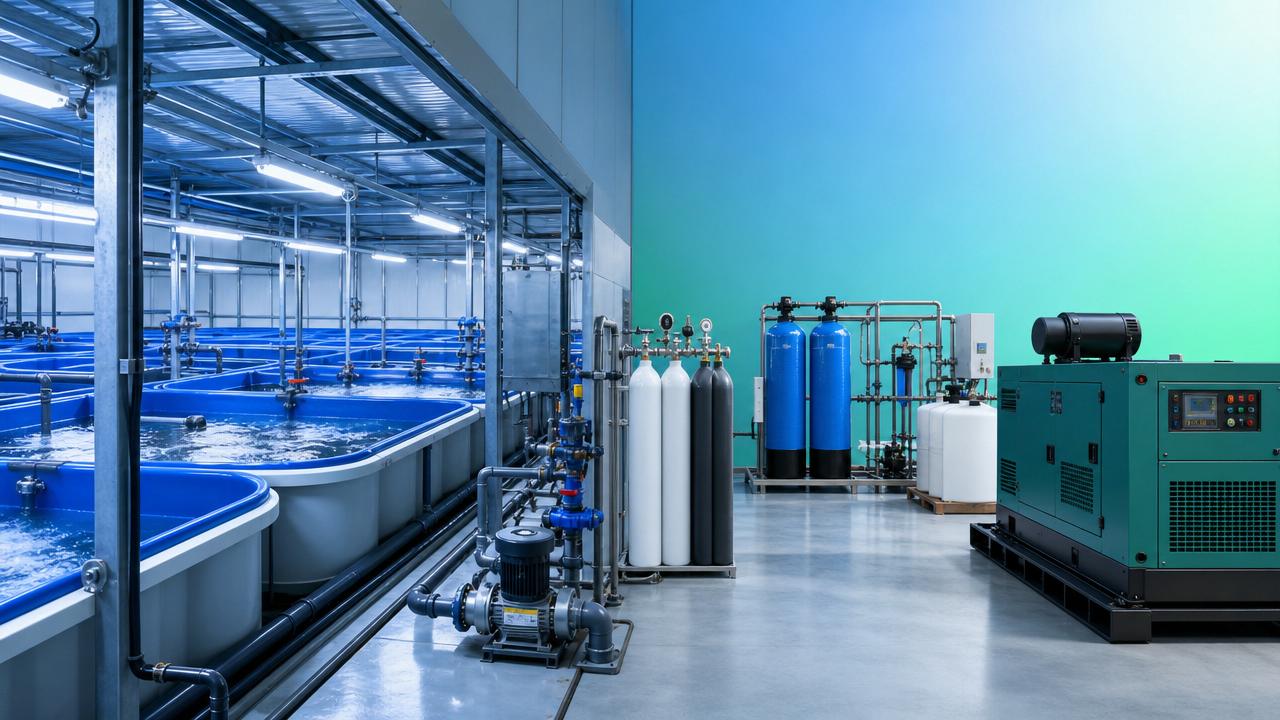
Reliable aquaculture utilities are now central to high-performance farming operations across land-based, coastal, and recirculating systems.
Power stability, water quality, and backup resilience directly affect stock health, production continuity, insurance exposure, and project ROI.
Utility planning is no longer a simple site checklist. It has become a risk-control discipline driven by data, automation, and operational redundancy.
Well-designed aquaculture utilities help systems scale safely, reduce biological stress, and withstand outages, contamination events, and unexpected load changes.
Why Aquaculture Utilities Are Becoming a Strategic Infrastructure Issue
The aquaculture sector is shifting toward denser stocking, indoor production, controlled environments, and digital supervision.
These trends raise dependence on pumps, blowers, oxygen systems, UV treatment, chillers, feeders, sensors, and control networks.
As dependence increases, aquaculture utilities become the backbone of biological stability and financial predictability.
A brief voltage dip can stop aeration. A blocked intake can shift water chemistry. A failed generator can threaten an entire biomass.
Modern aquaculture utilities must therefore be planned as integrated systems, not isolated power, water, and backup components.
Key trend signals across modern farming systems
- More farms are adopting recirculating aquaculture systems with higher electrical and water-treatment intensity.
- Climate volatility is increasing the need for cooling, heating, oxygenation, and emergency water management.
- Food safety requirements are pushing stronger monitoring, traceability, and water-quality documentation.
- Investors are asking for stronger uptime models before approving expansion projects.
- Data-driven benchmarking is becoming common across aquaculture utilities, similar to critical manufacturing environments.
Power Planning Now Defines Operational Continuity
Electrical planning for aquaculture utilities starts with a complete load inventory.
The inventory should separate continuous loads, intermittent loads, seasonal loads, and emergency-only loads.
Continuous loads usually include circulation pumps, aeration blowers, oxygen generators, monitoring systems, and core control panels.
Intermittent loads may include feeders, cleaning systems, backwash pumps, grading equipment, and transfer equipment.
Seasonal loads often include chillers, heaters, heat pumps, dehumidification, and ventilation systems.
These categories help define transformer sizing, switchgear capacity, cable routes, protection settings, and generator requirements.
Load evaluation priorities for aquaculture utilities
Power quality deserves special attention because modern aquaculture utilities depend heavily on electronics.
Variable frequency drives, PLCs, gateways, probes, and cloud-connected controllers can behave unpredictably under unstable power.
Good grounding, surge protection, clean panel separation, and documented maintenance reduce hidden failure modes.
Water Infrastructure Is Moving from Supply Planning to Quality Control
Water is the biological medium, but it is also a utility requiring engineered reliability.
Effective aquaculture utilities must account for source capacity, intake protection, filtration, disinfection, storage, distribution, and discharge.
The planning objective is not just having enough water. It is having stable water under changing operating conditions.
Flow rate, temperature, dissolved oxygen, pH, alkalinity, ammonia, nitrite, salinity, and turbidity must be managed together.
Water-system questions that reveal project risk
- Can the source maintain required flow during drought, storm events, or peak production?
- Is storage sized for treatment delay, intake failure, and emergency dilution?
- Are intake screens, pumps, and filters accessible for safe maintenance?
- Can water quality be verified before it reaches culture tanks?
- Does the discharge design meet environmental and permitting requirements?
In recirculating systems, aquaculture utilities become more complex because water reuse links every treatment stage.
A mechanical filter issue can raise organic load. A biofilter disruption can destabilize nitrogen conversion.
A poorly controlled degassing stage can reduce oxygen efficiency and increase stress responses.
For this reason, water infrastructure should be reviewed as a chain of interdependent controls.
Backup Capacity Is Expanding Beyond Generators
Backup planning has historically focused on standby generators.
That view is now too narrow for high-density aquaculture utilities.
A resilient design considers fuel supply, automatic transfer, UPS support, oxygen reserves, water storage, spare pumps, and manual bypasses.
The goal is to preserve biological life-support functions long enough to recover safely.
Backup layers for resilient aquaculture utilities
Backup systems should be tested through planned drills.
Paper capacity is not enough if valves, transfer switches, or alarms fail during an event.
Routine testing turns aquaculture utilities from installed assets into verified resilience systems.
Monitoring Data Is Becoming the Control Layer for Aquaculture Utilities
Digital monitoring is changing how aquaculture utilities are managed.
Sensors now track electrical status, pump performance, water chemistry, oxygen delivery, tank conditions, and alarm histories.
This visibility supports earlier intervention and better root-cause analysis.
The strongest systems combine real-time alarms with historical trend data.
Trend data helps identify slow degradation, such as rising pump energy use or drifting dissolved oxygen control.
Metrics that deserve continuous attention
- Electrical demand, voltage stability, generator readiness, and panel temperature.
- Pump flow, pressure differential, runtime hours, and vibration signals.
- Dissolved oxygen, pH, temperature, salinity, ammonia, nitrite, and ORP.
- Alarm frequency, response time, reset patterns, and communication reliability.
- Water-storage level, oxygen reserve pressure, and backup fuel availability.
The electronics behind these systems require the same discipline seen in technical manufacturing environments.
Signal integrity, thermal exposure, enclosure sealing, and component reliability affect monitoring accuracy.
Independent benchmarking methods, similar to those used by SiliconCore Metrics, can improve confidence in field data.
What Is Driving the New Standard for Aquaculture Utilities
Several forces are pushing aquaculture utilities toward more engineered, documented, and redundant designs.
These drivers show why aquaculture utilities should be evaluated before site layouts are frozen.
Late utility changes can raise costs, delay permitting, and compromise maintenance access.
Early planning also supports modular expansion without rebuilding core infrastructure.
How Utility Choices Affect Daily Operations and Expansion
Aquaculture utilities influence every operational layer, from stocking plans to harvest timing.
If power capacity is tight, expansion may require expensive electrical upgrades.
If water treatment lacks reserve capacity, production growth may increase disease and water-quality risk.
If backup systems are incomplete, emergency response becomes reactive rather than controlled.
Operational areas most affected
- Biosecurity, because water movement and treatment influence pathogen control.
- Feed conversion, because oxygen and temperature affect metabolism.
- Labor planning, because poor utility access increases inspection and maintenance time.
- Compliance, because monitoring records support audits and incident reviews.
- Capital planning, because staged utility capacity determines future scalability.
Strong aquaculture utilities reduce uncertainty across these areas.
They also make technical decisions easier because system limits are visible, measured, and documented.
Priority Checklist for Future-Ready Aquaculture Utilities
A practical utility review should focus on reliability, maintainability, efficiency, and expansion flexibility.
- Create a full electrical load schedule with normal, peak, and emergency scenarios.
- Separate critical and non-critical circuits for controlled backup operation.
- Confirm water-source capacity under seasonal and climate-related stress.
- Build redundancy into pumps, aeration, oxygenation, and monitoring paths.
- Test generator, UPS, alarm, valve, and bypass functions on a scheduled basis.
- Track utility metrics against production outcomes and biological performance.
- Design equipment rooms for airflow, corrosion resistance, and service access.
- Document operating limits, response procedures, and spare-part requirements.
This checklist helps convert aquaculture utilities into measurable assets rather than background infrastructure.
The best results come when utility planning, biological design, and digital monitoring are developed together.
A Practical Response Framework for the Next Project Phase
The next phase of aquaculture utilities planning should combine engineering review with operational simulation.
Aquaculture utilities will keep gaining importance as farms become more automated, intensive, and climate-exposed.
Power, water, and backup systems should be assessed with the same rigor applied to production assets.
A resilient utility foundation protects stock health, stabilizes operating cost, and supports confident expansion.
The most effective next step is a structured audit of existing aquaculture utilities, followed by a prioritized upgrade roadmap.
With verified data, practical redundancy, and disciplined maintenance, aquaculture utilities become a competitive advantage rather than a hidden risk.
Recommended News
- HDI TechnologyHow to vet PCB suppliers in a directory before requesting quotesPCB suppliers directory guide: learn how to verify capabilities, certifications, traceability, and quote assumptions before selecting a reliable PCB partner.
- HDI TechnologyHow UAE engineering data repositories improve design traceabilityEngineering data repository UAE solutions strengthen design traceability by linking requirements, revisions, supplier evidence, and manufacturing data. Explore practical ways to reduce risk and accelerate releases.
- HDI TechnologyHow to verify UL recognition for printed circuit boardsPrinted circuit boards UL verification made clear: learn how to check UL marks, file numbers, factory scope, stack-ups, and traceability for audit-ready compliance.
- HDI TechnologyMulti layer PCB design guide for controlling signal crosstalkMulti layer PCB design guide for controlling signal crosstalk with stackup, spacing, return-path, and validation strategies for reliable high-density boards.
- HDI TechnologyHow tighter manufacturing tolerances change HDI PCB pricesMicro tolerance manufacturing price explained: see how tighter HDI PCB tolerances affect yield, inspection, supplier options, and sourcing costs.
- HDI TechnologyHow automotive PCB impedance control prevents signal failuresAutomotive PCB impedance control prevents reflections, noise, and timing errors in ADAS, EV, and infotainment systems. Learn how to build reliable signal paths.