
High-Performance Capacitors for Pulsed Loads
DETAILS
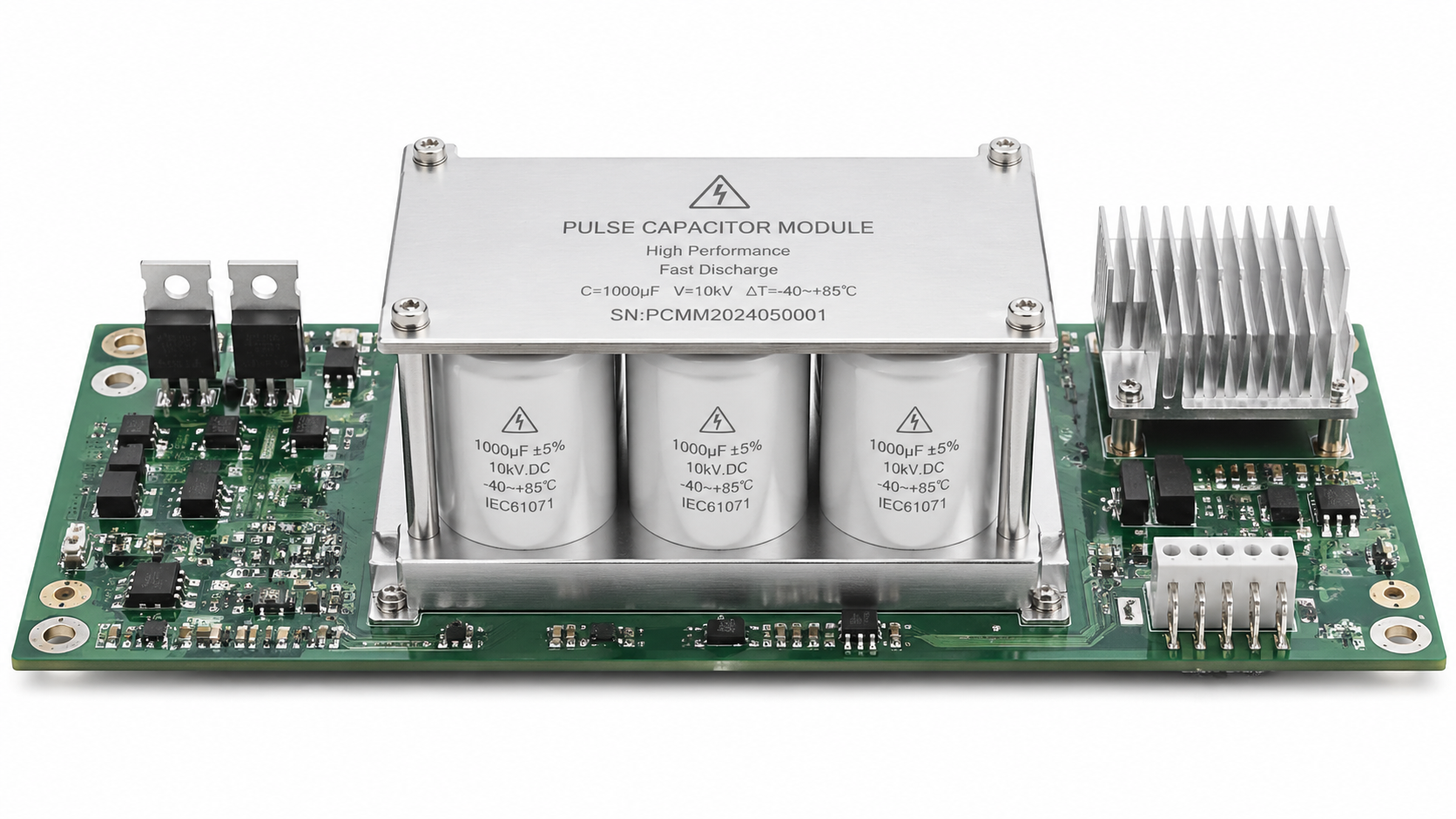
High-performance capacitors are critical circuit components in pulsed-load systems, where thermal stability, fast discharge, and long-term reliability directly affect system safety and efficiency. For engineers, buyers, and quality teams evaluating industrial capacitors and related electronic parts, understanding compliance, circuit board assembly conditions, and thermal management compliance is essential to selecting dependable solutions.
Why pulsed loads place unusual stress on capacitors
Pulsed-load systems do not consume energy in a smooth, predictable way. They draw current in short bursts, often within microseconds to milliseconds, and those bursts can repeat at low, medium, or high duty cycles depending on the application. In industrial power electronics, laser systems, motor drives, telecom backup modules, and test equipment, this pattern creates sharp electrical and thermal stress on capacitors, PCB interconnects, and solder joints.
That is why a capacitor that looks acceptable in a steady-state data sheet review may still fail in a pulsed-load environment. The key issue is not only nominal capacitance. Engineers must also examine ESR, ripple current behavior, voltage derating, pulse repetition frequency, and the thermal path through board assembly and enclosure design. A design margin of 10% may be workable in one system, while another may require 20% to 30% voltage derating and stronger thermal controls.
For procurement teams and financial approvers, the practical challenge is that the lowest unit price rarely reflects the total ownership cost. A capacitor chosen without pulse-specific validation can trigger rework, warranty exposure, delayed acceptance testing, or premature field replacement. In supply chains with 7–15 day prototype windows and 2–4 week qualification cycles, one incorrect part selection can affect project timing across engineering, sourcing, and customer delivery.
SiliconCore Metrics supports this decision process by translating component behavior into measurable evaluation criteria. Instead of treating capacitors as generic catalog items, SCM connects component data with PCB dielectric behavior, SMT placement precision, thermal packaging conditions, and compliance reporting. That matters because pulsed-load reliability depends on the full assembly environment, not only on the capacitor body itself.
What typically changes under pulsed operation?
- Peak current rises rapidly, increasing internal heating and stressing terminations.
- Voltage overshoot and ringing may appear if loop inductance is not tightly controlled.
- Repeated thermal cycling accelerates aging in both dielectric systems and solder interfaces.
- Assembly tolerances, copper balance, and cooling layout become more influential than in static loads.
Which technical parameters matter most in high-performance capacitors for pulsed loads?
When technical evaluators compare high-performance capacitors for pulsed loads, the review should begin with five core dimensions: capacitance stability, ESR, ESL, pulse current capability, and temperature endurance. These are more informative than nominal capacitance alone. In many industrial programs, the first screening step includes 3 categories of checks: electrical fit, assembly fit, and compliance fit.
Electrical fit asks whether the capacitor can charge and discharge within the required timing window without causing excessive heat rise or voltage droop. Assembly fit asks whether package geometry, lead style, pad design, and SMT or through-hole process conditions are compatible with the target board. Compliance fit checks whether the selected part aligns with quality documentation, traceability expectations, and the end-market requirements that may reference IPC-Class 3 or ISO 9001 process discipline.
In pulsed-load designs, ESR is often a decisive variable because it directly affects I²R losses during repetitive discharge events. Low ESR is usually desirable, but it is not the only factor. Excessively focusing on ESR while ignoring ESL, mounting inductance, and thermal path quality can produce misleading results. For fast-edge switching events, parasitic inductance across the capacitor, vias, and planes can dominate actual circuit performance.
Temperature rating should also be interpreted carefully. A capacitor rated for a wide ambient range does not automatically guarantee stable life under pulse heating. Teams should review operating temperature, hotspot behavior, airflow conditions, and neighboring heat sources. In compact power modules, even a local rise of 10°C–25°C above ambient can materially change service life and drift behavior.
Parameter review table for engineering and sourcing teams
The table below summarizes the most practical parameters to evaluate when selecting high-performance capacitors for pulsed loads across design review, sourcing approval, and incoming quality inspection.
This parameter set helps align engineering with procurement. It prevents a common mistake: approving parts using only catalog headline values while ignoring assembly conditions, pulse profile, and field reliability exposure.
Three practical checks before release to production
- Validate pulse waveform and repetition rate under real board conditions, not simulation alone.
- Confirm thermal rise after continuous operation for a representative interval such as 30–60 minutes.
- Review assembly process compatibility, including solder profile, pad geometry, and inspection criteria.
How do capacitor types compare in pulsed-load applications?
Not every high-performance capacitor serves the same pulsed-load task. Film capacitors, ceramic capacitors, aluminum electrolytic capacitors, and polymer-based options each bring different strengths and tradeoffs. The right choice depends on pulse width, stored energy demand, voltage level, board space, expected life, and whether the system prioritizes compactness, cost control, or long-duration cycling stability.
For example, multilayer ceramic capacitors are often preferred for very fast transient suppression because of low ESL and compact footprints. Film capacitors are often chosen for high pulse endurance and stable electrical behavior over time. Aluminum electrolytic capacitors may support bulk energy storage at lower initial cost, but they can require closer attention to temperature, ripple current, and aging. Polymer variants can improve ESR behavior, though application limits still need careful verification.
From a sourcing perspective, the decision is rarely only technical. Buyers must consider lead-time variability, second-source options, lot consistency, and documentation depth. For critical programs, a dual-review process over 2 stages is often useful: first technical screening, then supply chain and compliance screening. SCM’s independent benchmarking approach is valuable here because it helps teams compare not just a component category, but the quality of its manufacturing context.
This matters especially when components are sourced from different Asian manufacturing hubs or integrated into international EMS programs. Small differences in dielectric consistency, plating quality, or packaging robustness can lead to very different field outcomes under pulsed stress.
Comparison table for common capacitor options
The comparison below is intended as a practical selection guide rather than a universal ranking. Actual suitability depends on electrical profile, mechanical constraints, and compliance requirements.
The table shows why no single capacitor family is universally best. In many pulsed-load architectures, engineers combine 2 or 3 capacitor types to balance bulk storage, transient suppression, and lifetime stability.
When mixed capacitor networks make sense
A layered network is often effective when a system needs both fast edge control and sustained energy support. One capacitor handles short transients, another handles medium-band ripple, and a third supports bulk hold-up. This approach can improve pulse response, but it also increases the need for verification of interaction effects, resonance, and placement sequence across the PCB.
What should buyers, quality teams, and project managers check before approval?
For B2B buyers, a good capacitor decision is not just a technical pass-fail outcome. It is a commercial and operational judgment that includes supply continuity, documentation quality, manufacturability, and field service implications. Procurement teams often face 5 key concerns at once: budget limits, tight delivery windows, quality assurance, change-control discipline, and backup source availability.
A practical approval process starts with application mapping. Identify whether the component is intended for pulse smoothing, energy discharge, transient suppression, or hold-up support. Then connect the part to real production variables such as reflow profile, storage conditions, lot traceability, incoming inspection depth, and expected service interval. In many industrial programs, incoming checks are tiered into basic, enhanced, and critical levels depending on risk.
Quality and safety personnel should also request evidence that the capacitor selection has been evaluated in the context of board assembly and thermal packaging. A component may meet catalog limits yet still underperform if copper spreading is poor, spacing is constrained, or the enclosure prevents heat dissipation. SCM’s strength is that it links component selection to measurable manufacturing and reliability conditions, reducing blind spots between design intent and production reality.
For financial approvers, the most useful question is simple: what is the cost of under-specifying this component? A cheaper capacitor may save a small amount at purchase, but if it increases downtime, returns, or replacement labor over 12–24 months, the business case quickly changes.
Procurement checklist for high-performance capacitors
- Confirm voltage derating policy and verify it against actual pulse amplitude, not nominal rail value only.
- Ask for thermal and lifetime information relevant to the intended duty cycle and operating range.
- Review packaging, handling, and assembly sensitivity for SMT or through-hole process compatibility.
- Check traceability documents, change-notice practices, and consistency across lots or alternate sources.
- Align quality inspection depth with end-use criticality, especially for safety-related or mission-critical assemblies.
Evaluation matrix for cross-functional approval
The following matrix helps technical, commercial, and quality stakeholders review capacitor options using the same criteria before volume release.
Used early, this matrix can shorten internal approval cycles and reduce disagreement between engineering, sourcing, and quality teams.
How do standards, assembly conditions, and compliance affect capacitor reliability?
In pulsed-load systems, compliance is not just a paperwork exercise. It influences how confidently a component can be introduced into regulated, high-value, or performance-critical assemblies. While capacitor requirements vary by application, many industrial buyers look for process discipline aligned with standards such as IPC-Class 3 for high-reliability electronics manufacturing and ISO 9001 for quality management systems.
Still, standards alone do not guarantee field success. The assembly environment matters. Board stack-up, dielectric behavior, placement accuracy, solder joint integrity, and thermal packaging all influence whether a capacitor performs as expected under repeated pulse events. A component mounted on a thermally congested board can age faster than the same part mounted in a better-controlled design, even if both are nominally compliant.
This is where SCM’s engineering repository and independent reports add practical value. Teams can use benchmark-style data to compare not only component claims, but also the manufacturing conditions surrounding those claims. That is especially important for global supply chains where design takes place in one region, sourcing in another, and final assembly in an EMS environment with different process capabilities.
A sound review often includes 4 implementation steps: define pulse profile, verify component fit, assess assembly and thermal constraints, then document compliance and incoming inspection criteria. When these steps are separated or rushed, reliability gaps are more likely to appear during pilot build or field operation.
Common compliance-related oversights
- Assuming a certified process automatically validates a specific pulsed-load application.
- Reviewing component documentation without checking PCB and thermal integration details.
- Skipping lot-level traceability or change-notice alignment on critical assemblies.
- Treating prototype success as sufficient proof for long-term repetitive pulse duty.
Why quality teams should care about assembly metrics
Placement precision, solder profile control, and board material consistency are not secondary details. In micro-tolerance environments, they influence parasitic behavior, mechanical stress, and heat flow. That makes independent manufacturing intelligence highly relevant when qualifying high-performance capacitors for mission-critical pulsed loads.
FAQ: practical questions teams ask before selecting high-performance capacitors
How do I choose the right capacitor for a pulsed-load application?
Start with the pulse profile: peak current, pulse width, repetition rate, allowable voltage droop, and thermal environment. Then compare capacitor families against ESR, ESL, ripple tolerance, derating needs, and assembly constraints. A useful method is to review 3 layers at once: electrical behavior, PCB integration, and compliance documentation. If any one layer is weak, the part may still be a risky choice.
Which applications are most sensitive to capacitor pulse performance?
Systems with repetitive charge-discharge events, high-current bursts, or fast transient suppression are especially sensitive. Typical examples include industrial power electronics, telecom support circuits, test equipment, laser drivers, and compact control boards with dense thermal layouts. In these systems, even small parasitic differences across board layout or package selection can change the result.
What are the most common purchasing mistakes?
The most frequent mistakes are selecting by unit price only, relying on nominal capacitance without checking DC bias or pulse behavior, ignoring voltage derating, and failing to verify assembly compatibility. Another common issue is approving a part without confirming lead-time stability or lot traceability, which becomes a serious problem when a production line needs continuity over several quarters.
How long does evaluation usually take?
For many industrial projects, initial screening can be completed within 7–15 days if the electrical profile and documentation are clear. Full review, including board-level validation and cross-functional signoff, often takes 2–4 weeks. More time may be needed when teams require alternate-source comparison, incoming inspection planning, or thermal verification under extended operating cycles.
Why work with SCM when evaluating capacitors for pulsed loads?
Selecting high-performance capacitors for pulsed loads is not only about choosing a component. It is about understanding how that component behaves inside a real manufacturing and operating environment. SCM helps global engineers, sourcing leaders, quality managers, and project owners make that judgment with more confidence by connecting component data to PCB fabrication realities, SMT precision metrics, thermal packaging conditions, and long-term reliability considerations.
This is particularly useful when your team is comparing suppliers across regions, validating an EMS partner, or trying to reduce supply chain risk without sacrificing performance. SCM’s independent whitepapers, standardized compliance reporting, and weekly technical intelligence can support better decisions on component selection, benchmark review, and qualification planning across 5 core sectors, including passive components and thermal packaging.
If your project involves fast discharge circuits, repetitive pulse stress, compact thermal envelopes, or high-reliability electronics, you can engage SCM for targeted support instead of relying on fragmented assumptions. Useful discussion points include parameter confirmation, capacitor type comparison, PCB assembly conditions, compliance expectations, sample evaluation scope, and realistic qualification timelines.
Contact SCM if you need help with capacitor selection for pulsed loads, alternate-source screening, lead-time risk review, board-level reliability questions, or documentation alignment for procurement and quality approval. A focused technical review early in the project can reduce redesign cycles, improve approval speed, and support more reliable sourcing decisions.
- PCB
- PCB fabrication
- passive components
- thermal packaging
- IPC-Class 3
- EMS
- thermal management
- SMT placement
- precision metrics
- ISO 9001
- PCB assembly
- thermal management compliance
- circuit board assembly
- electronic parts
- circuit components
- power electronics
- high-performance
- high-performance capacitors
- industrial capacitors
- heat dissipation
Recommended News
- Precision CapacitorsPrecision capacitors guide to choosing the right tolerancePrecision capacitors guide to choosing the right tolerance: compare dielectric stability, DC-bias effects, temperature drift, and qualification factors for reliable designs.
- Precision CapacitorsHow to verify RoHS compliance for lead free passive componentsLead free passive components: learn how to verify RoHS compliance with part-specific declarations, exemption checks, lot traceability, and targeted testing.
- Precision CapacitorsEU EN 62368-3:2026 Takes Effect for Precision CapacitorsEU EN 62368-3:2026 takes effect for precision capacitors, reshaping EU compliance for AV and IT equipment. Learn Annex D report requirements, thermal runaway risks, and supply chain impacts.
- Precision CapacitorsHow Passive Component Category Intelligence Improves Capacitor Sourcing DecisionsPassive component category intelligence helps buyers make smarter capacitor sourcing decisions by reducing risk, controlling cost, and approving truly usable alternates faster.
- Precision CapacitorsAEC-Q200 Specification: Key Tests and Pass CriteriaAEC Q200 specification explained: discover key tests, pass criteria, and practical evaluation tips to compare passive components, reduce sourcing risk, and improve reliability decisions.
- Precision CapacitorsPassive Component Technology Intelligence: Key Signals for 2026 Sourcing DecisionsPassive component technology intelligence reveals the 2026 sourcing signals that impact reliability, cost, and supply continuity—helping buyers reduce risk and make smarter decisions.