
AEC-Q200 Specification: Key Tests and Pass Criteria
DETAILS
In reliability screening for automotive and other high-stress electronics, the AEC Q200 specification remains a practical baseline for passive component qualification. It matters because field failures rarely come from one dramatic event. More often, they emerge from thermal cycling, moisture exposure, solder stress, vibration, or slow material drift that was missed during sourcing.
That is why the AEC Q200 specification is not just a compliance label. It is a structured way to judge whether resistors, capacitors, inductors, ferrites, and protection components can maintain electrical and mechanical integrity in demanding environments. For organizations comparing suppliers across the semiconductor and EMS chain, it also creates a common language for reliability evidence.
From the perspective of SiliconCore Metrics, independent data matters here. Qualification results only become useful when test conditions, pass criteria, and part-family limits are read carefully, then compared against actual application stress rather than marketing claims.
What the AEC Q200 specification actually covers
The AEC Q200 specification is an Automotive Electronics Council stress-test standard for passive components. Its purpose is to confirm that qualified parts can survive defined environmental, electrical, and mechanical conditions without unacceptable degradation.
It does not certify an entire product design. It qualifies a component family under specific test methods and sample plans. That distinction is important. A passing result supports selection, but it does not replace board-level validation.
The standard is most often applied to:
- Chip resistors and current-sense resistors
- MLCCs and other capacitor types
- Inductors, chokes, and ferrite beads
- Varistors, thermistors, and circuit protection devices
- Special passive technologies used in control, sensing, or power subsystems
In practice, the value of the AEC Q200 specification is strongest when applications face temperature extremes, vibration, moisture, repetitive switching loads, or long service life expectations.
Why the standard receives so much attention
Electronic systems now operate with tighter thermal margins and denser layouts. Passive components that once looked interchangeable can behave very differently under load, solder strain, and aging.
This is especially relevant in power conversion, battery management, ADAS modules, industrial controls, telecom infrastructure, and high-reliability computing. Even outside automotive programs, the AEC Q200 specification is often used as a risk filter.
Another reason is supply chain variability. Similar datasheet ratings do not always imply similar construction, ceramic formulation, electrode design, or process stability. Independent benchmarking, the kind SCM emphasizes across PCB, SMT, active, passive, and thermal packaging sectors, helps expose those differences before qualification gaps become field issues.
Core test groups and what they are meant to reveal
The AEC Q200 specification combines multiple stress categories. Each one looks at a different failure mechanism rather than repeating the same reliability question.
Temperature-related stress
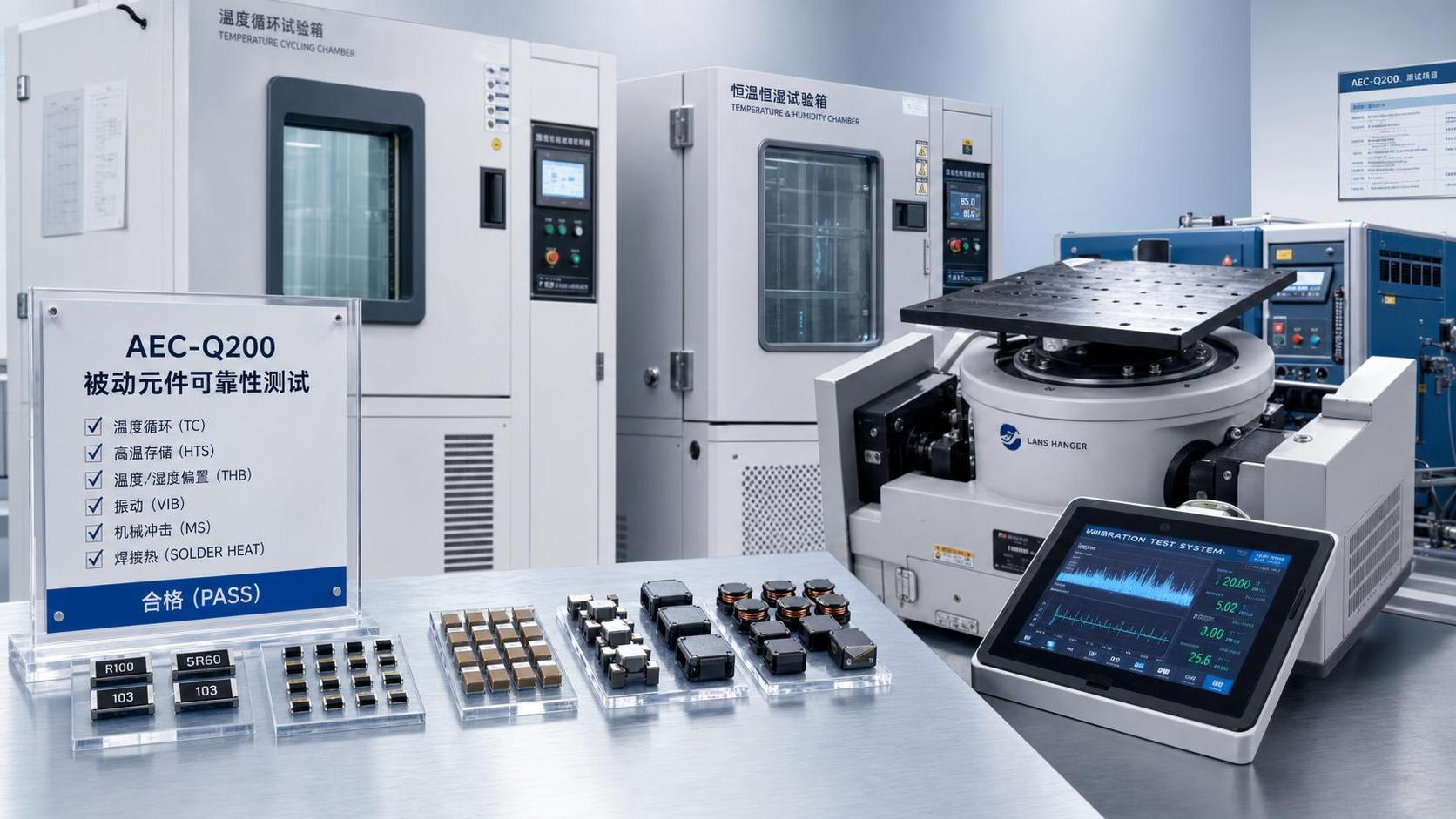
Temperature cycling checks whether repeated expansion and contraction cause cracks, resistance drift, dielectric damage, or termination failure. High-temperature exposure examines long-term stability at elevated storage or operating conditions.
For MLCCs and chip resistors, these tests are often decisive. Small structural differences can lead to large reliability divergence after many cycles.
Moisture and humidity resistance
Humidity bias and moisture resistance tests probe corrosion risk, insulation degradation, and leakage changes. These matter in under-hood assemblies, outdoor electronics, and equipment exposed to condensation or seasonal variation.
A part may pass a basic room-condition check yet fail once moisture accelerates internal material changes. That is why the AEC Q200 specification gives humidity a clear role.
Mechanical robustness
Board flex, mechanical shock, and vibration testing evaluate solder joint resilience and package integrity. These tests are critical for surface-mount passives placed near connectors, heat sinks, or heavy components.
In real assemblies, the weak point is often not nominal electrical rating. It is the interaction between land pattern, placement accuracy, reflow profile, and mechanical stress.
Electrical endurance and overload
Load life, operational life, surge, and short-time overload tests look at parameter stability while the device is electrically stressed. Passives used in power rails, filtering, or transient suppression are especially sensitive here.
These tests help answer a practical question: does the component remain within allowable drift after sustained or abnormal conditions, or does it degrade into a latent failure source?
Solderability and assembly survival
Solderability, resistance to solder heat, and terminal strength focus on manufacturability as much as reliability. A passive that is robust in theory but unstable through assembly is not truly qualified for production use.
This is where AEC Q200 specification data should be read alongside SMT placement capability, reflow control, and board material behavior.
Pass criteria are more than a simple pass or fail
A common mistake is treating AEC Q200 qualification as a binary stamp. The real value lies in the details of the pass criteria and the measured deltas.
Depending on component type, the standard typically looks for limits on:
- Resistance, capacitance, or inductance change
- Dissipation factor or Q variation
- Insulation resistance or leakage performance
- Visual damage, cracking, or delamination
- Solder joint or terminal integrity
- Absence of catastrophic failures in the sample set
The threshold values depend on the device class and test method. That means two components can both be AEC-qualified while showing different margins to failure. For selection work, margin matters more than the label alone.
How to apply AEC Q200 specification data in real evaluations
A useful review starts by matching the test evidence to the actual use case. AEC qualification is broad, but applications are specific.
A compact checklist usually helps:
- Confirm the exact part series, size, dielectric, resistance technology, and terminal finish
- Check whether qualification covers the intended operating temperature range
- Review post-stress parameter shift, not only final pass status
- Look for lot-to-lot consistency and change control history
- Compare assembly conditions with the supplier’s tested solder profile
- Use board-level validation where vibration, flex, or pulse loading is unusually severe
This is also where cross-domain knowledge becomes valuable. SCM’s work on dielectric behavior, placement precision, and thermal stress is relevant because passive reliability often fails at the intersection of material science, assembly quality, and long-term electrical loading.
Where qualification gaps usually appear
Some risk points are easy to miss when reviewing the AEC Q200 specification in isolation. One is family-level qualification. A tested representative may not reflect every case size or value under the same stress.
Another gap is application mismatch. A qualified capacitor may still crack if the PCB bends beyond what the test setup assumed. A resistor may pass overload testing but drift under repetitive pulse patterns unique to the end design.
Documentation quality also matters. Reliable qualification files should clearly show methods, sample counts, revisions, and acceptance limits. Ambiguous declarations reduce the value of the AEC Q200 specification as a sourcing filter.
A practical next step for component decisions
The AEC Q200 specification is most useful when treated as the starting point for disciplined comparison, not the end of analysis. It helps narrow the field, identify likely weak points, and standardize conversations across design, quality, and supply chain teams.
For current programs, the most productive next move is to map each critical passive to its stress environment, then review whether the available AEC Q200 specification data actually matches that condition. If gaps remain, targeted validation, independent benchmarking, and closer review of supplier test reports usually provide better guidance than relying on a checkbox claim alone.
Recommended News
- Precision CapacitorsPrecision capacitors guide to choosing the right tolerancePrecision capacitors guide to choosing the right tolerance: compare dielectric stability, DC-bias effects, temperature drift, and qualification factors for reliable designs.
- Precision CapacitorsHow to verify RoHS compliance for lead free passive componentsLead free passive components: learn how to verify RoHS compliance with part-specific declarations, exemption checks, lot traceability, and targeted testing.
- Precision CapacitorsEU EN 62368-3:2026 Takes Effect for Precision CapacitorsEU EN 62368-3:2026 takes effect for precision capacitors, reshaping EU compliance for AV and IT equipment. Learn Annex D report requirements, thermal runaway risks, and supply chain impacts.
- Precision CapacitorsHow Passive Component Category Intelligence Improves Capacitor Sourcing DecisionsPassive component category intelligence helps buyers make smarter capacitor sourcing decisions by reducing risk, controlling cost, and approving truly usable alternates faster.
- Precision CapacitorsAEC-Q200 Specification: Key Tests and Pass CriteriaAEC Q200 specification explained: discover key tests, pass criteria, and practical evaluation tips to compare passive components, reduce sourcing risk, and improve reliability decisions.
- Precision CapacitorsPassive Component Technology Intelligence: Key Signals for 2026 Sourcing DecisionsPassive component technology intelligence reveals the 2026 sourcing signals that impact reliability, cost, and supply continuity—helping buyers reduce risk and make smarter decisions.