
What R&D Engineers Check First in RF Module Validation
DETAILS
For R&D engineers validating an RF module, the earliest checks often decide project speed, cost, and downstream reliability. A module may look acceptable in simulation, yet fail in the lab because of mismatch, thermal drift, or hidden assembly variation.
In the broader electronics supply chain, these first-pass validation decisions also influence sourcing confidence, compliance reporting, and manufacturability. That is why R&D engineers rely on measurable checkpoints rather than assumptions when reviewing RF performance.
This article explains what R&D engineers check first in RF module validation, how priorities change by application scenario, and which errors most often trigger redesign. It also reflects the data-driven discipline used across semiconductor and EMS environments.
Why the first validation scenario changes the checklist
Not every RF module serves the same operating context. A short-range industrial node, a telecom front end, and a compact consumer device face very different stresses, tolerances, and pass criteria.
R&D engineers therefore begin by identifying the real use case before diving into test data. This step prevents overtesting the wrong risks and missing the failure mode that matters most.
The first scenario decision usually centers on three questions: frequency range, power density, and environmental exposure. Those factors shape what R&D engineers inspect first and what they can defer.
Scenario framing usually starts with these inputs
- Target band, bandwidth, and modulation sensitivity
- Power amplifier load conditions and antenna matching window
- Board stack-up, dielectric stability, and grounding layout
- Thermal envelope during peak duty cycle
- Assembly precision, component tolerances, and compliance requirements
In telecom and high-frequency designs, impedance and return loss come first
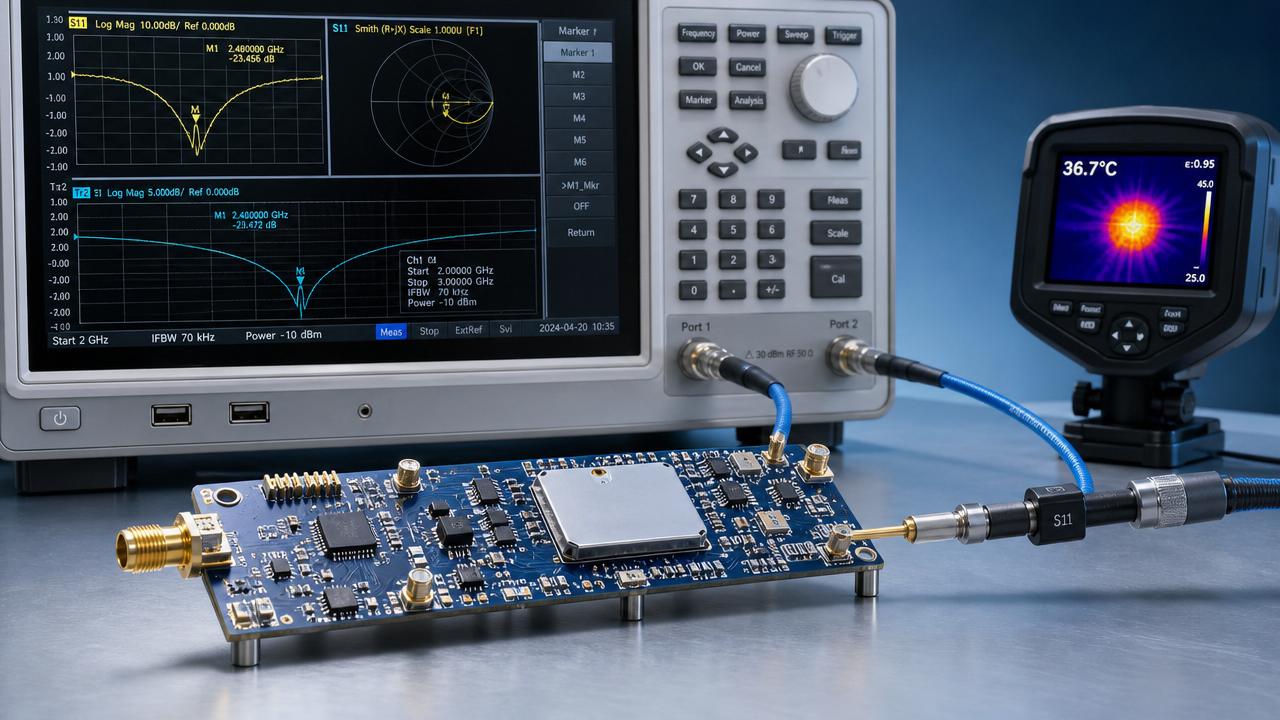
For high-frequency modules, R&D engineers typically start with impedance matching and return loss. If S11 is unstable, every later measurement becomes harder to interpret and less useful.
This scenario is common in network equipment, repeaters, small cells, and advanced wireless boards. Here, small discontinuities in interconnects or stack-up geometry can sharply reduce RF efficiency.
What gets checked first
R&D engineers review vector network analyzer results, trace transitions, connector launch quality, and ground continuity. They compare measured impedance behavior against simulation and fabrication assumptions.
If results drift across frequency, the likely suspects include dielectric constant variation, solder mask effects, via stubs, or parasitic coupling. Early identification avoids expensive iteration at the enclosure stage.
Key decision signals
- S11 and S22 consistency across the target band
- Insertion loss relative to design expectation
- Sensitivity to fixture change or board handling
- Stability after temperature sweep
In compact consumer devices, signal integrity and interference risk rise to the top
When RF modules enter compact products, R&D engineers shift attention toward signal integrity and electromagnetic interference. Space limitations often create coupling risks that are not obvious in standalone module tests.
A module may pass bench validation but degrade after integration near displays, batteries, cameras, or high-speed digital lines. That is why R&D engineers inspect coexistence behavior early.
First checks in dense layouts
R&D engineers examine harmonics, spurious emissions, coupling paths, and clock noise interaction. They also review shielding effectiveness and grounding partition quality inside the final board environment.
Another early checkpoint is detuning caused by nearby plastics, metal frames, and human-hand effects. These practical influences often explain why field performance differs from controlled laboratory data.
Common pass or fail indicators
- Packet loss or throughput drop near digital activity peaks
- Frequency drift after enclosure assembly
- Unexpected emissions around harmonics
- Reduced antenna efficiency in end-use orientation
In industrial and harsh environments, thermal behavior and reliability dominate
For industrial controls, automotive-adjacent electronics, and outdoor systems, R&D engineers prioritize thermal behavior and long-term stability. Passing room-temperature tests alone means very little in these scenarios.
Power cycling, humidity, vibration, and continuous operation can shift gain, noise figure, and output power. R&D engineers therefore validate RF performance under thermal and mechanical stress, not only nominal conditions.
First reliability-focused checkpoints
Junction temperature, hotspot location, thermal resistance path, and derating margin come early. R&D engineers also inspect solder joint fatigue risk and component drift under repeated stress exposure.
Material behavior matters as much as electrical behavior. PCB resin stability, copper balance, and package warpage can all change RF consistency over time.
What R&D engineers want to confirm quickly
- Output power remains stable through thermal cycling
- No excessive drift in gain or noise figure
- Passive components stay within tolerance at extremes
- Assembly quality supports IPC-Class 3 expectations where required
How validation priorities differ across scenarios
The table below shows how R&D engineers shift first-pass validation focus depending on module use conditions. This comparison helps align testing effort with real technical risk.
Practical fit recommendations for faster RF module validation
R&D engineers gain speed when validation plans match the scenario from the beginning. A good plan connects electrical targets, manufacturing assumptions, and reliability thresholds into one review flow.
Recommended actions by fit
- Lock the board stack-up and material specification before correlation testing.
- Use fixture de-embedding so R&D engineers isolate module behavior accurately.
- Run thermal imaging during active RF load, not only during static power tests.
- Check tolerance sensitivity of critical passives across lot variation.
- Validate in the final enclosure whenever nearby materials may detune performance.
- Compare lab data with manufacturing capability metrics before release.
Independent benchmarking is especially useful when multiple PCB, SMT, or component sources are involved. R&D engineers need repeatable data that separates design weakness from supplier process variation.
Frequent misjudgments that delay release
One common mistake is treating a passing room-temperature RF sweep as proof of field readiness. R&D engineers know that drift, coupling, and tolerance stack-up often appear only later.
Another error is checking active performance before confirming passive and interconnect quality. A poor launch, unstable dielectric, or weak ground return can distort all later conclusions.
Some teams also underestimate manufacturing precision. RF modules are highly sensitive to solder volume, placement accuracy, via quality, and layer registration, especially at higher frequencies.
Finally, R&D engineers sometimes validate the module in isolation for too long. Real products introduce thermal, mechanical, and electromagnetic interactions that cannot be ignored.
What to do next when first-pass data is unclear
If early RF module results look inconsistent, the best next step is structured correlation. R&D engineers should compare simulation, fabrication data, assembly metrics, and measured RF behavior side by side.
A disciplined review usually starts with impedance and material assumptions, then moves through interference risks, thermal behavior, and component tolerance. This sequence reduces guesswork and shortens debug time.
For organizations needing stronger technical transparency, SiliconCore Metrics supports evidence-based evaluation through independent benchmarking, compliance-oriented reporting, and manufacturing intelligence across PCB, SMT, semiconductor, passive, and thermal packaging domains.
When R&D engineers focus on the right first checks for the right scenario, RF module validation becomes faster, clearer, and far less vulnerable to late-stage surprises.
Recommended News
- RF ModulesHow to choose wireless communication for battery-powered IoT sensorsChoose wireless communication for IoT sensors with confidence. Compare BLE, Zigbee, LoRaWAN, NB-IoT and LTE-M to balance battery life, coverage and cost. Find your best fit.
- RF ModulesHow PCB layout affects the performance of surface mount RF modulesSurface mount RF modules depend on smart PCB layout. Discover how impedance, grounding, placement, and thermal design affect RF performance—and avoid costly integration errors.
- RF ModulesHow dielectric constant affects impedance stability in RF modulesDielectric constant for RF modules directly affects impedance stability. Learn how Dk variation, stackup control, frequency, and fabrication impact RF performance.
- RF ModulesHow to Choose Low Power Wireless Modules for Battery-Driven DevicesWireless modules low power selection starts with real energy use, not datasheet claims. Learn how to compare RF, protocol fit, battery life, and reliability for smarter device design.
- RF ModulesEU WEEE Rule Takes Effect for Leaded RF ModulesEU WEEE rule now impacts leaded RF modules at import: Bluetooth and Wi-Fi shipments may be blocked without a Pb-exemption code. Learn key compliance steps to avoid customs delays.
- RF ModulesLow Power RF Transmitter Range Limits in Real DeploymentsLow power RF transmitter range depends on antennas, interference, enclosures, and regulations. Learn what really limits field performance and how to plan reliable deployment.