
High Frequency PCB Loss Factors That Affect Signal Integrity
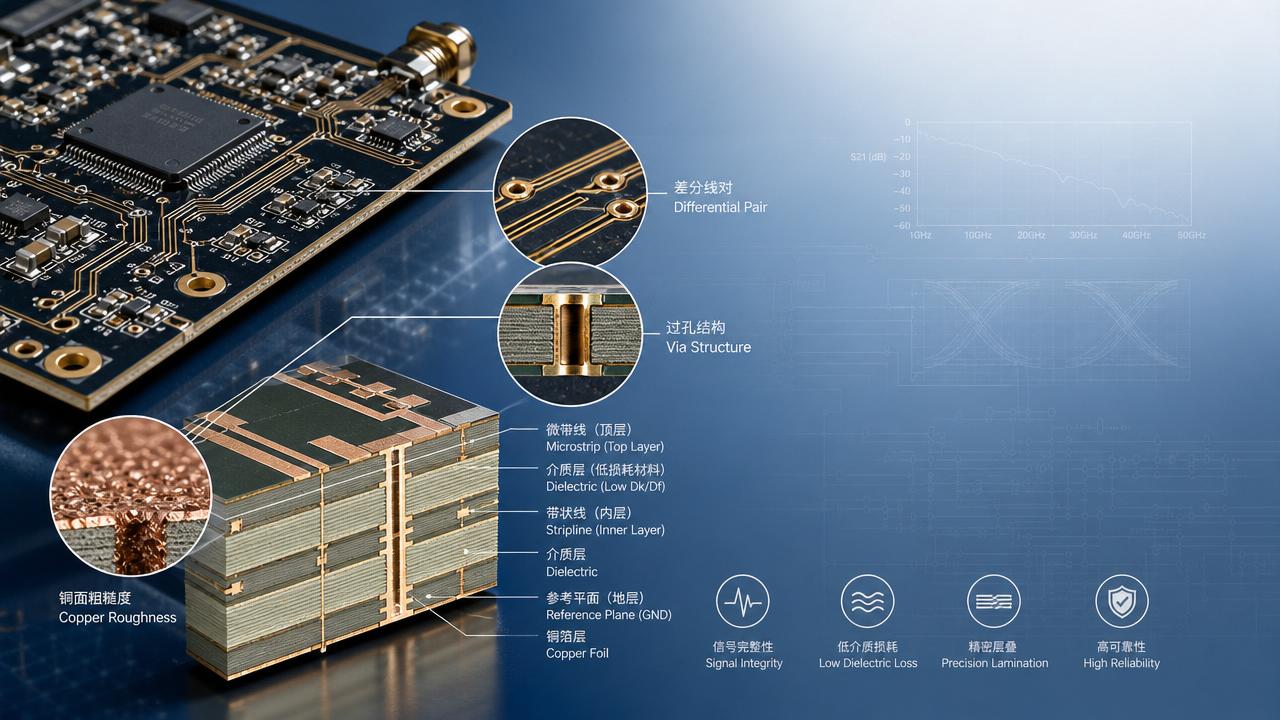
DETAILS
In high-speed electronics, high frequency PCB performance can make or break signal integrity, reliability, and overall system efficiency.
From dielectric loss and copper surface roughness to trace geometry and material selection, many variables shape signal behavior at higher frequencies.
This guide explains the main loss factors in a high frequency PCB, why they matter, and how to reduce avoidable design and manufacturing risks.
What does loss mean in a high frequency PCB?
Loss describes how much signal energy disappears as heat or distortion while traveling through a high frequency PCB structure.
At low frequencies, these losses may seem small. At multi-gigahertz speeds, they quickly become system-level problems.
Two major categories dominate most discussions: conductor loss and dielectric loss.
- Conductor loss comes from current flowing through copper traces and reference planes.
- Dielectric loss comes from energy absorbed by the insulating material between conductors.
- Radiation loss and discontinuity loss also matter in poorly controlled layouts.
In practical terms, excess loss reduces eye opening, weakens amplitude, raises jitter, and worsens timing margins.
For SCM, this is not just a design topic. It is a measurable manufacturing and material compliance issue.
Why does dielectric loss matter so much in high frequency PCB design?
Dielectric loss increases when alternating electric fields polarize the laminate and release part of that energy as heat.
The key parameter is dissipation factor, often called Df or loss tangent.
A lower Df usually means lower insertion loss, especially in longer channels or higher-frequency links.
Another important parameter is dielectric constant, or Dk. It affects impedance, propagation delay, and phase stability.
A high frequency PCB using unstable Dk across frequency or temperature may pass initial tests but fail later margins.
Common dielectric-related risk factors
- Using FR-4 grades without verified high-frequency data.
- Assuming catalog Dk values apply across all test frequencies.
- Ignoring resin content, glass weave, and moisture absorption.
- Mixing stack-up materials without modeling interface behavior.
Loss-sensitive applications often shift toward low-loss hydrocarbon ceramic, PTFE-based, or advanced engineered resin systems.
However, better electrical performance can also change drilling, lamination, and dimensional control behavior.
That is why independent benchmarking matters when evaluating any high frequency PCB material set.
How does copper roughness increase conductor loss?
At higher frequencies, current tends to flow near the conductor surface. This is the skin effect.
When copper is rough, the actual path becomes longer and more resistive than a smooth surface.
That added resistance raises insertion loss in a high frequency PCB channel.
Very rough copper may also complicate impedance prediction because the effective conductor geometry changes.
Where roughness problems often appear
- Very thin traces carrying multi-gigabit differential signals.
- Long backplane or mezzanine interconnect paths.
- Laminates paired with standard electrodeposited copper foils.
- Designs optimized for impedance but not surface profile.
Low-profile and very-low-profile copper can help reduce this effect.
Still, smoother copper is not always the only answer. Adhesion, yield, and process stability must remain acceptable.
SCM often treats copper profile data as essential when comparing high frequency PCB fabrication capability across suppliers.
Which layout factors hurt signal integrity on a high frequency PCB?
Material choice matters, but layout still decides whether theoretical performance becomes real electrical performance.
Even a premium high frequency PCB stack-up can underperform if geometry control is poor.
The most common layout-related loss drivers
- Trace widths drifting from impedance targets.
- Reference plane gaps under critical routes.
- Excessive via transitions and unused via stubs.
- Sharp bends, neck-down sections, and asymmetrical pairs.
- Connector launches that are not field-solver validated.
Return path discontinuity is especially harmful. Signals always need a stable electromagnetic path, not just a copper line.
Differential pairs also require tight spacing consistency. Small spacing changes alter odd-mode impedance and pair balance.
For a high frequency PCB, back-drilling, via optimization, and launch tuning often deliver measurable improvements.
How do manufacturing tolerances affect high frequency PCB loss?
A design may simulate well and still fail in production if tolerances are not realistic.
High frequency PCB performance depends on repeatable control of thickness, etching, plating, registration, and resin flow.
Small dimensional shifts can move impedance enough to change insertion loss and return loss behavior.
Critical process variables
- Dielectric thickness variation across the panel.
- Copper plating nonuniformity inside vias.
- Etch compensation errors on fine traces.
- Glass weave skew affecting differential timing.
- Lamination movement causing layer misregistration.
This is where process data, not just datasheets, becomes important.
SCM’s benchmarking approach aligns with this need by translating technical process capability into comparable decision data.
For channels near margin limits, lot-to-lot consistency can be more important than a single best-case sample result.
How can you choose the right high frequency PCB material and stack-up?
The best choice depends on frequency range, trace length, thermal demands, assembly method, and reliability targets.
No single laminate is always best for every high frequency PCB application.
Use this selection logic
- Define the highest relevant frequency, not just the clock rate.
- Estimate total channel loss budget before locking materials.
- Check Dk and Df over actual operating conditions.
- Match copper profile to insertion loss targets.
- Confirm fabrication compatibility and yield expectations.
- Validate with test coupons or measured S-parameter data.
A lower-cost material may still work for short links or moderate edge rates.
A premium laminate becomes easier to justify when channels are long, dense, and margin-sensitive.
The right high frequency PCB decision balances electrical performance, fabrication stability, and lifecycle reliability.
What mistakes often lead to avoidable loss and rework?
Many failures come from assumptions carried over from standard digital boards.
A high frequency PCB should be treated as a controlled transmission structure from the first stack-up draft.
Frequent mistakes to avoid
- Choosing material by generic brand reputation only.
- Ignoring copper roughness in loss calculations.
- Relying on nominal stack-up values without tolerance analysis.
- Skipping launch design around connectors and packages.
- Assuming simulation models already match production reality.
Testing should also include correlation between simulated and measured results.
That correlation often reveals whether the problem came from material data, geometry, or process variation.
High frequency PCB FAQ and decision table
High frequency PCB loss is never caused by one factor alone.
It emerges from the interaction of laminate properties, copper profile, geometry, transitions, and manufacturing control.
The most reliable path is to combine field-aware design with validated material data and repeatable process capability.
SCM supports that approach through independent benchmarking, technical analysis, and transparent engineering metrics across the electronics supply chain.
If a high frequency PCB program is approaching tighter loss budgets, the next step is clear: verify assumptions with measured data before volume release.
Recommended News
- RF ModulesHow PCB layout affects the performance of surface mount RF modulesSurface mount RF modules depend on smart PCB layout. Discover how impedance, grounding, placement, and thermal design affect RF performance—and avoid costly integration errors.
- RF ModulesHow dielectric constant affects impedance stability in RF modulesDielectric constant for RF modules directly affects impedance stability. Learn how Dk variation, stackup control, frequency, and fabrication impact RF performance.
- RF ModulesHow to Choose Low Power Wireless Modules for Battery-Driven DevicesWireless modules low power selection starts with real energy use, not datasheet claims. Learn how to compare RF, protocol fit, battery life, and reliability for smarter device design.
- RF ModulesEU WEEE Rule Takes Effect for Leaded RF ModulesEU WEEE rule now impacts leaded RF modules at import: Bluetooth and Wi-Fi shipments may be blocked without a Pb-exemption code. Learn key compliance steps to avoid customs delays.
- RF ModulesLow Power RF Transmitter Range Limits in Real DeploymentsLow power RF transmitter range depends on antennas, interference, enclosures, and regulations. Learn what really limits field performance and how to plan reliable deployment.
- RF ModulesRF Transmitter Price Breakdown: What Drives Total CostRF transmitter price depends on more than the quote. Discover how specs, certification, materials, and reliability testing shape total cost and smarter supplier decisions.