
EMI shielding materials compared by durability, cost, and grounding
DETAILS
Choosing the right EMI shielding material means balancing durability, cost, grounding performance, and manufacturability across electronic manufacturing workflows. For engineers, procurement teams, and quality leaders working with PCB assembly, circuit board assembly, reflow soldering, electronic parts, electrical connectors, electrical relays, and relay switches, this comparison highlights how EMI shielding options affect reliability, compliance, and long-term electronic solutions in real-world applications.
In practice, EMI shielding is rarely a single-variable decision. A material that performs well in a 1 GHz to 6 GHz enclosure test may fail under vibration, humidity cycling, or repeated service access. Another option may reduce bill-of-material cost by 15% to 25% but add assembly complexity, grounding uncertainty, or rework risk. That is why technical evaluation should connect laboratory shielding effectiveness with assembly realities, connector interfaces, and long-term maintenance behavior.
For organizations navigating the semiconductor and EMS supply chain, the most useful comparison is not simply “which shield blocks more noise.” The better question is which EMI shielding material fits the required attenuation range, grounding path, service life, production volume, and compliance target without creating hidden quality costs. This article breaks down common options and selection criteria in a way that supports engineering review, sourcing decisions, and cross-functional project planning.
How EMI shielding materials are evaluated in electronics manufacturing
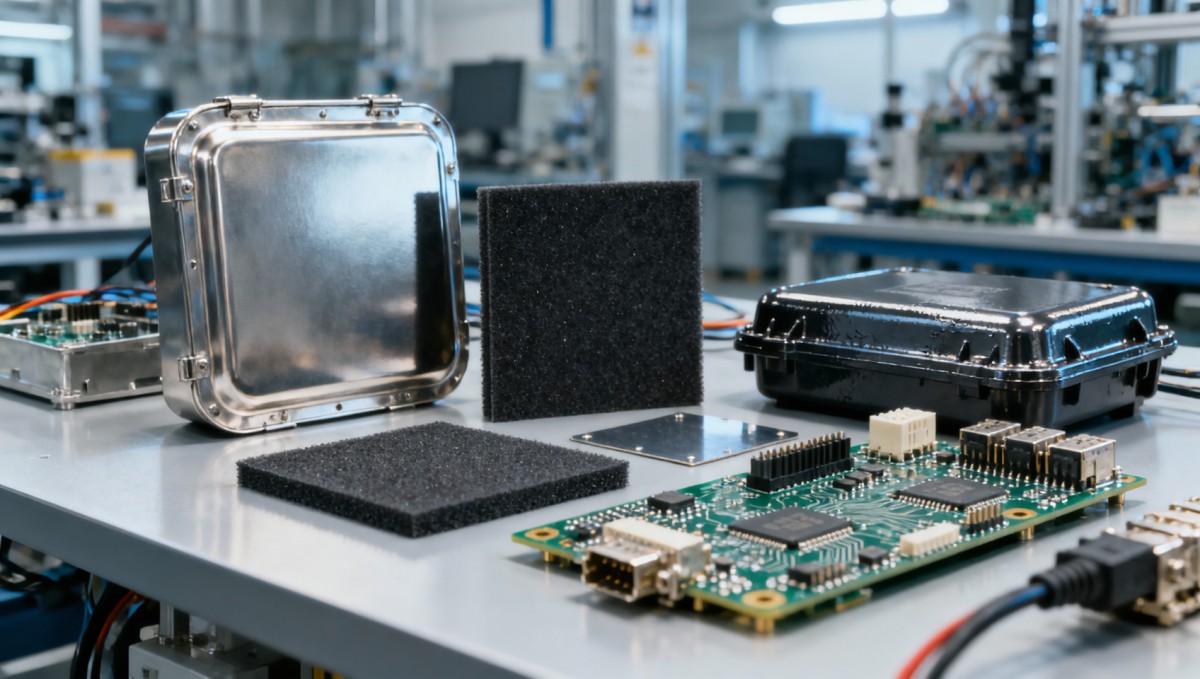
EMI shielding materials are usually compared across 4 primary dimensions: shielding effectiveness, mechanical durability, grounding reliability, and total cost of implementation. In electronics manufacturing, these factors affect not only product performance but also reflow compatibility, enclosure design, connector continuity, and inspection criteria. A material that tests well in isolation may still perform poorly if contact resistance rises after 500 opening-and-closing cycles or after salt mist exposure.
For PCB assembly and circuit board assembly projects, the evaluation window often includes frequencies from several MHz up to 10 GHz, depending on the product category. Industrial control units, relay switch housings, telecom modules, automotive electronics, and compact embedded systems all create different electromagnetic environments. The acceptable solution may vary depending on whether the design requires 40 dB, 60 dB, or more than 80 dB attenuation in a defined frequency band.
Grounding matters just as much as the shielding material itself. Conductive gaskets, metalized fabrics, conductive coatings, and board-level shielding cans can all lose practical value if the mating surfaces are oxidized, poorly compressed, or mechanically unstable. In many field failures, the root cause is not the nominal material spec, but inconsistent grounding pressure, poor fastening torque, or contamination on connector and enclosure interfaces.
Procurement and quality teams should therefore treat EMI shielding as a system-level decision. The review should include at least 6 checkpoints: target attenuation range, mechanical life, grounding method, environmental exposure, assembly process fit, and inspection repeatability. For higher-reliability applications, especially where IPC-Class 3 expectations are relevant, it is useful to compare not only unit price but also replacement intervals, rework rates, and validation burden.
Core criteria used by engineering and sourcing teams
- Shielding effectiveness across the target frequency range, often reviewed in dB at 100 MHz, 1 GHz, and 5 GHz.
- Durability under compression set, abrasion, vibration, thermal cycling, and humidity exposure over 12 to 36 months.
- Grounding stability, including contact resistance, surface oxidation tolerance, and consistency after repeated maintenance access.
- Manufacturing compatibility with SMT assembly, enclosure tolerances, adhesive steps, and inspection methods.
- Total cost, including material price, installation labor, scrap risk, field service, and qualification testing.
Common EMI shielding material categories
The most widely used categories include metal shields and cans, conductive elastomers, conductive foam, fabric-over-foam gaskets, metalized tapes, conductive coatings, and board-level shielding structures. Each has a different balance of conductivity, compression behavior, environmental life, and cost. The right choice depends on whether the design priority is compact board-level protection, enclosure seam control, or flexible grounding across multiple mating points.
The table below compares widely used EMI shielding material options in terms relevant to assembly, durability, and grounding. Values are directional ranges used for practical selection, not universal guarantees, because final performance depends on geometry, compression, surface finish, and test setup.
A useful takeaway is that the lowest apparent material cost does not always translate into the lowest lifecycle cost. Conductive coatings and low-cost gasket solutions can be effective in consumer or light-duty products, but for harsher duty cycles or products that require repeated service access, metal shields or more robust conductive gasket systems often deliver better long-term stability.
Durability: what survives heat, vibration, handling, and service cycles
Durability is often underestimated during early EMI shielding selection because first-pass validation focuses on attenuation. In real deployments, however, materials face thermal cycling from -40°C to 85°C or even 125°C, enclosure stress, cleaning chemicals, vibration, and manual re-entry during repair. If the shield loses shape, plating integrity, compression, or contact pressure, performance can drift long before a device reaches end of life.
Board-level shields usually score well in dimensional stability, especially in densely populated SMT assemblies. Their main risks are tied to solder attachment quality, warpage after reflow, and access difficulty during debug or repair. By contrast, gasket-based materials provide mechanical flexibility but can suffer from compression set, tearing, adhesive creep, or conductive layer wear after 1,000 to 5,000 compression cycles, depending on design stress and environment.
Durability should also be matched to service strategy. If a power electronics enclosure or relay control module is opened only once in 5 years, a moderate-life fabric-over-foam gasket may be fully acceptable. If a telecom chassis, test instrument, or industrial control cabinet is opened every quarter, the required material should hold grounding integrity after dozens of service cycles without visible damage or major loss in compression recovery.
For quality and safety teams, durability review should include environmental and mechanical checkpoints rather than relying on a single vendor datasheet line. A more reliable approach is to define 3 layers of acceptance: initial attenuation performance, post-stress mechanical condition, and post-stress grounding continuity. This helps prevent false confidence based on lab data generated before realistic environmental loading.
Key failure modes to screen during evaluation
- Compression set that reduces seam contact pressure by the end of the product service interval.
- Oxidation or plating wear that increases contact resistance at enclosure seams or connector-adjacent points.
- Adhesive failure caused by thermal aging, solvent exposure, or poor surface preparation.
- Solder joint cracking or shield-can detachment after vibration or repeated local heating during rework.
- Abrasion damage from repeated cover removal, especially in products serviced more than 4 times per year.
Practical durability guidance by application style
In compact consumer assemblies, conductive coating plus selective grounding points may be cost-effective if the enclosure is rarely opened and the product life target is 2 to 3 years. In industrial or medical electronics, engineers often prefer metal structures or higher-grade conductive elastomers because the validation burden is lower under repeated stress. Automotive-adjacent modules, outdoor devices, and high-vibration power systems generally justify stronger mechanical retention and more conservative material choices.
A common mistake is to choose a soft gasket solely because it closes tolerance gaps easily. If the enclosure has high screw-to-screw spacing, uneven flatness, or local warpage after assembly, the material may experience nonuniform compression. That creates zones with poor grounding and zones with premature fatigue. Mechanical stack-up review is therefore as important as electrical performance review.
Cost comparison: material price is only one part of the equation
When sourcing EMI shielding materials, direct unit cost is only the first layer. The better metric is total implementation cost over the expected product life. That includes tooling, installation labor, adhesive handling, reflow compatibility, inspection time, scrap exposure, field replacement frequency, and the cost of validating design changes. In many EMS programs, a shield option that is 8% cheaper on paper becomes 12% more expensive after accounting for assembly and service issues.
Stamped metal shielding cans often involve upfront tooling cost, but in stable designs and medium-to-high production runs, they become very economical. Gasket systems reduce tooling barriers and help accommodate enclosure tolerances, but labor can rise if operators must manually place strips, control compression, or rework misalignment. Conductive coatings may lower part count, yet they add dependency on surface preparation, masking, cure control, and inspection consistency.
For procurement teams, cost should be segmented into at least 5 buckets: material, assembly, validation, maintenance, and risk. This is particularly important when comparing projects with volumes below 5,000 units versus programs above 50,000 units annually. Volume has a strong effect on whether tooling-heavy metal solutions or more flexible gasket and coating approaches provide better value.
Commercial teams should also consider sourcing resilience. Some EMI shielding materials rely on specialized plating, conductive fillers, or custom die-cut profiles that may lengthen lead times to 4 to 8 weeks. More standardized shield cans or broadly available conductive tapes may shorten replenishment cycles, but only if form factor and grounding requirements remain stable through engineering change cycles.
Cost factors that frequently change the sourcing decision
The following matrix helps teams compare visible and hidden costs across common shielding approaches. It is especially useful for project managers balancing launch timing, validation burden, and after-sales maintenance exposure.
This comparison shows why cost reviews should be completed jointly by engineering, sourcing, manufacturing, and quality. A purchasing decision based only on piece price can shift the burden into assembly labor, delayed qualification, or service failures. In many cases, the best value is the option that reduces process variability and grounding uncertainty, even if initial material cost is higher.
Grounding performance: the difference between nominal shielding and real shielding
Grounding is the practical bridge between shielding theory and field performance. A highly conductive material does little if the path to chassis or PCB ground is inconsistent. In enclosure-level applications, grounding quality depends on mating surface flatness, fastener distribution, oxide control, and compression force. In board-level applications, it depends on solder continuity, via stitching, pad design, and the relationship between the shield and the local return path.
For electrical connectors, relay switches, and control modules, grounding problems often emerge at interfaces rather than at the main shield body. Small increases in contact resistance can lead to leakage points that become visible only under specific load or frequency conditions. This is why grounding should be measured after assembly and, where relevant, after environmental stress or repeated disassembly cycles.
As a practical benchmark, teams often look for low and stable contact resistance at key grounding points rather than chasing a single absolute number. What matters most is repeatability. A shield system that starts with excellent resistance but changes significantly after 20 service cycles is usually less desirable than one with slightly lower initial performance but stable behavior over time.
Grounding design should be reviewed early in DFM and DFA discussions. Common process issues include coating over intended contact areas, insufficient compression around corners, poor screw spacing, floating shield islands, and contamination after cleaning. These failures can be avoided through layout review, fixture design, assembly instructions, and incoming inspection criteria.
How to improve grounding reliability during implementation
- Define clear grounding points and keep contact surfaces free from paint, residue, and uncontrolled oxidation.
- Specify compression windows for gaskets, typically around 10% to 30%, and verify enclosure tolerance stack-up.
- Use distributed fastening or controlled latch geometry so grounding pressure is not concentrated at only 2 or 3 points.
- For shielding cans, confirm solder wetting, pad design, and via stitching around sensitive circuits.
- Include post-assembly checks such as continuity testing, visual seam inspection, and periodic revalidation after service trials.
Grounding risks that often appear late in projects
Late-stage failures are commonly linked to enclosure changes, alternate suppliers, or undocumented process substitutions. A change in plating finish, adhesive type, or coating thickness may alter contact resistance enough to affect EMI performance. This is especially important in global sourcing environments where equivalent-looking materials do not always behave identically under thermal and mechanical stress.
Independent benchmarking and structured qualification help reduce this risk. When engineering and procurement teams compare grounding retention, service-cycle stability, and assembly consistency across candidate materials, they gain a more defensible basis for supplier approval and long-term supply chain planning.
Selection framework for engineers, buyers, and quality teams
A practical EMI shielding material decision should align technical targets with manufacturing reality. For most B2B electronics programs, the selection path can be organized into 5 steps: define the interference problem, map the grounding path, shortlist mechanically compatible materials, validate under environmental stress, and compare lifecycle cost. This structure helps cross-functional teams move beyond generic datasheet claims.
Engineers should begin by identifying where the shielding function sits: board level, enclosure seam, cable entry, connector interface, or mixed architecture. Buyers should then review supplier stability, lead times, and process consistency. Quality managers should define acceptance points before procurement begins, including dimensional control, continuity, compression, and service-cycle inspection where applicable.
Project managers can reduce downstream delays by locking 3 decision gates early: design fit, process fit, and reliability fit. If a material passes attenuation testing but requires labor-intensive manual placement or causes frequent enclosure alignment issues, it may still be the wrong choice for a tight launch schedule. A robust material decision supports not just compliance, but predictable delivery and reduced rework.
For organizations evaluating suppliers across Asia and global EMS networks, standardized comparison criteria are essential. This is where independent technical review becomes valuable. By converting material and manufacturing behavior into comparable benchmarks, teams can make faster and lower-risk decisions across PCB fabrication, SMT assembly, active and passive component integration, and thermal packaging contexts.
A practical shortlist matrix
The matrix below provides a straightforward selection guide for typical electronics manufacturing scenarios. It can be adapted during technical reviews, RFQ preparation, or supplier qualification meetings.
This framework makes one point clear: EMI shielding materials should be selected according to application behavior, not generic ranking. The best option is the one that meets attenuation needs while maintaining grounding stability, manufacturability, and lifecycle value in the intended operating environment.
FAQ for technical and commercial evaluation
How do I choose between a shielding can and a gasket?
Choose a shielding can when the EMI problem is localized on the PCB and the design benefits from repeatable board-level grounding during SMT production. Choose a gasket when the main leakage path is at the enclosure seam or when serviceability matters. If the product is opened more than 10 to 20 times during its life, gasket durability and compression control become decisive.
Which EMI shielding material is usually the most cost-effective?
There is no universal lowest-cost answer. In high volumes, metal shielding cans can be very economical after tooling. In lower volumes or complex enclosure shapes, conductive coatings or die-cut gasket materials may reduce upfront cost. The most cost-effective choice is the one that balances material price with assembly efficiency, low rework, and predictable grounding performance.
What grounding issue is most often missed during sourcing?
The most commonly missed issue is contact stability over time. Teams may confirm conductivity on day 1 but fail to check whether the grounding path remains stable after thermal cycling, vibration, or service access. A short qualification plan that includes initial test, post-stress test, and post-service-cycle test can reveal this risk early.
How long is a typical qualification cycle for EMI shielding materials?
For an existing design with minimal geometry change, a focused qualification may take 2 to 4 weeks. If the project requires new enclosure features, multiple suppliers, or environmental validation, 4 to 8 weeks is more realistic. High-reliability sectors may require additional iterations to align mechanical, electrical, and compliance requirements.
Comparing EMI shielding materials by durability, cost, and grounding leads to better decisions when teams evaluate the full operating context rather than isolated datasheet claims. For electronics manufacturers, OEMs, sourcing groups, and quality leaders, the strongest results come from matching material behavior to service life, assembly flow, frequency range, and grounding architecture.
SiliconCore Metrics supports this type of decision-making with independent, data-driven benchmarking across the semiconductor and EMS supply chain. If you need a more structured way to compare shielding options, supplier readiness, PCB assembly implications, or long-term reliability risks, contact us to discuss your application, request a tailored evaluation framework, or explore more technical solutions.
Recommended News
- EMI ShieldingHow to choose a design verification resource for EMI testingDesign verification resource guide for EMI testing: compare technical depth, traceable evidence, and compliance insight to prevent costly redesigns.
- EMI ShieldingHow automotive component compliance testing supports EMC approvalComponent compliance testing automotive helps secure EMC approval through traceability, pre-compliance checks, and controlled design changes. Learn how to reduce risk.
- EMI ShieldingDo High-Performance Embedded Boards Need Different EMI Shielding?Do high-performance embedded boards require different EMI shielding approaches? Explore practical strategies for grounding, thermal design, cable control, compliance, and reliable performance.
- EMI ShieldingEU Adds Halogenated Flame Retardants and EMI Coatings to RoHS ScopeEU RoHS scope expands to halogenated flame retardants and EMI coatings under Directive (EU) 2026/1389. See how PCB exporters can prepare for the 2027 compliance deadline.
- EMI ShieldingEU Requires EPDs for EMI Shielding PartsEU Requires EPDs for EMI Shielding Parts from January 2027. Learn how the new EU rule affects compliance, carbon disclosure, shipment timing, and supplier planning.
- EMI ShieldingCBP Tightens Filing Rules for EMI Shielding ImportsCBP Tightens Filing Rules for EMI Shielding Imports: learn how the September 2026 ACE filing change affects RoHS, REACH, customs timing, and buyer risk for U.S.-bound shipments.