
EMI Shielding Costs You Should Estimate Early
DETAILS
EMI shielding costs are often underestimated until they disrupt circuit board assembly, thermal management compliance, and procurement budgets. From circuit components such as electrical relays, industrial capacitors, and high-performance capacitors to RF transmitter, RF receiver, and RF transceiver systems, early cost estimation helps engineers and buyers balance performance, SMT compliance, PCB compliance, and semiconductor compliance while avoiding expensive redesigns.
In semiconductor and EMS programs, EMI control is rarely a single line item. It affects enclosure design, PCB stack-up, gasketing, coating selection, grounding strategy, test validation, and even after-sales serviceability. For technical evaluators, procurement teams, project managers, and finance approvers, the real challenge is not simply asking how much shielding costs, but identifying where the costs appear across the product lifecycle.
For organizations working with high-speed digital boards, mixed-signal modules, RF front ends, and thermally dense assemblies, a late-stage shielding decision can add 2 to 8 weeks to validation and trigger tooling, layout, and sourcing changes. That is why independent technical benchmarking, material comparison, and compliance-oriented cost planning have become essential in early design reviews.
Why EMI Shielding Costs Escalate When Estimated Too Late
Early budgeting for EMI shielding is often overlooked because many teams treat shielding as a corrective measure instead of a design parameter. In reality, the cost footprint starts as soon as signal frequencies rise, enclosure seams multiply, cable routing becomes dense, or switching power stages create noise coupling risks. Even a product that passes initial functional testing may still fail pre-compliance scans at 30 MHz to 6 GHz.
The cost escalation pattern is predictable. A shielding requirement identified during concept design may only affect material choice, board edge clearance, or connector placement. The same issue found after EVT or DVT can force a metal can redesign, BOM revision, new SMT fixtures, and repeat chamber testing. In practical terms, a low four-figure preventive decision can become a five-figure corrective action once tooling and schedule disruption are included.
This matters across multiple buyer roles. Engineers focus on attenuation performance and grounding integrity. Procurement teams care about MOQ, lead time, and vendor substitution risk. Finance approvers want to know whether shielding raises total landed cost by 3%, 8%, or more. Quality and safety teams need confidence that shielding materials will remain stable under humidity, vibration, and thermal cycling.
Common late-stage cost triggers
- A failed pre-compliance scan requiring shield cans, absorber sheets, or conductive gaskets after PCB layout is frozen.
- Thermal rework caused by shielding components that trap heat and push hotspot temperatures 5°C to 15°C higher than expected.
- Supplier changes due to unavailable conductive fabrics, plated enclosures, or stamped covers with 4 to 10 week lead times.
- Mechanical redesign when fasteners, vents, cable exits, and seam continuity do not support effective shielding.
Another reason budgets slip is that teams often separate electrical compliance from mechanical sourcing. In high-density electronics, however, EMI shielding interacts directly with thermal packaging, component spacing, and reliability requirements. A shield can that works electrically but complicates rework access or underfills nearby components may increase assembly time by 10% to 20%.
Lifecycle impact by project phase
The earlier shielding is costed, the more options remain open. During concept and schematic review, teams can still optimize partitioning, return paths, and enclosure zoning. During pilot build, choices narrow, and the solution tends to rely on add-on materials or custom metalwork. After launch, cost control becomes even harder because service teams may need field retrofits, updated work instructions, and spare shielding kits.
The table below shows how cost exposure typically expands across product development stages.
The key takeaway is simple: early EMI shielding cost estimation is less about adding budget and more about avoiding compounded costs later. For semiconductor and EMS decision-makers, that prevention mindset supports better forecasting, cleaner sourcing plans, and fewer compliance surprises.
The Main Cost Buckets You Should Model From the Start
A useful EMI shielding estimate should break costs into at least five buckets: materials, design integration, manufacturing impact, test and compliance, and lifecycle support. Looking only at the purchase price of a shield can or conductive gasket creates a distorted business case. In many electronics programs, secondary costs are equal to or greater than the raw shielding component itself.
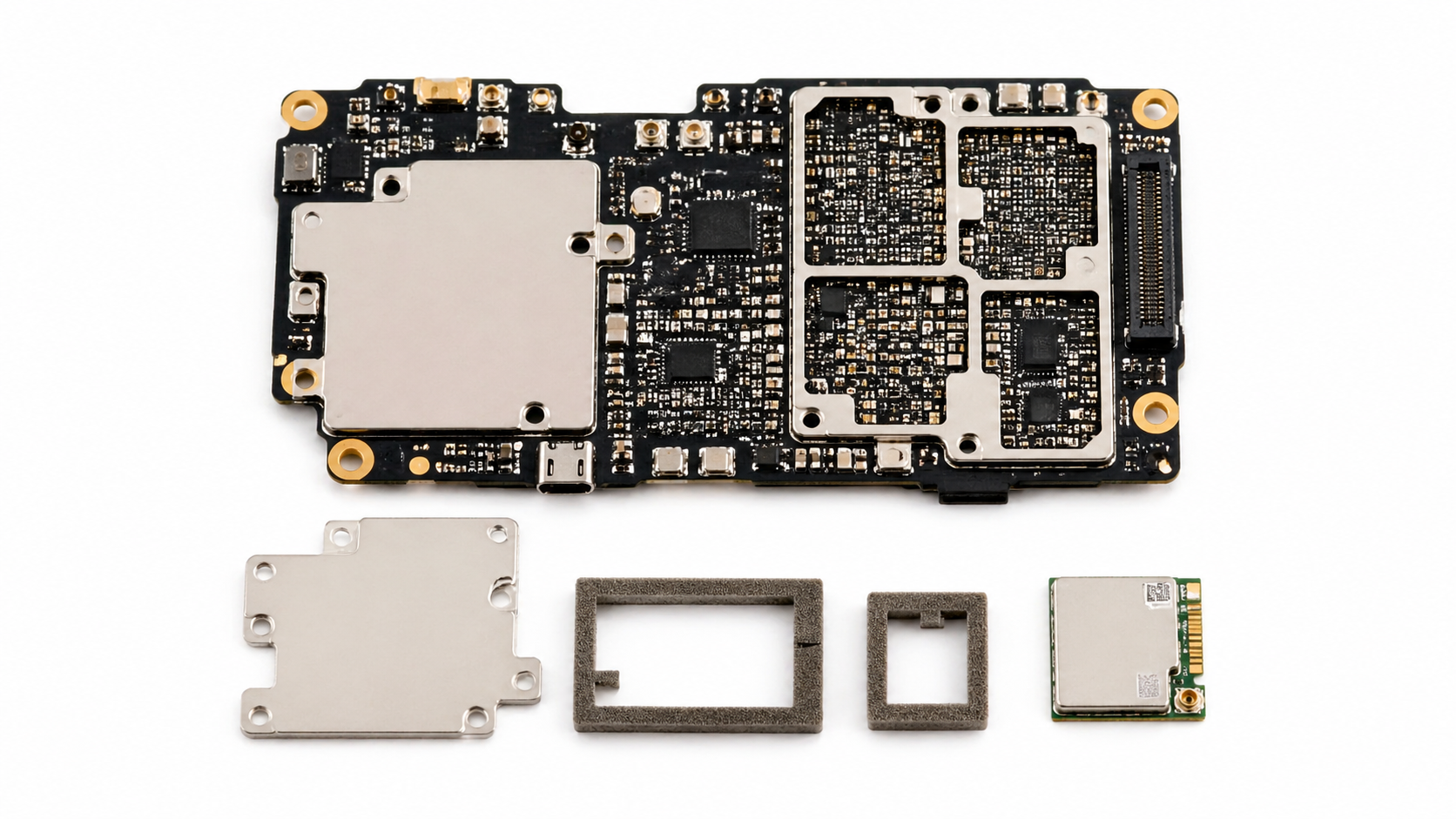
Material costs vary widely by shielding method. Conductive coatings may appear inexpensive for simple housings, but consistency, masking, and adhesion control can add process burden. Stamped metal shields are common for PCB-level suppression, but the total cost depends on tooling, plating, placement method, and rework access. Conductive elastomers and fabric-over-foam gaskets are effective at seam control, yet pricing often changes with compression tolerance, environmental rating, and volume.
Design integration costs are often less visible. Engineers may need extra PCB keep-out areas, more ground stitching vias, dedicated mounting points, or revised stack-up structures. For high-speed boards, even a 2 to 4 mm clearance change near a noisy converter or RF stage can influence routing complexity and layer usage. That can affect bare board cost, assembly time, and first-pass yield.
Five cost buckets to quantify
- Material acquisition: shield cans, gaskets, absorber sheets, conductive coatings, plated housings, grounding hardware.
- Engineering and redesign: CAD changes, PCB rerouting, enclosure updates, thermal simulation, SI/EMI review.
- Manufacturing effects: SMT accessibility, hand assembly steps, fixture changes, cycle time increase, scrap exposure.
- Validation and compliance: pre-scan fees, chamber time, repeat testing, documentation, qualification cycles.
- Lifecycle support: maintenance access, replacement parts, field service instructions, supplier continuity.
For procurement and commercial reviewers, one practical question is whether the EMI solution scales from prototype to volume. A design that works at 50 units may become inefficient at 50,000 units if it depends on manual tape application or a supplier with unstable lead times. Conversely, a higher upfront tooling investment may lower per-unit cost once annual demand crosses a threshold such as 10,000 or 20,000 assemblies.
Typical shielding methods and cost considerations
The following comparison helps teams align shielding performance with sourcing and manufacturing reality.
This kind of structured estimate gives finance and sourcing teams a more realistic basis for approval. It also helps engineering teams justify why an EMI budget should include validation, assembly impact, and thermal trade-offs instead of material costs alone.
How EMI Shielding Interacts With PCB, SMT, Thermal, and Semiconductor Compliance
In advanced electronics manufacturing, EMI shielding should never be reviewed in isolation. A design that meets attenuation targets but undermines SMT process stability or thermal dissipation can still fail as a production solution. This is especially true in compact boards with BGAs, fine-pitch packages, power semiconductors, industrial capacitors, RF transceivers, and high-current relays sharing limited space.
On the PCB side, shielding choices affect layer count, return path continuity, via fencing density, and grounding strategy. For example, adding a shield can may require a perimeter ground pattern and solderable fence points. If that perimeter conflicts with trace escape routing, the board may move from 6 layers to 8 layers, instantly changing the bare board cost structure. That is not unusual in mixed-signal industrial control or communications hardware.
In SMT assembly, the issue is process compatibility. A shield can may be placed automatically, hand-soldered, or attached after selective operations depending on size and board architecture. Each method has different cycle times and yield implications. Rework complexity is another major factor. If a shield blocks access to QFNs, oscillators, or filter networks, defect analysis and field repair can become significantly slower.
Compliance interactions that affect cost
- PCB compliance: stack-up control, dielectric behavior, copper distribution, grounding continuity, and spacing constraints.
- SMT compliance: solderability, placement tolerance, component shadowing, AOI visibility, and rework accessibility.
- Thermal compliance: airflow restriction, hotspot amplification, interface material interaction, and derating margin.
- Semiconductor compliance: package sensitivity, RF stability, noise susceptibility, and long-term reliability under stress.
Thermal coupling is one of the most frequent blind spots. A shielding element can trap radiated energy while also reducing natural convection. In dense enclosures, even a small cover over a DC-DC region may raise local component temperature beyond preferred operating margin. If the thermal increase is 8°C to 12°C, capacitor life and semiconductor reliability may be affected, which then creates a hidden lifecycle cost not visible in the initial EMI fix.
Practical review points before design freeze
A cross-functional review before design freeze usually saves more than it costs. The best review teams include layout engineering, manufacturing engineering, sourcing, quality, and sometimes service operations. A 5-point review framework is often enough: emission source mapping, thermal impact check, assembly access review, supplier readiness check, and pre-compliance test planning.
Independent benchmarking is particularly valuable here. Organizations such as SCM add value by translating material behavior, SMT precision, dielectric properties, and component reliability data into sourcing and compliance decisions. That helps global teams compare manufacturing hubs, assess tolerances objectively, and avoid selecting an EMI approach that looks inexpensive on paper but performs poorly in production or field use.
A Practical Cost Estimation Framework for Engineers, Buyers, and Approvers
An effective EMI shielding estimate should be built as a structured workflow instead of a rough quote request. For most B2B electronics programs, a 4-step model works well: define the noise risk, shortlist feasible shielding methods, quantify manufacturing and validation impact, and compare total ownership cost. This approach gives technical and financial stakeholders a common decision language.
Step 1 is source classification. Teams should identify whether the main issue comes from switching power stages, high-speed data lines, RF transmit paths, cable leakage, or enclosure seam radiation. The source determines whether board-level shielding, material absorption, enclosure treatment, or grounding redesign is the primary lever. Skipping this step often leads to over-designed and overpriced solutions.
Step 2 is candidate selection. Most projects should compare at least 2 to 3 shielding approaches before locking the BOM. One option may be lower in material cost but weaker in serviceability. Another may improve compliance margin by 6 dB to 12 dB but increase thermal burden or tooling cost. The goal is not only passing a test once, but achieving stable manufacturability across batches.
Recommended estimation inputs
- Operating frequency range, noise source intensity, target attenuation, and enclosure architecture.
- Annual volume, prototype quantity, MOQ sensitivity, and approved supplier list status.
- Assembly route, rework frequency, AOI or X-ray visibility needs, and service access constraints.
- Thermal headroom, component derating policy, and environmental stress conditions such as humidity or vibration.
- Expected pre-scan and certification cycles, including possible retest windows of 1 to 3 rounds.
Step 3 is cost modeling. Rather than asking for a single figure, request a cost range for prototype, pilot, and volume production. This captures tooling amortization, setup charges, and labor variation. In many cases, the prototype cost per unit can be 2 to 4 times the volume cost, especially for custom metal parts or low-volume conductive materials.
The table below offers a practical template for decision reviews.
Step 4 is approval alignment. Project managers and finance reviewers usually respond best when technical teams translate EMI decisions into schedule risk, retest probability, and total cost scenarios. A clear estimate should show not just unit cost, but also possible delay cost, redesign cost, and field support impact over 12 to 24 months.
Selection Mistakes, Procurement Risks, and Ways to Reduce Total Cost
The most common EMI shielding mistake is selecting by material price alone. Low-cost shielding parts can become expensive when they require manual application, fail compression stability, interfere with thermal performance, or come from a single supplier with inconsistent availability. For sourcing teams, total cost discipline means balancing piece price with process risk, lead time, and quality stability.
A second mistake is over-shielding. Some teams add multiple layers of cans, gasket materials, and ferrites before validating the dominant emission path. This can push cost up without improving compliance margin proportionally. In many cases, a cleaner ground return, enclosure seam improvement, or component relocation delivers more benefit than stacking additional shielding materials.
A third risk is ignoring maintenance and service access. After-sales teams often inherit products where a shielded area cannot be inspected or reworked without damaging adjacent components. That matters for industrial, telecom, and embedded systems expected to remain in service for 5 to 10 years. A design that saves a small amount in production but complicates replacement or repair creates downstream cost pressure.
Risk control checklist for procurement and quality teams
- Confirm whether the shielding supplier can support prototype, pilot, and volume phases without changing material formulation.
- Review environmental stability for heat, humidity, and vibration, especially if the product targets industrial or outdoor use.
- Check whether the solution preserves IPC-aligned assembly quality and does not block inspection or rework paths.
- Ask for tolerance data on thickness, compression, plating, or adhesion where process variation could affect yield.
- Build at least one alternate-source path when annual demand or compliance exposure is high.
FAQ: questions that often come up during evaluation
These questions are common among technical evaluators, buyers, and program owners trying to estimate EMI shielding costs early.
How early should EMI shielding be budgeted?
Ideally during architecture or early layout planning, before board dimensions and enclosure interfaces are fixed. If teams wait until pre-compliance failure, redesign cost and schedule impact usually rise sharply. A good practice is to include EMI review in the first 20% to 30% of the design cycle.
What is the most overlooked cost element?
Repeat validation and process disruption. Chamber retesting, revised fixtures, delayed sourcing approvals, and extra engineering time often exceed the visible cost of the shielding hardware. In compact electronics, thermal side effects are another hidden expense.
Are custom shields always more expensive than standard parts?
Not always. For low volume, standard shields can reduce tooling cost. For stable medium or high volume, custom designs may lower installation time, improve fit, and reduce retest risk. The right answer depends on annual quantity, geometry complexity, and compliance margin requirements.
How can companies reduce EMI shielding cost without sacrificing compliance?
Use a cross-functional review, benchmark material and process data early, compare at least 2 to 3 solution paths, and model total cost instead of piece price. Independent data on PCB materials, SMT precision, component reliability, and manufacturing capability can prevent expensive guesswork.
Estimating EMI shielding costs early is a practical risk-control measure for electronics companies that depend on reliable PCB fabrication, stable SMT assembly, strong thermal management, and predictable semiconductor performance. The most accurate estimates account for material choice, integration effort, compliance testing, manufacturing impact, and long-term service requirements together rather than as isolated expenses.
For R&D teams, procurement leaders, quality managers, and financial approvers, better shielding decisions begin with better data. SiliconCore Metrics supports that process through independent benchmarking, compliance-oriented analysis, and technical insight across PCB fabrication, SMT assembly, semiconductors, passive components, and thermal packaging. To reduce redesign risk and make more confident sourcing decisions, contact us to discuss your application, request a tailored evaluation framework, or learn more about practical EMI cost benchmarking for your next program.
- PCB
- PCB fabrication
- SMT assembly
- passive components
- thermal packaging
- EMS
- thermal management
- environmental stress
- PCB materials
- component reliability
- SMT process
- semiconductor reliability
- thermal management compliance
- PCB compliance
- SMT compliance
- semiconductor compliance
- circuit board assembly
- circuit components
- embedded systems
- semiconductor
- Power Semi
- high-performance
- RF modules
- RF transceiver
- RF transmitter
- RF receiver
- high-performance capacitors
- industrial capacitors
- relays
- electrical relays
- EMI shielding
Recommended News
- EMI ShieldingHow to choose a design verification resource for EMI testingDesign verification resource guide for EMI testing: compare technical depth, traceable evidence, and compliance insight to prevent costly redesigns.
- EMI ShieldingHow automotive component compliance testing supports EMC approvalComponent compliance testing automotive helps secure EMC approval through traceability, pre-compliance checks, and controlled design changes. Learn how to reduce risk.
- EMI ShieldingDo High-Performance Embedded Boards Need Different EMI Shielding?Do high-performance embedded boards require different EMI shielding approaches? Explore practical strategies for grounding, thermal design, cable control, compliance, and reliable performance.
- EMI ShieldingEU Adds Halogenated Flame Retardants and EMI Coatings to RoHS ScopeEU RoHS scope expands to halogenated flame retardants and EMI coatings under Directive (EU) 2026/1389. See how PCB exporters can prepare for the 2027 compliance deadline.
- EMI ShieldingEU Requires EPDs for EMI Shielding PartsEU Requires EPDs for EMI Shielding Parts from January 2027. Learn how the new EU rule affects compliance, carbon disclosure, shipment timing, and supplier planning.
- EMI ShieldingCBP Tightens Filing Rules for EMI Shielding ImportsCBP Tightens Filing Rules for EMI Shielding Imports: learn how the September 2026 ACE filing change affects RoHS, REACH, customs timing, and buyer risk for U.S.-bound shipments.