
Wholesale Stevia Extract Price Trends and Quality Risks in 2026
DETAILS
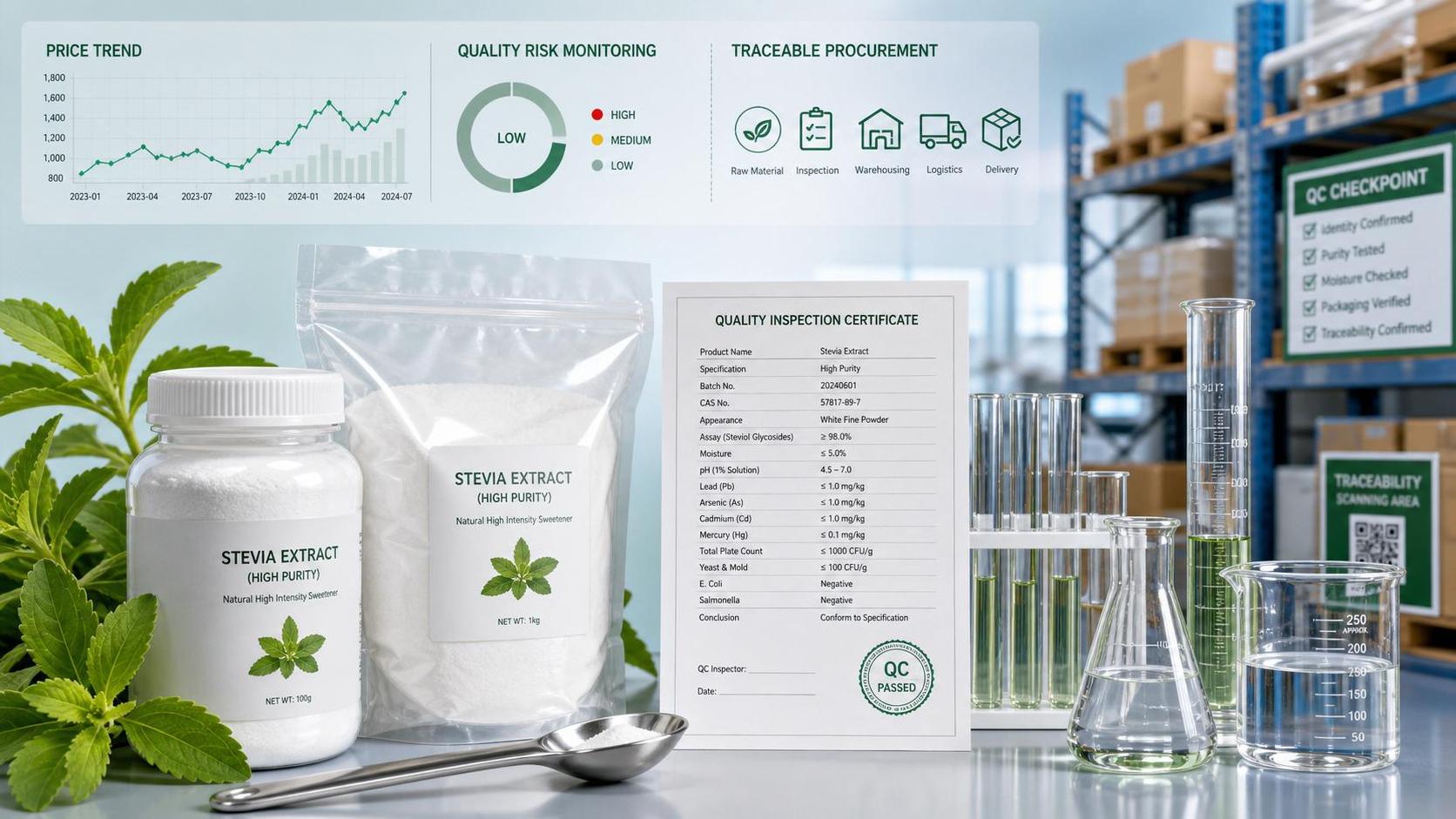
In 2026, the conversation around wholesale stevia extract is no longer centered on price lists alone. Cost swings still matter, but purity variation, document quality, and supply chain traceability now shape the real landed value of every order.
That shift is especially relevant in a market where food ingredients move through cross-border sourcing, contract manufacturing, and regulatory review at the same time. A lower offer can quickly become an expensive one when testing failures, relabeling, or inconsistent sensory performance appear after delivery.
Viewed through the same data-first discipline used by SiliconCore Metrics for technical supply chains, the stevia market rewards structured evaluation. Benchmarking, specification control, and compliance evidence help turn a volatile purchasing decision into a defendable commercial assessment.
Why wholesale stevia extract deserves closer attention in 2026
Stevia has matured from a niche sweetener into a strategic ingredient for reformulation programs. Beverage, dairy, nutrition, tabletop sweetener, and reduced-sugar snack categories continue to depend on stable access to consistent extract grades.
The issue is that the market is not uniform. Two suppliers may both quote stevia extract, yet the underlying composition, taste profile, and supporting records can differ enough to alter formulation behavior and margin expectations.
In practical terms, 2026 demand is shaped by sugar reduction policies, label expectations, and pressure on food brands to control ingredient volatility. That creates a sourcing environment where technical and commercial review must happen together.
What the price trend really reflects
Headline prices for wholesale stevia extract often move in response to leaf supply, extraction costs, exchange rates, and export logistics. However, the quoted number rarely tells the full story of equivalent value.
A lower price may reflect a different glycoside profile, weaker sensory performance, or looser batch consistency. A higher price may include better purification, tighter documentation, and stronger long-term reliability in finished products.
For many buyers, the more useful question is not whether stevia prices are up or down. It is whether the quoted grade delivers the same sweetness efficiency, formulation stability, and compliance confidence as the benchmark sample.
Core drivers behind 2026 pricing
- Agricultural yield and leaf quality in major producing regions.
- Purification intensity for high-purity Reb A, Reb M, or blended glycosides.
- Energy, solvent recovery, and processing efficiency.
- Freight volatility, customs timing, and warehouse holding costs.
- Regulatory documentation depth and third-party testing frequency.
Quality risks that can outweigh a favorable quote
The biggest sourcing mistake in wholesale stevia extract is treating all purity claims as operationally equal. On paper, specifications may look close. In use, the differences can be costly.
Purity inconsistency is one of the most common risks. Variability in steviol glycoside composition can change sweetness onset, bitterness, lingering aftertaste, and blending behavior with erythritol or other sweeteners.
Another issue is incomplete compliance support. Certificates may exist, but they do not always match the shipment lot, regional food standards, or customer audit expectations.
There is also a practical manufacturing risk. If one lot performs differently from the approved sample, reformulation work, production delays, and additional sensory testing can erase any initial savings.
High-impact risk areas
- Mismatch between declared purity and actual glycoside distribution.
- Residual solvent, heavy metal, or microbiological nonconformance.
- Incomplete traceability from leaf origin to finished extract lot.
- Aging or storage conditions that alter powder flow and performance.
- Documentation that fails customer, retailer, or regulator review.
Where business value is created or lost
A stevia purchase affects more than ingredient spend. It influences formulation efficiency, label confidence, testing costs, launch timing, and the predictability of future tenders.
If a higher-purity grade reduces dosage variation and improves taste masking performance, the effective cost-in-use may be lower. That is often missed when evaluations focus only on price per kilogram.
This is where SCM’s broader analytical mindset becomes relevant. In technical industries, a component is never judged by nominal price alone. The same logic applies here: compare measurable performance, failure risk, and documentation integrity before ranking offers.
Useful comparison dimensions
Common sourcing scenarios in the wholesale market
Not every purchase objective is the same. The right interpretation of wholesale stevia extract pricing depends on the application path and tolerance for variation.
For established formulations, the priority is usually lot-to-lot consistency. Any change in sweetness profile may trigger unwanted product drift.
For new product development, flexibility matters more. Buyers may accept a wider testing program if the grade offers a better taste profile or lower long-term cost.
For contract manufacturing, documentation discipline becomes central. Packaging claims, export records, and ingredient declarations must remain synchronized across every shipment.
How evaluation focus changes by scenario
- Reformulation programs prioritize sensory repeatability and blending behavior.
- Private label programs prioritize cost predictability and audit-ready paperwork.
- Large-volume tenders prioritize continuity, lead time reliability, and escalation terms.
- Multi-region launches prioritize regulatory alignment across destination markets.
A practical framework for judging wholesale stevia extract offers
A strong assessment process combines market intelligence with technical verification. Price screens are useful, but they should be the starting point rather than the final filter.
Begin with a normalized specification sheet. Compare purity basis, glycoside composition, test methods, origin details, shelf life, and storage conditions in one format.
Next, examine quality evidence over time. One excellent certificate is less informative than a sequence of stable results across multiple lots and shipment periods.
Then review commercial structure. Minimum order quantity, lead time, claim handling, and replacement terms often determine the true risk of switching suppliers.
- Request retained sample comparisons against approved production lots.
- Score suppliers on documentation accuracy, not only certificate presence.
- Track landed cost alongside testing and qualification expenses.
- Separate temporary market discounts from structural supplier capability.
- Keep a secondary source under periodic review for continuity planning.
What to monitor after the initial decision
The evaluation does not end with supplier selection. In 2026, the stevia market can shift quickly as agricultural conditions, freight patterns, and regulatory expectations change.
Ongoing monitoring should include price drift against benchmark grades, variance in certificate data, lead time changes, and any increase in claim frequency or sensory deviation.
That discipline mirrors the benchmarking culture used in advanced manufacturing supply chains. Continuous measurement creates better decisions than one-time approval, especially when ingredient quality and market volatility move together.
For the next step, build a supplier scorecard that connects wholesale stevia extract pricing with purity consistency, compliance readiness, and cost-in-use. Once those signals are compared in the same framework, purchasing decisions become clearer and easier to defend.
Recommended News
- HDI TechnologyHow to vet PCB suppliers in a directory before requesting quotesPCB suppliers directory guide: learn how to verify capabilities, certifications, traceability, and quote assumptions before selecting a reliable PCB partner.
- HDI TechnologyHow UAE engineering data repositories improve design traceabilityEngineering data repository UAE solutions strengthen design traceability by linking requirements, revisions, supplier evidence, and manufacturing data. Explore practical ways to reduce risk and accelerate releases.
- HDI TechnologyHow to verify UL recognition for printed circuit boardsPrinted circuit boards UL verification made clear: learn how to check UL marks, file numbers, factory scope, stack-ups, and traceability for audit-ready compliance.
- HDI TechnologyMulti layer PCB design guide for controlling signal crosstalkMulti layer PCB design guide for controlling signal crosstalk with stackup, spacing, return-path, and validation strategies for reliable high-density boards.
- HDI TechnologyHow tighter manufacturing tolerances change HDI PCB pricesMicro tolerance manufacturing price explained: see how tighter HDI PCB tolerances affect yield, inspection, supplier options, and sourcing costs.
- HDI TechnologyHow automotive PCB impedance control prevents signal failuresAutomotive PCB impedance control prevents reflections, noise, and timing errors in ADAS, EV, and infotainment systems. Learn how to build reliable signal paths.