
PCB Fabrication Tolerances That Affect Yield and Rework Rates
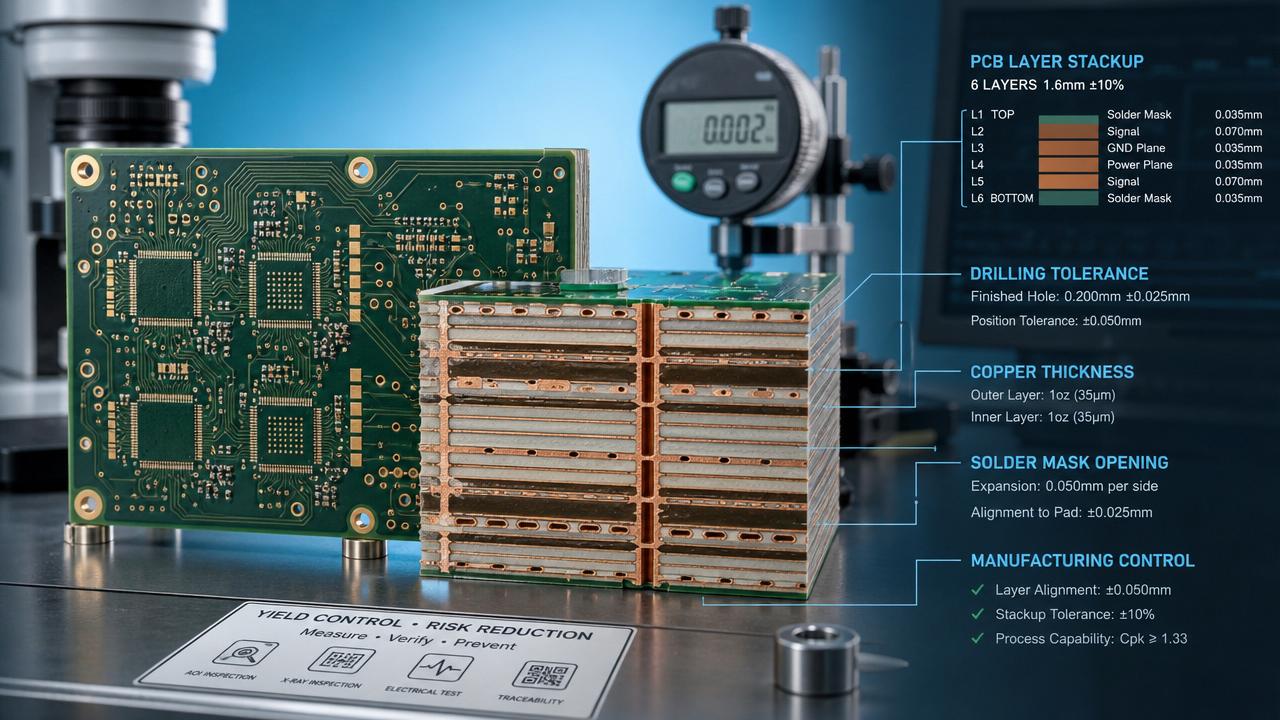
DETAILS
PCB Fabrication Tolerances That Affect Yield and Rework Rates
In PCB fabrication, small tolerance shifts rarely stay small for long.
They show up as scrap, late-stage rework, unstable test results, and avoidable schedule pressure.
That is why tolerance review should happen before release, not after first articles fail.
For teams managing complex builds, PCB fabrication is not only a sourcing task.
It is a risk-control exercise tied to yield, cost, field reliability, and launch timing.
The most important question is simple: which tolerances truly drive manufacturability?
The answer usually starts with dimensional accuracy, hole quality, layer registration, and copper consistency.
When these variables drift, downstream assembly performance also starts to drift.
A disciplined PCB fabrication review helps catch those problems while they are still inexpensive to fix.
Why PCB fabrication tolerances matter earlier than most teams expect
Tolerance is not just a drawing detail.
In PCB fabrication, it defines how much real-world variation the process can absorb.
If design intent leaves no margin, normal process movement can create hidden defects.
Those defects may not appear until soldering, electrical test, or environmental screening.
From a project perspective, this is where yield loss becomes a planning issue.
Rework adds labor, slows qualification, and can reduce confidence in the final product.
More importantly, repeated rework often masks a deeper PCB fabrication capability gap.
So the goal is not only passing DFM review, but matching the design to proven factory control windows.
Dimensional tolerances and board outline control
Board dimensions seem straightforward, but they influence much more than fit.
In PCB fabrication, outline variation can affect connectors, enclosures, fixtures, and automated handling.
A slight edge deviation may still pass visual inspection and fail during final integration.
This is especially common in dense products with tight mechanical interfaces.
Tooling hole location is equally important.
If holes shift beyond process expectations, panelization and assembly alignment can suffer.
That can create cumulative error across printing, placement, and depanelization stages.
In practical terms, dimensional tolerance should be reviewed with the assembly path in mind.
If the final application is mechanically sensitive, PCB fabrication capability data becomes essential before release.
What to verify
- Board outline tolerance versus enclosure clearance.
- Tooling and mounting hole positional accuracy.
- Panel breakaway effects on finished dimensions.
- Warp and twist limits after lamination and finish.
Drilled hole accuracy and finished hole tolerance
Hole quality is one of the most underestimated drivers of PCB fabrication yield.
Designs often specify nominal sizes without enough attention to finished hole reality.
Drill wander, plating build-up, and material behavior all affect the final result.
A via or component hole can meet drill intent and still miss fit requirements.
That matters for press-fit parts, high-pin-count connectors, and thermal vias.
Annular ring is closely linked to this issue.
When registration and drilling variation stack together, breakout risk increases quickly.
The result may be intermittent opens, weak plating, or extra touch-up during inspection.
In advanced PCB fabrication, finished hole tolerance should always be assessed with plating assumptions included.
Common risk signals
- Minimal annular ring on dense via fields.
- Finished holes specified too close to drill capability limits.
- High aspect ratio vias with limited plating margin.
- Connector pins requiring tighter insertion tolerance than the fab can repeatedly hold.
Layer registration and inner-layer alignment
Layer registration is where complex PCB fabrication often succeeds or struggles.
As layer count rises, material movement becomes harder to manage.
Press cycles, resin flow, and copper density all influence alignment behavior.
Even slight misregistration can reduce annular ring, alter impedance geometry, or create spacing violations.
This is more obvious in HDI, fine-pitch BGA escape routing, and controlled impedance layouts.
The challenge is that registration errors may not look dramatic on paper.
But in production, small shifts across many layers compound into lower yield.
Strong PCB fabrication control means understanding both nominal alignment and process drift over time.
Why it affects rework
Misregistration often pushes defects into hard-to-repair territory.
Electrical opens inside the stack cannot be fixed like a solder bridge.
That means more scrap, more root-cause analysis, and slower corrective action cycles.
Copper thickness, etching control, and conductor geometry
Copper control affects electrical, thermal, and reliability performance at the same time.
In PCB fabrication, copper thickness is never just a materials line item.
Variation changes current carrying capacity, impedance, heat spreading, and etch profile.
If etching is not tightly controlled, trace width and spacing can shift beyond design expectations.
That risk grows when designs use fine lines, heavy copper, or mixed-density routing.
A board may still be buildable and fail its signal or thermal targets later.
This is one reason independent benchmarking matters in PCB fabrication supplier selection.
Stable copper distribution and etch compensation reduce both direct defects and performance escapes.
Key checks
- Base copper tolerance versus current and thermal requirements.
- Finished trace width after etch compensation.
- Copper balance across layers to limit distortion.
- Consistency between prototype data and mass production data.
Solder mask, surface finish, and assembly-related tolerances
Some PCB fabrication issues only become visible during assembly.
Solder mask registration is a good example.
If mask openings shift, fine-pitch pads can bridge or lose protection.
Surface finish thickness also affects coplanarity, solderability, and contact performance.
These are not secondary details when yields are tight.
They directly shape first-pass assembly success.
In actual programs, many rework events begin as fabrication tolerance drift, not assembly execution failure.
That is why PCB fabrication and SMT quality reviews should never be isolated from each other.
How to evaluate PCB fabrication tolerance capability before problems scale
A useful review process combines drawing analysis, capability evidence, and failure learning.
Start with the tolerances that most affect function, not the ones easiest to measure.
Then compare those requirements against actual fab performance history.
If a supplier can hold a number once, that is not enough.
What matters is repeatability across lots, materials, and panel conditions.
- Map critical tolerances to failure modes such as opens, poor fit, or solder defects.
- Request process capability data, not only specification promises.
- Review stack-up behavior, drill strategy, and copper balance during NPI.
- Cross-check PCB fabrication data with assembly and field-return evidence.
- Use independent technical benchmarks when supplier claims are difficult to compare.
This approach reduces surprises because it links tolerance decisions to business outcomes, not only drawings.
A practical tolerance review checklist
Closing perspective
PCB fabrication tolerances shape far more than compliance paperwork.
They influence yield stability, rework exposure, supplier risk, and program confidence.
The strongest teams treat tolerance review as an engineering decision with commercial impact.
That mindset makes PCB fabrication more predictable and much easier to scale.
When critical tolerances are benchmarked early, fewer issues escape into assembly or the field.
And when tolerance data is transparent, sourcing and engineering can make faster, better decisions.
The next smart step is to review current PCB fabrication requirements against proven process capability before the next build release.
Recommended News
- HDI TechnologyHow to vet PCB suppliers in a directory before requesting quotesPCB suppliers directory guide: learn how to verify capabilities, certifications, traceability, and quote assumptions before selecting a reliable PCB partner.
- HDI TechnologyHow UAE engineering data repositories improve design traceabilityEngineering data repository UAE solutions strengthen design traceability by linking requirements, revisions, supplier evidence, and manufacturing data. Explore practical ways to reduce risk and accelerate releases.
- HDI TechnologyHow to verify UL recognition for printed circuit boardsPrinted circuit boards UL verification made clear: learn how to check UL marks, file numbers, factory scope, stack-ups, and traceability for audit-ready compliance.
- HDI TechnologyMulti layer PCB design guide for controlling signal crosstalkMulti layer PCB design guide for controlling signal crosstalk with stackup, spacing, return-path, and validation strategies for reliable high-density boards.
- HDI TechnologyHow tighter manufacturing tolerances change HDI PCB pricesMicro tolerance manufacturing price explained: see how tighter HDI PCB tolerances affect yield, inspection, supplier options, and sourcing costs.
- HDI TechnologyHow automotive PCB impedance control prevents signal failuresAutomotive PCB impedance control prevents reflections, noise, and timing errors in ADAS, EV, and infotainment systems. Learn how to build reliable signal paths.