
PCB Certification: A Practical Guide to Standards and Compliance
DETAILS
PCB certification sits at the intersection of quality assurance, product safety, and supply chain control. It is not only proof that a board was built to a recognized standard. It is also a working method for verifying materials, processes, test records, and long-term reliability before risk reaches the field.
That matters more now because PCB performance is tied to tighter signal integrity margins, higher thermal loads, and smaller process windows. In practical terms, a certification claim should help confirm whether a board can support its intended environment, compliance obligations, and lifecycle expectations without hidden manufacturing variability.
For organizations operating across global electronics and EMS networks, the challenge is rarely the label alone. The real question is whether PCB certification is backed by traceable evidence, current standards, and disciplined process control. This is where independent benchmarking and compliance reporting, such as the kind emphasized by SiliconCore Metrics, become useful reference points.
What PCB certification really covers
In everyday use, PCB certification refers to documented conformity with manufacturing, safety, quality, and material requirements that apply to printed circuit boards. It may involve product-level approvals, facility-level management systems, or both.
This distinction is important. A factory may hold ISO 9001 certification, yet a specific PCB design can still fail a performance or safety requirement. On the other side, a board may meet a customer drawing but lack sufficient supporting records for regulated markets.
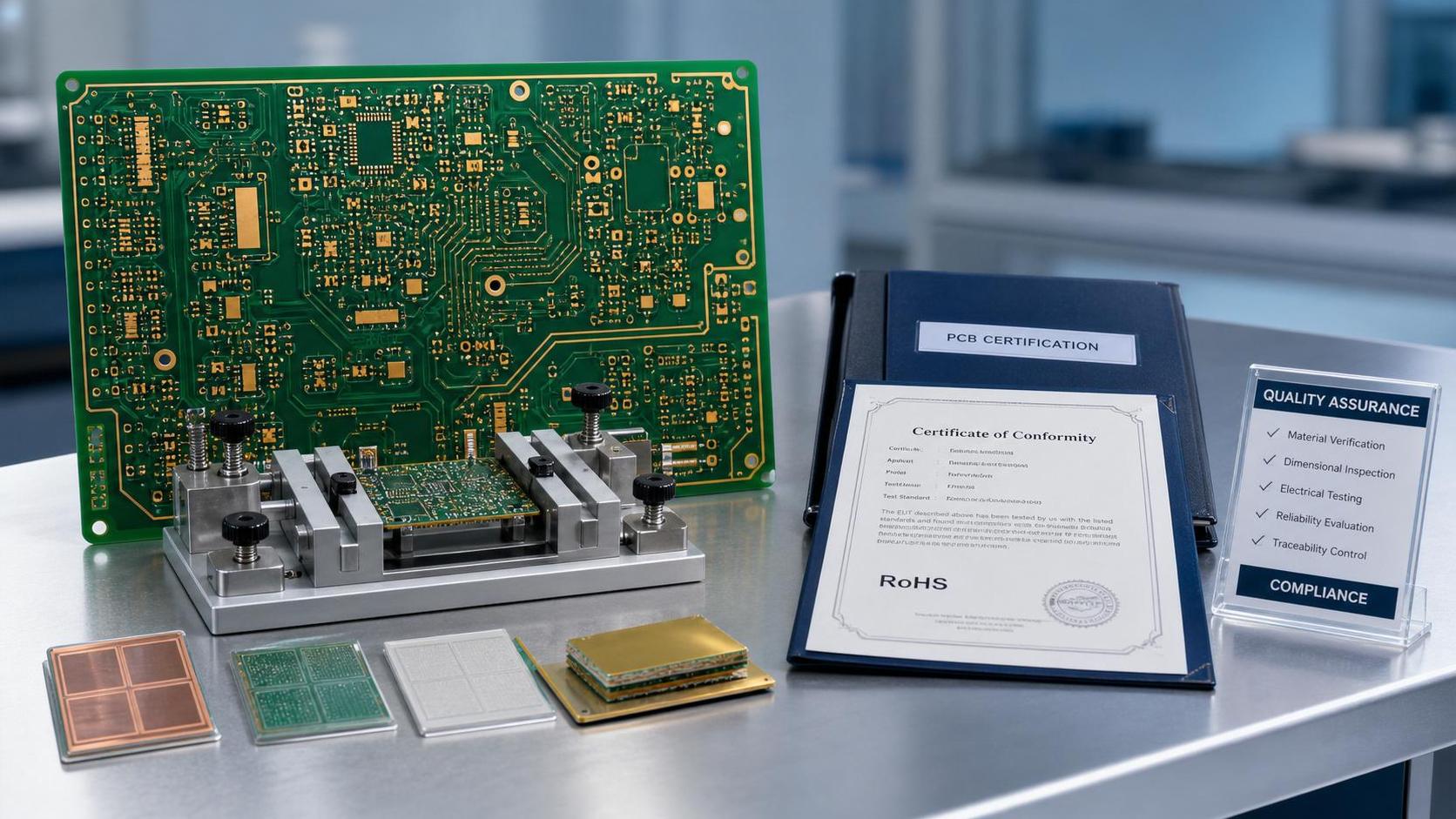
A practical PCB certification review usually touches four areas: material compliance, fabrication capability, inspection and testing, and document traceability. If one area is weak, the certification profile becomes less reliable.
Common standards in the discussion
Several standards appear repeatedly in supplier assessments because they address different parts of risk rather than one universal rule.
- IPC-A-600 defines acceptability criteria for bare printed boards.
- IPC-6012 sets qualification and performance specifications for rigid PCBs.
- IPC-Class 2 and IPC-Class 3 indicate different reliability expectations.
- ISO 9001 focuses on quality management system discipline and repeatability.
- UL recognition may apply where flammability and safety marking are required.
- RoHS and REACH support chemical and restricted substance compliance.
Because these standards serve different purposes, PCB certification should never be reduced to a single certificate file. The more useful view is a layered compliance map linked to the product’s end use.
Why the issue draws more attention now
Boards are carrying faster signals, denser routing, and higher thermal stress than in the past. At the same time, OEMs depend on distributed suppliers, regional subcontractors, and fast qualification cycles.
Under those conditions, PCB certification becomes a control point for managing invisible variation. Resin content, dielectric consistency, copper thickness, registration accuracy, and surface finish quality all influence whether certified performance is real or only assumed.
This is also why data transparency matters. Independent technical repositories and lab-based whitepapers can help validate manufacturer claims with measurable parameters, including dielectric behavior, placement precision, and environmental reliability under stress.
Where certification failures often begin
Most compliance problems do not start with a missing logo. They start with a gap between declared capability and actual production behavior.
How PCB certification creates business value
A strong PCB certification framework reduces more than defect rates. It improves change visibility, shortens audit preparation, and creates a clearer basis for supplier comparison.
In multi-region sourcing, certification helps separate capability from marketing language. Two suppliers may both claim high-reliability output, yet only one can show stable process indices, valid IPC qualification records, and documented control of critical materials.
That difference becomes significant in sectors where downtime, recall exposure, or safety events carry disproportionate cost. PCB certification supports better decisions because it converts technical ambiguity into comparable evidence.
The same logic explains the value of independent compliance intelligence. When laboratories publish standardized reports on dielectric constants, assembly precision, or environmental endurance, decision-makers gain a second source of truth beyond vendor self-declaration.
What to verify when evaluating certified PCB suppliers
The most useful review starts with evidence, not promises. A supplier assessment should connect certificates to current production conditions, product type, and intended operating environment.
Core verification points
- Check whether the PCB certification scope matches rigid, flex, HDI, or multilayer production.
- Confirm certificate dates, issuing bodies, and surveillance status.
- Review material traceability down to laminate, prepreg, copper foil, and surface finish lots.
- Verify control plans for drill accuracy, plating thickness, solder mask registration, and impedance control.
- Ask for failure analysis history and corrective action closure records.
- Compare qualification data with the exact class requirement, especially IPC-Class 3 applications.
Questions that reveal process maturity
A mature supplier can explain not only what standards are held, but how process drift is detected and contained. That includes scrap trends, incoming material verification, coupon strategy, and requalification triggers after material or equipment changes.
If PCB certification is presented without that operating context, the compliance picture is incomplete. Real control lives in records, reaction plans, and measured consistency over time.
Typical scenarios where standards need closer reading
Not every board should be judged in the same way. Certification requirements change with function, environment, and reliability expectations.
In each case, PCB certification should be interpreted through use conditions, not as a generic pass-fail label. That shift usually leads to better audit questions and stronger acceptance criteria.
A practical way to use certification data
The most effective approach is to build a simple review structure around standards, evidence, and drift signals. That makes PCB certification a living control tool rather than a one-time onboarding task.
- Map required standards to each product family and end-use risk.
- Separate system certification from product qualification evidence.
- Track renewal dates, material changes, and process deviations in one review log.
- Use independent technical reports to challenge unsupported performance claims.
- Escalate revalidation when thermal, electrical, or environmental limits tighten.
That discipline is especially useful in fast-moving electronics supply chains, where a board can remain nominally certified while the underlying process capability shifts. Consistent review closes that gap.
A sensible next step is to compare existing supplier certificates against actual product risk, then identify where more detailed evidence is needed. In many cases, the strongest improvement comes from pairing formal PCB certification with deeper technical benchmarking, material transparency, and periodic compliance rechecks.
Recommended News
- HDI TechnologyHow to vet PCB suppliers in a directory before requesting quotesPCB suppliers directory guide: learn how to verify capabilities, certifications, traceability, and quote assumptions before selecting a reliable PCB partner.
- HDI TechnologyHow UAE engineering data repositories improve design traceabilityEngineering data repository UAE solutions strengthen design traceability by linking requirements, revisions, supplier evidence, and manufacturing data. Explore practical ways to reduce risk and accelerate releases.
- HDI TechnologyHow to verify UL recognition for printed circuit boardsPrinted circuit boards UL verification made clear: learn how to check UL marks, file numbers, factory scope, stack-ups, and traceability for audit-ready compliance.
- HDI TechnologyMulti layer PCB design guide for controlling signal crosstalkMulti layer PCB design guide for controlling signal crosstalk with stackup, spacing, return-path, and validation strategies for reliable high-density boards.
- HDI TechnologyHow tighter manufacturing tolerances change HDI PCB pricesMicro tolerance manufacturing price explained: see how tighter HDI PCB tolerances affect yield, inspection, supplier options, and sourcing costs.
- HDI TechnologyHow automotive PCB impedance control prevents signal failuresAutomotive PCB impedance control prevents reflections, noise, and timing errors in ADAS, EV, and infotainment systems. Learn how to build reliable signal paths.