
Band Sawmills Bulk Orders: Cost Factors and Supplier Checks
DETAILS
Band Sawmills Bulk Orders: Cost Factors and Supplier Checks
Evaluating band sawmills bulk orders goes far beyond unit pricing.
The real decision depends on cost structure, supplier reliability, output consistency, and service risk.
This matters even more when order volume is high and replacement delays can stop production.
A low quote may look attractive at first.
In practice, hidden logistics, quality variance, and support gaps often decide the final outcome.
For that reason, band sawmills bulk sourcing should be handled as a total value assessment.
The goal is simple: reduce landed cost, protect uptime, and avoid long-term supply headaches.
Why band sawmills bulk buying needs a wider cost view
Many buyers compare offers by price per unit alone.
That approach works for simple commodities, but not for industrial equipment or related assemblies.
Band sawmills bulk orders usually involve configuration choices, steel quality, motor options, controls, and packaging standards.
Each variable changes both the upfront quote and the operating cost later.
More importantly, supplier discipline affects performance consistency across the batch.
That is why cost review and supplier checks must happen together, not as separate tasks.
The difference between quoted price and actual cost
Actual cost includes freight, duties, compliance, inspection, installation support, spare parts, and failure exposure.
It also includes the internal cost of managing claims, delays, and technical clarification.
When band sawmills bulk projects scale up, these soft costs become very visible.
Main cost factors in band sawmills bulk orders
A disciplined sourcing review starts with a clear cost map.
This helps compare suppliers on a like-for-like basis.
1. Material grade and structural design
Frame steel thickness, blade wheel balance, bearing brand, and guide system design all influence price.
Lower-cost builds may use lighter sections or inconsistent machining tolerances.
That can reduce durability and increase vibration, maintenance, and cut accuracy issues.
2. Configuration and customization level
Band sawmills bulk orders often involve custom voltage, blade length, feed system, or safety guarding.
Some suppliers quote a base model first, then add extras later.
A complete specification sheet prevents that pricing drift.
3. Production scale and batch efficiency
Bulk pricing improves when suppliers can standardize production and buy inputs efficiently.
However, very aggressive discounts may signal capacity pressure or weak margin control.
That raises the risk of late delivery or inconsistent quality during peak periods.
4. Tooling, testing, and pre-shipment inspection
Some factories include run testing, blade tracking checks, and paint or packaging upgrades.
Others treat them as optional services.
In band sawmills bulk transactions, inspection scope should be documented before order confirmation.
5. Freight, packaging, and import exposure
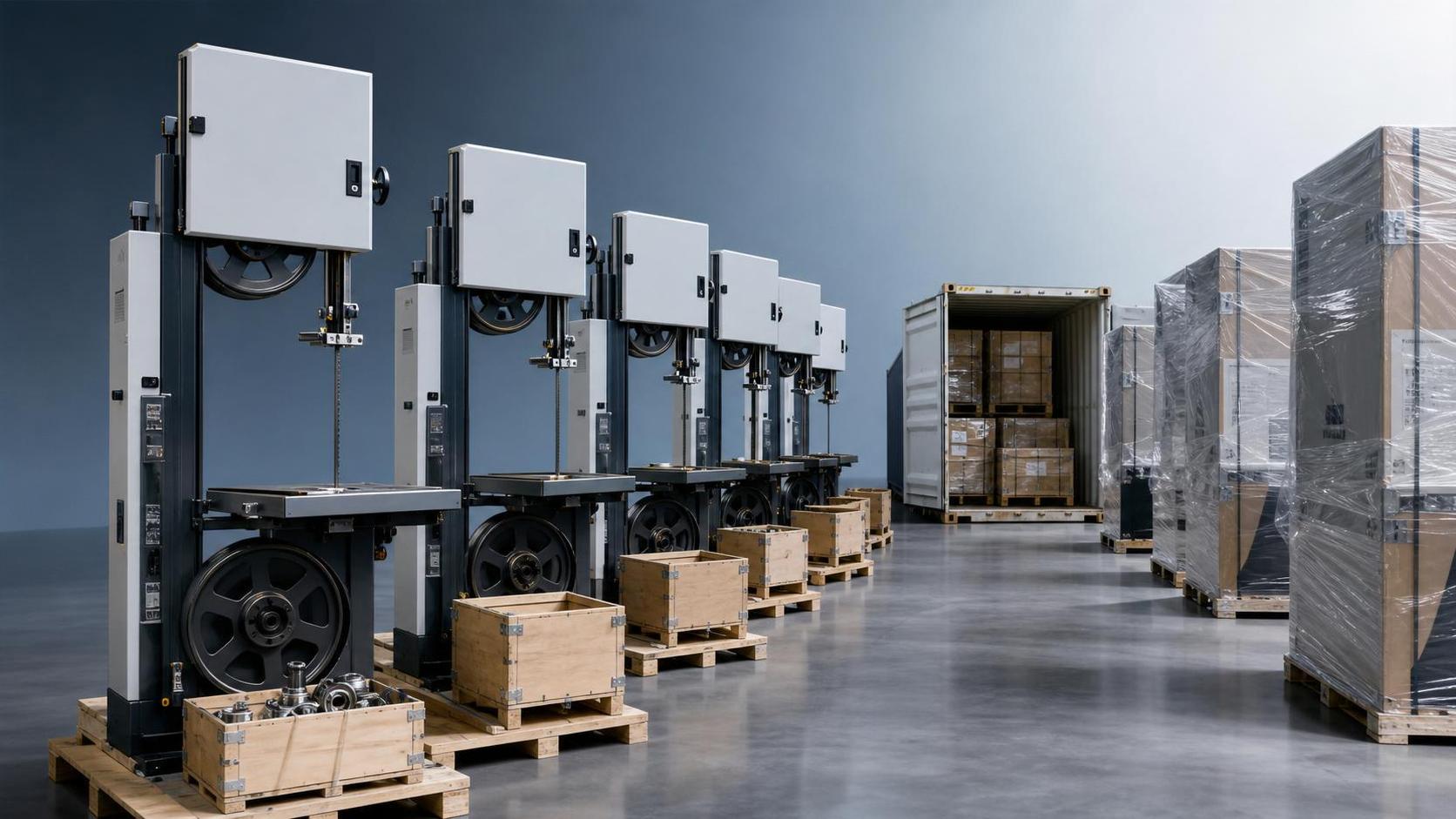
Wooden crates, rust prevention, container loading density, and route stability all affect landed cost.
A cheaper ex-works offer may become more expensive after logistics and damage claims.
This is one of the most common mistakes in band sawmills bulk sourcing.
6. Spare parts and service support
Replacement bearings, belts, blades, motors, and electrical parts should be priced early.
If spare parts are exclusive, future dependence on one supplier increases.
Reliable support often saves more money than a small discount on the initial order.
How to compare band sawmills bulk quotations properly
Good comparison starts with a normalized bid sheet.
Every supplier should respond to the same technical and commercial template.
- List core machine specifications, tolerances, and included accessories.
- Separate unit price from tooling, packaging, testing, and freight terms.
- Define Incoterms clearly to prevent hidden logistics assumptions.
- Ask for warranty length, spare parts lead time, and service response terms.
- Request the same payment structure from each bidder.
This approach makes band sawmills bulk evaluation faster and far more accurate.
It also exposes quotes that look cheap only because important items were left out.
Simple comparison framework
Essential supplier checks before confirming band sawmills bulk orders
A strong quote means little without supplier credibility.
Recent market shifts have made this even more important.
Capacity swings and cost pressure can change factory behavior quickly.
Verify manufacturing capability
Check whether the supplier is a true manufacturer, an assembler, or a trading intermediary.
This affects engineering control, pricing flexibility, and problem resolution speed.
For band sawmills bulk business, factory process visibility is a major advantage.
Review quality systems and records
Ask for inspection workflows, calibration records, test reports, and corrective action examples.
Formal certification helps, but process discipline matters more than logos alone.
A supplier that documents failures clearly is usually easier to work with later.
Check batch consistency and traceability
Bulk buyers need confidence that unit ten will match unit one hundred.
Traceability for motors, bearings, controls, and steel inputs supports that goal.
Without traceability, root-cause analysis becomes slow and expensive.
Evaluate communication speed and technical clarity
Fast replies are useful, but precise replies matter more.
Watch how suppliers answer questions about tolerances, testing, and warranty scope.
Clear answers usually indicate better internal control over band sawmills bulk production.
Confirm after-sales execution, not just promises
Ask how warranty claims are handled, who pays freight, and how replacement parts are shipped.
Request sample service cases if possible.
This is often where weak suppliers become obvious.
Practical risk controls for better band sawmills bulk decisions
Good sourcing decisions are rarely based on trust alone.
A few simple controls can reduce exposure without slowing the project too much.
- Use a locked specification and revision-controlled quotation sheet.
- Approve a pre-production sample or pilot unit before full release.
- Set measurable inspection criteria for mechanics, electrics, and finish quality.
- Link payment milestones to production progress and inspection acceptance.
- Build a spare parts package into the initial band sawmills bulk order.
These steps support better negotiation as well.
Suppliers usually respond more carefully when requirements are concrete and measurable.
Using data-led sourcing to improve long-term value
In technical supply chains, data creates leverage.
That principle applies to band sawmills bulk sourcing just as much as electronics manufacturing.
Independent benchmarking, structured supplier review, and documented quality evidence improve buying confidence.
This is where a research-driven approach becomes useful.
Organizations such as SiliconCore Metrics focus on turning technical complexity into comparable sourcing intelligence.
While SCM is rooted in semiconductor and EMS analysis, the same discipline applies here.
Standardized evaluation frameworks help separate marketing claims from measurable supplier performance.
That gives sourcing teams a stronger basis for both negotiation and risk control.
Final takeaway for band sawmills bulk sourcing
The best band sawmills bulk deal is not always the lowest quote.
It is the offer that balances build quality, delivery reliability, service support, and full landed cost.
When comparing suppliers, keep the process practical and evidence-based.
Normalize quotations, verify capability, inspect quality controls, and define service terms early.
That approach reduces surprises and improves long-term return on every band sawmills bulk order.
If the next sourcing round is approaching, start with a tighter cost model and a tougher supplier checklist.
Recommended News
- HDI TechnologyHow to vet PCB suppliers in a directory before requesting quotesPCB suppliers directory guide: learn how to verify capabilities, certifications, traceability, and quote assumptions before selecting a reliable PCB partner.
- HDI TechnologyHow UAE engineering data repositories improve design traceabilityEngineering data repository UAE solutions strengthen design traceability by linking requirements, revisions, supplier evidence, and manufacturing data. Explore practical ways to reduce risk and accelerate releases.
- HDI TechnologyHow to verify UL recognition for printed circuit boardsPrinted circuit boards UL verification made clear: learn how to check UL marks, file numbers, factory scope, stack-ups, and traceability for audit-ready compliance.
- HDI TechnologyMulti layer PCB design guide for controlling signal crosstalkMulti layer PCB design guide for controlling signal crosstalk with stackup, spacing, return-path, and validation strategies for reliable high-density boards.
- HDI TechnologyHow tighter manufacturing tolerances change HDI PCB pricesMicro tolerance manufacturing price explained: see how tighter HDI PCB tolerances affect yield, inspection, supplier options, and sourcing costs.
- HDI TechnologyHow automotive PCB impedance control prevents signal failuresAutomotive PCB impedance control prevents reflections, noise, and timing errors in ADAS, EV, and infotainment systems. Learn how to build reliable signal paths.