
Passive Component Suppliers: Cost vs Reliability Checklist
DETAILS
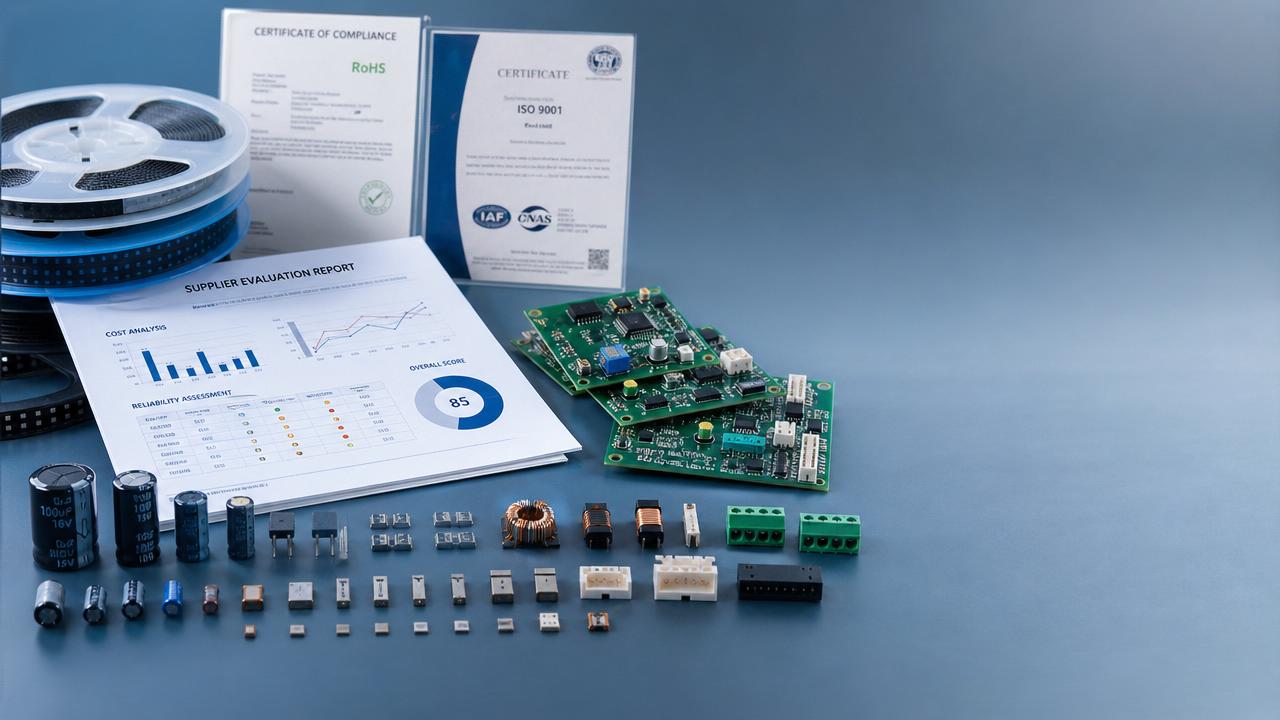
Choosing passive component suppliers is no longer just about unit price—it is a strategic decision that affects product reliability, compliance, and long-term supply stability. For procurement professionals, this checklist highlights how to balance cost pressures with technical performance, qualification standards, and sourcing risk, helping you make smarter supplier decisions in a demanding electronics supply chain.
Why procurement teams struggle with passive component suppliers
In many organizations, passive components are still treated as low-risk line items. That assumption creates avoidable exposure. A resistor, capacitor, inductor, connector, or protection device may represent a small share of BOM cost, yet its failure can stop an entire product shipment.
For procurement teams, the pressure is constant: lower pricing, shorter lead times, approved alternates, and fewer supply disruptions. The challenge is that passive component suppliers vary widely in process discipline, material control, documentation quality, and long-term reliability performance.
This is where data matters. SiliconCore Metrics (SCM) supports sourcing decisions with independent benchmarking, technical analysis, and compliance-oriented reporting across the semiconductor and EMS supply chain. That matters when buyers must justify not only cost, but also risk-adjusted value.
- Unit price often hides downstream costs such as requalification, line stoppage, field returns, and emergency resourcing.
- Supplier claims may not reflect stable performance under thermal cycling, humidity stress, voltage derating, or vibration.
- Documentation gaps can delay customer approvals, especially in industrial, telecom, automotive-adjacent, and high-reliability electronics programs.
What should you compare first: price, reliability, or supply continuity?
The right answer is not one factor, but a sequence. Effective evaluation of passive component suppliers starts with application risk, then moves to reliability evidence, and only then to price optimization. A low-cost source can be valid for non-critical assemblies, but dangerous in harsh-environment or high-uptime systems.
The table below gives procurement teams a practical comparison framework for balancing cost versus reliability when screening passive component suppliers.
A balanced model is usually the most practical for procurement. It prevents overbuying on benign applications while protecting programs where downtime, compliance failure, or warranty claims would outweigh any initial savings.
A simple rule for supplier prioritization
If the passive component affects signal integrity, thermal behavior, power stability, safety margin, or field serviceability, reliability should be weighted more heavily than headline cost. If it sits in a non-critical support circuit with multiple validated equivalents, price flexibility is easier to justify.
How to build a practical checklist for passive component suppliers
Procurement teams need a repeatable checklist, not a one-time opinion. The most useful checklist combines commercial, technical, quality, and operational signals. It also creates a common language between sourcing, quality, and engineering teams.
Core sourcing checklist
- Confirm application class. Define whether the part is used in consumer, industrial, communications, power, medical-adjacent, or other high-dependability contexts.
- Review material and process stability. Ask whether the supplier controls ceramic formulations, metal film consistency, plating quality, and lot traceability.
- Check reliability evidence. Look beyond a standard datasheet and ask for environmental stress results, drift behavior, and common failure mode data.
- Validate compliance documentation. Confirm RoHS, REACH, conflict minerals disclosures where relevant, and quality system documentation such as ISO 9001.
- Assess packaging and handling. Moisture sensitivity, reel integrity, labeling discipline, and ESD-sensitive handling can affect line performance.
- Map lead time and allocation risk. Check factory location concentration, raw material exposure, and second-source readiness.
- Calculate total cost of ownership. Include incoming inspection effort, PPAP-like approval effort where applicable, line fallout, and field replacement risk.
SCM’s value in this process is the ability to convert technical complexity into structured procurement evidence. Independent benchmarking helps buyers challenge vague supplier claims and align sourcing choices with actual operating risk.
Which technical parameters matter most in supplier evaluation?
Not every passive category uses the same metrics. However, several parameters repeatedly influence whether passive component suppliers can support stable production and long service life. Procurement does not need to become a design authority, but it must know which technical flags deserve escalation.
The table below summarizes high-value technical checks procurement teams should request or confirm during qualification.
This is where independent test interpretation becomes useful. SCM’s technical reporting model helps procurement teams understand not just nominal values, but performance under realistic stress, where many supplier comparisons start to diverge.
Questions worth asking engineering before approving an alternate
- Does the alternate have equivalent performance after derating, not only at room-temperature nominal conditions?
- Has the part been reviewed for assembly compatibility, including footprint tolerance, solderability, and reflow behavior?
- Does the supplier provide enough lot traceability to support root-cause investigation if failures appear later?
How do standards and compliance affect supplier selection?
Compliance is often treated as a document collection task, but for passive component suppliers it also indicates manufacturing maturity. Certifications alone do not prove reliability, yet the absence of structured quality systems increases sourcing uncertainty.
What procurement should verify
- ISO 9001 quality management status and whether it covers the relevant production site.
- IPC-related compatibility expectations for the final assembly, especially where high-reliability workmanship requirements apply.
- Environmental declarations such as RoHS and REACH, plus update cadence when regulations change.
- Change notification discipline for raw materials, plating, dimensions, and process transfers.
For multinational sourcing, documentation consistency matters almost as much as the certificate itself. Buyers frequently lose time when supplier forms, lot labels, or material declarations differ by plant or region. SCM helps bridge that gap through standardized compliance reporting that makes supplier comparisons easier across Asian manufacturing hubs and global customer requirements.
Where does low price become expensive?
The cheapest quote can become the most expensive decision when it increases hidden operational cost. This is common when passive component suppliers offer attractive pricing but weak consistency, slower corrective action, or limited traceability.
The cost model below helps procurement teams compare visible price savings against downstream financial exposure.
This does not mean low-cost passive component suppliers should be excluded. It means they should be segmented by risk. For some applications, they can be a smart secondary source. For others, they should remain outside the approved list until more technical evidence is available.
What are the most common mistakes buyers make?
Mistake 1: treating all passive components as interchangeable
Two suppliers may offer the same package size and nominal value, yet differ significantly in effective behavior under load, frequency, heat, or moisture. Cross-reference lists are useful, but they are not automatic qualification tools.
Mistake 2: relying only on datasheets
Datasheets often describe standard conditions. They rarely capture lot-to-lot variation, edge-case stress behavior, or the consistency of factory execution over time. Procurement should ask for deeper evidence when application risk is high.
Mistake 3: qualifying without supply-chain mapping
A technically acceptable supplier may still present concentration risk if production, raw materials, or subcontracted steps rely on a single geography. Supply continuity must be part of the approval decision.
Mistake 4: comparing only on current lead time
Short lead time today does not guarantee stable delivery during allocation cycles. Buyers should assess capacity discipline, forecast responsiveness, and the supplier’s history of communication during disruptions.
FAQ: procurement questions about passive component suppliers
How should buyers evaluate alternate passive component suppliers quickly?
Start with application criticality, then screen for core electrical equivalence, environmental suitability, compliance documents, and traceability. If the part affects power, protection, timing, or signal quality, involve engineering before commercial approval. A fast process works best when a predefined checklist already exists.
Are passive component suppliers with lower prices always riskier?
Not always. Some lower-cost suppliers can be suitable for less demanding assemblies or as controlled second sources. The key issue is evidence. Without reliable qualification data, stable documentation, and supply continuity planning, lower pricing may simply transfer cost into quality and operations.
What documents should procurement request during qualification?
Typical requests include datasheets, material declarations, quality certifications, process change notification policy, packaging specifications, lot traceability format, and where relevant, stress or endurance test summaries. For high-reliability programs, ask whether additional validation support is available.
How much should lead time influence supplier choice?
Lead time should influence the sourcing model, not just the purchase order. A supplier with acceptable quality but unstable lead time may still be useful in a dual-source strategy. The right question is whether the lead-time profile matches forecast volatility, inventory policy, and customer delivery commitments.
Why independent benchmarking gives procurement an advantage
Procurement teams often sit between engineering caution and commercial urgency. Independent technical intelligence helps resolve that tension. Instead of choosing between the cheapest quote and the loudest supplier pitch, buyers can compare passive component suppliers using normalized data, realistic stress interpretation, and supply-chain context.
SCM brings particular value because it combines engineering analysis, laboratory-driven insight, and market intelligence across PCB fabrication, SMT assembly, semiconductors, passive components, and thermal packaging. That cross-domain view matters when a component decision affects assembly yield, thermal performance, or end-product reliability.
Why choose us for supplier evaluation and sourcing support
If your team is reviewing passive component suppliers, SCM can help turn technical uncertainty into a structured procurement decision. Our support is designed for sourcing professionals who need defensible choices, faster internal alignment, and clearer risk visibility.
- Parameter confirmation support for comparing alternate parts beyond nominal datasheet values.
- Supplier benchmarking insights to assess reliability positioning, documentation maturity, and sourcing risk.
- Guidance on qualification priorities for applications requiring IPC-Class 3 awareness, ISO 9001-aligned quality expectations, or stricter environmental robustness.
- Discussion support around delivery cycles, second-source planning, compliance review, and sample validation pathways.
- Practical input for RFQ comparison, risk-based sourcing strategy, and communication between procurement, quality, and engineering teams.
If you are balancing cost targets against reliability demands, contact SCM to discuss supplier screening criteria, alternate selection, documentation review, delivery risk, sample support, and quote-stage evaluation. The goal is not simply to buy cheaper parts, but to source components that protect production, compliance, and long-term product performance.
Recommended News
- Precision CapacitorsPrecision capacitors guide to choosing the right tolerancePrecision capacitors guide to choosing the right tolerance: compare dielectric stability, DC-bias effects, temperature drift, and qualification factors for reliable designs.
- Precision CapacitorsHow to verify RoHS compliance for lead free passive componentsLead free passive components: learn how to verify RoHS compliance with part-specific declarations, exemption checks, lot traceability, and targeted testing.
- Precision CapacitorsEU EN 62368-3:2026 Takes Effect for Precision CapacitorsEU EN 62368-3:2026 takes effect for precision capacitors, reshaping EU compliance for AV and IT equipment. Learn Annex D report requirements, thermal runaway risks, and supply chain impacts.
- Precision CapacitorsHow Passive Component Category Intelligence Improves Capacitor Sourcing DecisionsPassive component category intelligence helps buyers make smarter capacitor sourcing decisions by reducing risk, controlling cost, and approving truly usable alternates faster.
- Precision CapacitorsAEC-Q200 Specification: Key Tests and Pass CriteriaAEC Q200 specification explained: discover key tests, pass criteria, and practical evaluation tips to compare passive components, reduce sourcing risk, and improve reliability decisions.
- Precision CapacitorsPassive Component Technology Intelligence: Key Signals for 2026 Sourcing DecisionsPassive component technology intelligence reveals the 2026 sourcing signals that impact reliability, cost, and supply continuity—helping buyers reduce risk and make smarter decisions.