
What to Check in Connectors Before Volume Orders
DETAILS
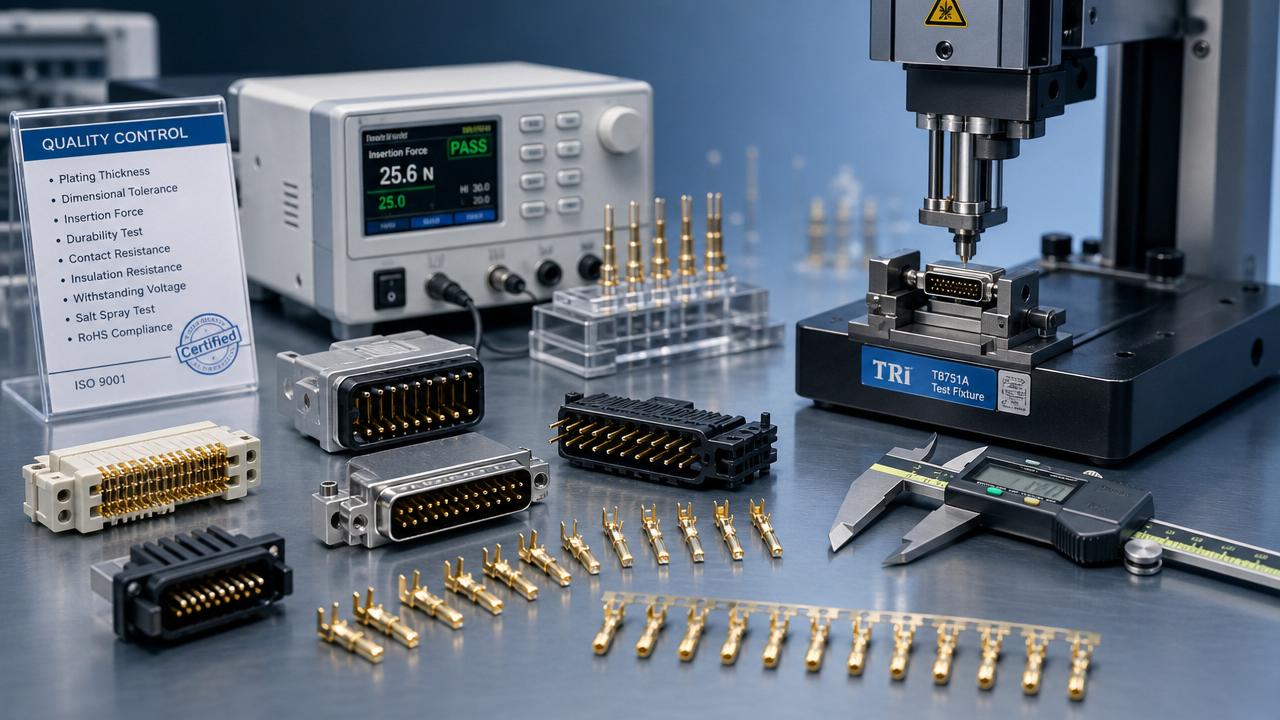
Before placing volume orders, buyers need more than price comparisons—they need evidence. When sourcing electronic components such as connectors, small variations in materials, plating, tolerances, and reliability can create major downstream risks. This guide outlines the key checks business evaluators should make to reduce supply chain uncertainty, protect product performance, and support more confident procurement decisions.
For business evaluators, the core question is simple: can this connector supplier support stable quality, predictable delivery, and acceptable lifecycle risk at scale? Price matters, but preventable failures, returns, qualification delays, and field issues usually cost far more than a modest unit-price difference.
The strongest procurement decisions come from combining technical verification with commercial discipline. In practice, that means checking whether the connector meets electrical, mechanical, environmental, manufacturing, and compliance expectations before issuing a volume purchase order, not after problems appear in production.
What business evaluators should confirm first
When evaluating electronic components for volume procurement, connectors deserve early scrutiny because they sit at the intersection of signal transfer, mechanical fit, assembly yield, and long-term reliability. A connector that looks acceptable on paper can still create failure risk if specifications are vague or testing is incomplete.
Start with three top-level questions. Does the part match the application environment? Can the supplier manufacture it consistently at scale? Is there enough objective evidence to support qualification, audit, and risk review? If any answer is unclear, the order should not proceed without further validation.
These opening checks align directly with business concerns. Procurement teams want fewer supplier surprises, engineering teams want stable performance, and quality teams want traceable proof. A connector program becomes easier to approve when all three functions can review the same data set and reach the same conclusion.
Check the connector against the real use case, not just the catalog
One common sourcing mistake is approving a connector based only on a distributor listing or a simplified datasheet. Volume orders should be tied to the actual operating profile, including voltage, current, mating cycles, vibration, ambient temperature, contamination exposure, and assembly method.
For example, a connector intended for low-power board-to-board communication may be unsuitable for repeated field service, high-humidity conditions, or elevated thermal cycling. A catalog rating is only meaningful if the test conditions behind it resemble the environment your finished product will face.
Ask whether the contact system supports the required signal integrity and whether insulation materials can withstand heat during soldering and operation. For business evaluators, this is not a deep engineering exercise alone. It is a direct check on whether the purchased electronic components will create warranty exposure later.
In procurement reviews, request a usage matrix that maps product conditions to connector specifications. This quickly reveals whether the supplier has truly understood the project or is simply pushing a standard part. A supplier that cannot clearly relate the connector to the application may also struggle in later quality discussions.
Review material selection and plating in detail
Connectors often fail because of seemingly minor material differences. Contact base metal, plating thickness, shell material, housing resin, and solder-tail finish can all influence conductivity, wear resistance, corrosion behavior, and manufacturability. These are not cosmetic details; they shape field performance and total cost.
Gold plating, tin plating, and nickel underlayers each serve different functions, and the right choice depends on mating frequency, current load, environmental exposure, and budget. For instance, a low-cost plating option may reduce initial spend while increasing contact resistance drift or fretting corrosion risk over time.
Business evaluators should ask for measurable data, not general claims like “high quality material” or “industry standard finish.” Useful evidence includes plating thickness ranges, adhesion test results, contact resistance performance, salt spray outcomes where relevant, and material certifications tied to lot traceability.
Resin selection matters as much as metal selection. Connector housings must tolerate soldering temperatures, mechanical stress, and aging without deformation or cracking. If the supplier cannot provide clear specifications for flammability rating, thermal resistance, and dimensional stability, qualification should remain open.
Verify dimensional tolerances and mating compatibility
Many connector issues surface during assembly rather than in bench testing. Even a technically capable part can generate rework, line stoppage, or intermittent failures if coplanarity, pitch tolerance, insertion force, or latch geometry vary too much across lots. Volume orders amplify these small inconsistencies.
Ask for mechanical drawings with controlled dimensions, tolerance windows, and revision history. Then confirm that those dimensions are compatible not only with your product design but also with the PCB footprint, enclosure constraints, cable routing, and automated assembly process used in manufacturing.
It is especially important to check mating compatibility if the supplier claims equivalence to a well-known original brand. “Drop-in replacement” statements should be validated through actual fit testing, retention testing, and production trials. Minor geometric deviations can lead to unreliable locking or pin damage.
For commercial decision-makers, dimensional control is a yield issue. Poor mechanical consistency increases hidden costs through scrap, slower assembly, operator intervention, and delayed product launch. If the supplier cannot provide process capability data or consistent inspection records, the risk premium rises significantly.
Examine electrical performance with realistic margins
Electrical ratings in connector datasheets often look straightforward, but business evaluators should look beyond headline numbers. Current rating, voltage rating, contact resistance, insulation resistance, and dielectric withstand values all need context. The real question is how the connector behaves under expected load and stress.
Current carrying capacity, for example, may depend on ambient temperature, adjacent loaded contacts, airflow, and housing design. A connector that passes a laboratory benchmark under ideal conditions may overheat in a dense enclosure. Derating curves and thermal rise data are therefore more useful than nominal current values alone.
For higher-speed or sensitive applications, signal integrity must also be considered. Impedance consistency, insertion loss, crosstalk behavior, and shielding effectiveness may matter more than basic continuity. Even if the buying team is commercially focused, they should confirm that engineering has reviewed these parameters explicitly.
When suppliers provide only broad claims without test methodology, ask for the underlying standard, sample size, and pass criteria. Objective data supports not only product selection but also supplier accountability. If performance later degrades, documented pre-order evidence helps clarify whether the issue was design-related or supplier-driven.
Focus on reliability testing that predicts field outcomes
Volume procurement should never rely solely on initial sample appearance or one-time functional tests. Reliability evidence is critical because connectors are exposed to repeated mechanical and environmental stress across the product lifecycle. Buyers need proof that the part remains stable, not just operational on day one.
Relevant tests may include mating cycle endurance, thermal shock, temperature-humidity bias, vibration, mechanical shock, contact retention, insertion and withdrawal force stability, and solderability where applicable. The exact mix depends on the application, but the goal is consistent: predict failure modes before scaling purchases.
Pay close attention to how results are reported. A supplier saying “passed 500 cycles” is less useful than a report showing pre- and post-test contact resistance, visible wear observations, failure criteria, and lot identification. Good reporting indicates disciplined engineering culture and stronger future support.
For business evaluators, reliability data translates directly into risk forecasting. Better tested electronic components reduce the chance of warranty claims, service calls, emergency resourcing, and customer dissatisfaction. In high-value assemblies, connector failure can compromise an entire system, making preventive review financially justified.
Assess manufacturing consistency and process control
A connector that performs well in prototype quantities can still become problematic in mass production if process control is weak. Before a volume order, ask how the supplier manages stamping, plating, molding, assembly, inspection, and final packaging. Consistency at each step influences delivered quality.
Useful questions include whether critical dimensions are monitored statistically, whether plating thickness is checked by lot, whether automated optical or electrical inspection is used, and how nonconforming material is segregated. Suppliers with mature controls are typically more transparent and less defensive about these topics.
It is also worth reviewing change management. If tooling, resin grade, plating chemistry, sub-supplier, or manufacturing location changes, how will customers be notified? A low-cost connector can become a high-risk purchase if engineering changes are introduced without formal approval and requalification triggers.
From a business standpoint, process discipline supports supply predictability. Stable manufacturing lowers the probability of lot disputes, incoming inspection failures, and production interruptions. It also reduces the internal oversight burden on your own teams, which matters when sourcing many categories of electronic components simultaneously.
Confirm compliance, traceability, and documentation readiness
For commercial approvals, documentation quality is often as important as technical quality. A supplier may offer a competitively priced connector, but if compliance evidence is incomplete, the procurement decision can stall at customer audit, regulatory review, or internal quality gate.
At minimum, confirm applicable declarations such as RoHS, REACH, material content statements, and country-of-origin information where required. Depending on the industry and market, buyers may also need UL references, halogen-free claims, conflict minerals reporting, or other customer-specific compliance records.
Traceability should also be reviewed before placing a large order. Can the supplier tie finished lots back to raw material batches, plating records, inspection data, and production dates? If a field issue emerges later, traceability determines how quickly the problem can be isolated and contained.
Documentation responsiveness is itself a supplier signal. If basic records are slow, inconsistent, or repeatedly revised during evaluation, expect similar friction after the purchase order is issued. For business evaluators, this is a practical indicator of future administrative cost and escalation risk.
Compare supplier risk, not just unit price
Price benchmarking remains necessary, but the true procurement question is total risk-adjusted value. A lower-priced connector may look attractive until the buyer accounts for qualification effort, yield loss, delayed shipments, inconsistent lots, or customer returns. These costs often exceed the apparent savings.
Build a comparison framework that includes technical performance, reliability evidence, documentation quality, lead time stability, response speed, minimum order flexibility, and corrective action capability. This allows stakeholders to compare suppliers on the factors that actually affect business continuity and delivered margin.
It is also wise to evaluate concentration risk. If a connector program depends on one source with limited capacity visibility or geopolitical exposure, the commercial risk increases. For strategic products, dual-source planning or approved alternates can be more valuable than negotiating the last fraction of unit cost.
Experienced evaluators also consider lifecycle risk. Is the part mature and stable, or likely to face obsolescence, tooling updates, or material substitutions soon? Secure sourcing of electronic components depends not only on present capability but also on the supplier’s ability to support future demand reliably.
Create a pre-volume approval checklist that teams can share
To avoid fragmented decisions, convert the evaluation into a structured checklist used by procurement, engineering, quality, and operations. This improves speed and reduces subjective judgments. It also creates an audit trail showing why a connector was approved, conditionally approved, or rejected.
A practical checklist should cover application fit, material and plating details, critical dimensions, electrical ratings with derating data, reliability test evidence, process control maturity, compliance documents, traceability, packaging suitability, lead time commitment, and change notification procedures.
Where information is incomplete, assign action owners and deadlines before volume release. Conditional approvals can work when the remaining gaps are minor and clearly controlled. However, high-impact unknowns such as unverified materials, unclear reliability results, or unstable dimensions should block full-scale ordering.
This checklist approach creates measurable business value. It shortens repeated review cycles, improves supplier accountability, and helps purchasing teams explain decisions internally. In markets where connector options appear interchangeable, disciplined evaluation is often the clearest competitive advantage.
Final takeaway for connector sourcing decisions
Before placing volume orders for connectors, business evaluators should focus less on advertised specifications and more on evidence of repeatable performance. The best sourcing decisions are grounded in verified application fit, controlled materials, stable dimensions, realistic electrical behavior, and credible reliability results.
Just as important, the supplier must demonstrate process discipline, compliance readiness, and traceability strong enough to support audits and problem resolution. These factors determine whether a connector remains a dependable electronic component in production or becomes a recurring source of cost and disruption.
In short, a connector should earn approval through data, not assumption. When buyers check the right details before committing volume, they reduce uncertainty, protect product quality, and put the organization in a stronger position to negotiate from knowledge rather than from urgency.
Recommended News
- ConnectorsHow to compare connector suppliers when quoted prices differSupplier comparison price guide for connector sourcing: compare technical fit, landed cost, quality, lead times, and supplier risk to make confident purchasing decisions.
- ConnectorsHow to assess connector quality when sourcing electronic components in SingaporeElectronic components Singapore sourcing guide: assess connector quality, traceability, plating, mechanical reliability, and supplier controls to reduce costly failures.
- ConnectorsHow to prevent connector corrosion in aquaculture installationsAquaculture installations need reliable connectors. Discover practical ways to prevent corrosion with smart sealing, material selection, cable routing, and maintenance.
- ConnectorsHow to select automotive connector systems for high-vibration environmentsAutomotive connector systems for high-vibration environments: learn how to evaluate contact stability, sealing, locking, harness support, and qualification evidence.
- ConnectorsWhen should you source from a connector systems wholesaler?connector systems wholesaler: learn when wholesale sourcing reduces supply risk, controls total cost, and protects production with qualified, reliable availability.
- ConnectorsHow to select connector systems for telecom exposed to vibrationConnector systems for telecom exposed to vibration demand more than basic specs. Learn how to protect signal integrity, retention, and reliability with smarter selection criteria.