
How to Source CE Components Without Delaying Approval
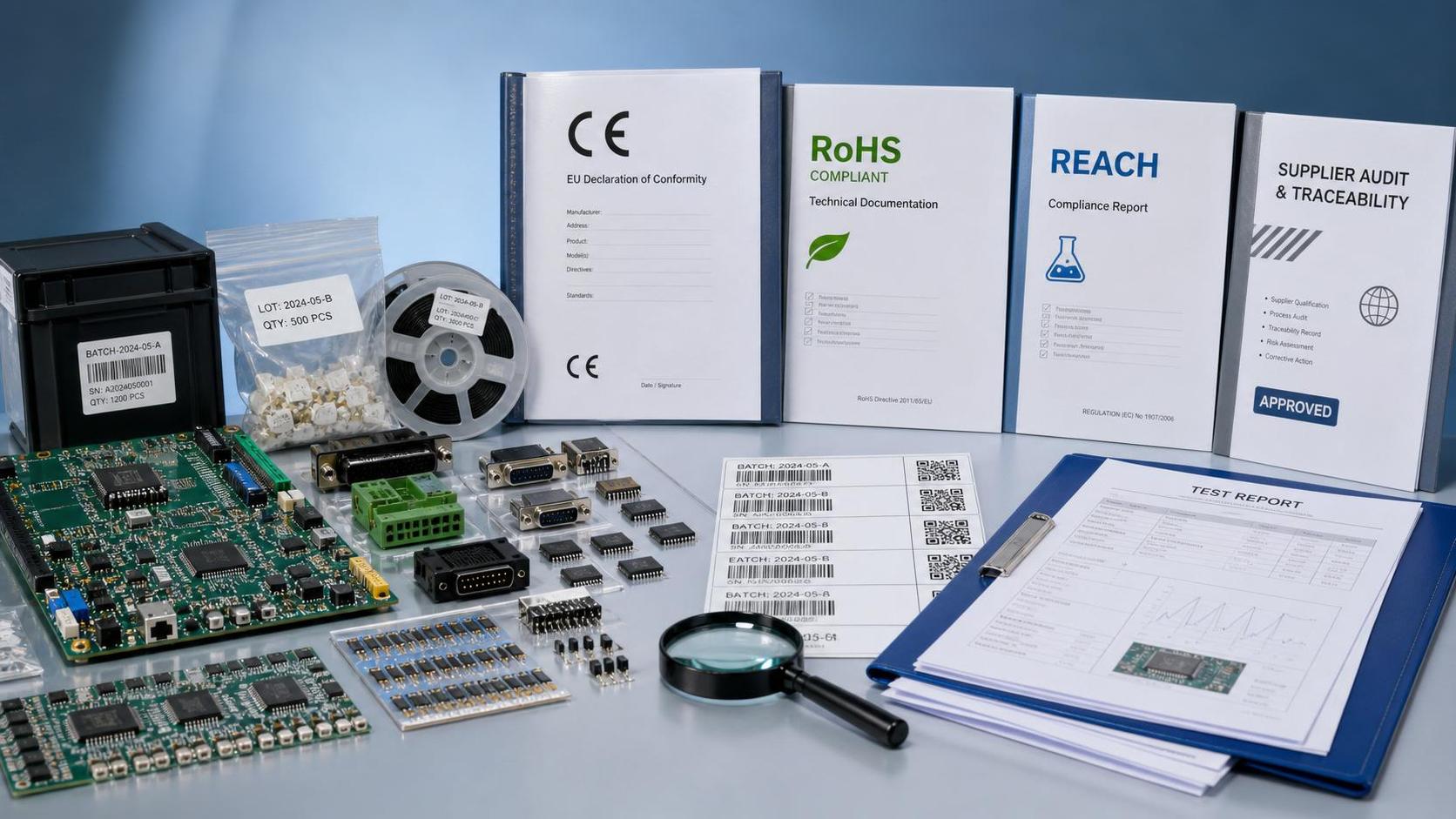
DETAILS
Why does component sourcing CE so often slow down approval?
Component sourcing CE work rarely fails because parts are unavailable. It usually stalls because evidence arrives late, arrives incomplete, or does not match the product claim.
In practical terms, CE approval depends on more than a supplier saying a part is compliant. The file must support the declaration, the intended use, and the technical construction.
That is why component sourcing CE becomes a timing issue as much as a compliance issue. One missing material statement can hold the entire review queue.
The faster route is to treat sourcing and approval as one workflow. When supplier selection starts with documentation readiness, fewer surprises appear near launch.
This matters even more in electronics, where component substitutions affect signal integrity, thermal behavior, and long-term reliability. A compliant part on paper may still create risk in application.
A more reliable approach is to check regulatory documents together with engineering evidence. Independent benchmarking, the kind SCM publishes across semiconductor and EMS categories, is useful here because it connects compliance to actual performance data.
What should be checked before asking for a CE-ready quote?
A quote request should never begin with price alone. For component sourcing CE, the first filter is whether the supplier can support approval without extra back-and-forth.
The most useful pre-quote checks are usually simple:
- Current declaration or conformity support documents
- RoHS and REACH status tied to exact part numbers
- Traceability to batch, factory, and authorized channel
- Revision control for datasheets and process changes
- Reliability data for the intended thermal and environmental load
Need to move faster? Ask suppliers to return a documentation matrix with the quote. That changes the discussion from “Can you supply?” to “Can you supply and clear approval?”
This is where many teams lose days. They qualify commercial terms first, then discover the compliance package is generic, expired, or unrelated to the offered manufacturing site.
For higher-risk categories, such as power semiconductors, connectors, multilayer PCBs, or thermal materials, it helps to request evidence of consistency, not just one certificate. Process capability and failure history matter.
A quick screening table for early supplier conversations
The table below works well as a first-pass screen during component sourcing CE reviews. It keeps approval risk visible before price negotiations become dominant.
Which documents actually matter for component sourcing CE?
A common mistake is collecting every possible file, then discovering half of it has no approval value. Faster approval comes from asking for the right evidence in the right order.
Usually, the useful core set includes datasheets, material declarations, RoHS and REACH confirmations, traceability records, and formal change notifications.
Depending on the component, test reports may be more important than generic declarations. Thermal interface materials, high-speed PCB laminates, and active devices often need deeper technical support.
That is where neutral technical repositories help. SCM’s coverage of dielectric behavior, SMT placement precision, and component durability under stress reflects a more realistic approval mindset.
The question is not only “Is this component compliant?” It is also “Can this component hold compliance in the final product under expected use conditions?”
When documentation is prioritized this way, review teams spend less time sorting files and more time making decisions.
Is the cheapest compliant source really the lowest-cost option?
Not often. In component sourcing CE, the visible unit price is only one part of the cost. Approval delays create hidden expenses that can easily erase nominal savings.
Typical hidden costs include re-validation, engineering review time, urgent freight, alternate build planning, and delayed customer commitments.
There is also substitution risk. A low-cost part may meet the listed electrical range, yet perform differently in thermal cycling, solderability, or long-term drift.
In real sourcing cycles, the better comparison is cost per approved component, not cost per purchased component. That single change improves decision quality.
A useful internal question is this: if the supplier package is challenged tomorrow, how many working days are needed to repair the file? The answer often reveals the true cost.
For strategic categories, independent market intelligence also matters. When supply conditions shift across Asian manufacturing hubs, early warning on source stability can protect both lead time and compliance continuity.
How to compare two “CE-capable” offers without guessing
- Compare document freshness, not only document presence
- Check whether test data matches the actual production site
- Review PCN discipline and past responsiveness
- Assess fit for IPC-Class 3 or other target quality levels
- Estimate the cost of rework if the first file is rejected
Where do approval delays usually start, even when suppliers look qualified?
Delays often begin in the handoff between sourcing, engineering, and quality review. Each group assumes another group has checked the weak points.
In component sourcing CE, three trouble spots appear repeatedly. The first is part-number ambiguity. The second is site-level inconsistency. The third is outdated support data.
Part-number ambiguity sounds minor, but it creates major review friction. A single suffix difference may change plating, package material, or assembly route.
Site-level inconsistency matters because quality systems and process windows vary. A certificate from one facility does not automatically describe another.
Outdated data is the quietest problem. A file may look complete, yet fail because it no longer reflects current substances, process controls, or product revisions.
This is why data governance matters. Independent reporting models, especially those built around standardized compliance evidence, reduce dependence on supplier self-description alone.
What does a faster component sourcing CE process look like in practice?
The fastest process is not the one with fewer checks. It is the one that places checks earlier, using a consistent decision framework.
A workable model usually has four moves. Define the compliance scope first. Screen supplier evidence second. Validate technical fit third. Lock traceability and change control before release.
That sequence helps because it prevents commercial momentum from outrunning technical proof. Once a low-visibility part reaches late-stage review, recovery becomes expensive.
In actual electronics programs, the best results come from combining supplier claims with benchmarked engineering data. SCM’s role is relevant here because it translates complex manufacturing variables into comparable evidence.
This kind of cross-check is especially valuable when sourcing from multiple Asian production clusters, where capability can be strong but documentation discipline may vary by site and tier.
If approval speed matters, build an internal checklist that treats component sourcing CE as a controlled input to product release, not as an afterthought appended to sourcing.
A practical next-step checklist
- Map critical components by compliance sensitivity and technical risk
- Require document matrices with every strategic quote
- Separate generic certificates from part-specific evidence
- Use benchmark data for thermal, mechanical, and reliability questions
- Review change-control commitments before volume release
When component sourcing CE is handled this way, approval tends to move faster because the evidence arrives in decision-ready form.
The next useful step is to sort current suppliers by documentation quality, technical transparency, and revision discipline, then compare that against cost and lead time. That gives a clearer basis for future sourcing decisions.
Recommended News
- ConnectorsHow to compare connector suppliers when quoted prices differSupplier comparison price guide for connector sourcing: compare technical fit, landed cost, quality, lead times, and supplier risk to make confident purchasing decisions.
- ConnectorsHow to assess connector quality when sourcing electronic components in SingaporeElectronic components Singapore sourcing guide: assess connector quality, traceability, plating, mechanical reliability, and supplier controls to reduce costly failures.
- ConnectorsHow to prevent connector corrosion in aquaculture installationsAquaculture installations need reliable connectors. Discover practical ways to prevent corrosion with smart sealing, material selection, cable routing, and maintenance.
- ConnectorsHow to select automotive connector systems for high-vibration environmentsAutomotive connector systems for high-vibration environments: learn how to evaluate contact stability, sealing, locking, harness support, and qualification evidence.
- ConnectorsWhen should you source from a connector systems wholesaler?connector systems wholesaler: learn when wholesale sourcing reduces supply risk, controls total cost, and protects production with qualified, reliable availability.
- ConnectorsHow to select connector systems for telecom exposed to vibrationConnector systems for telecom exposed to vibration demand more than basic specs. Learn how to protect signal integrity, retention, and reliability with smarter selection criteria.