
Electronics Guide USA: Key Connector Standards to Know
DETAILS
The U.S. connector market looks familiar on the surface, yet qualification decisions rarely depend on part numbers alone. In this electronics guide USA, connector standards matter because they shape signal behavior, mechanical fit, environmental endurance, and long-term sourcing confidence across semiconductor and EMS programs.
A connector may pass a basic mating test and still fail a real deployment. High-speed data, thermal cycling, vibration, and contamination expose weak assumptions quickly. That is why a useful electronics guide USA starts with standards, not marketing claims.
For organizations working across PCB fabrication, SMT assembly, active devices, passive components, and thermal packaging, connector choices sit at the intersection of design and supply chain risk. Independent benchmarking, the kind associated with SiliconCore Metrics, helps translate specifications into measurable qualification criteria.
Why connector standards deserve closer attention
Connectors are often treated as accessories to larger assemblies. In practice, they are control points for electrical continuity, insertion reliability, shielding performance, and field serviceability.
In the U.S. market, standards also support cross-border sourcing. When designs rely on components from multiple manufacturing regions, standardized test references reduce ambiguity between drawing approval and production reality.
This is where an electronics guide USA becomes useful beyond catalog browsing. It helps teams compare compliance language, test methods, and performance thresholds before committing to expensive validation cycles.
The core standards behind connector evaluation
No single standard covers every connector type. Most evaluations combine mechanical, electrical, environmental, and manufacturing references.
EIA and IEC baseline references
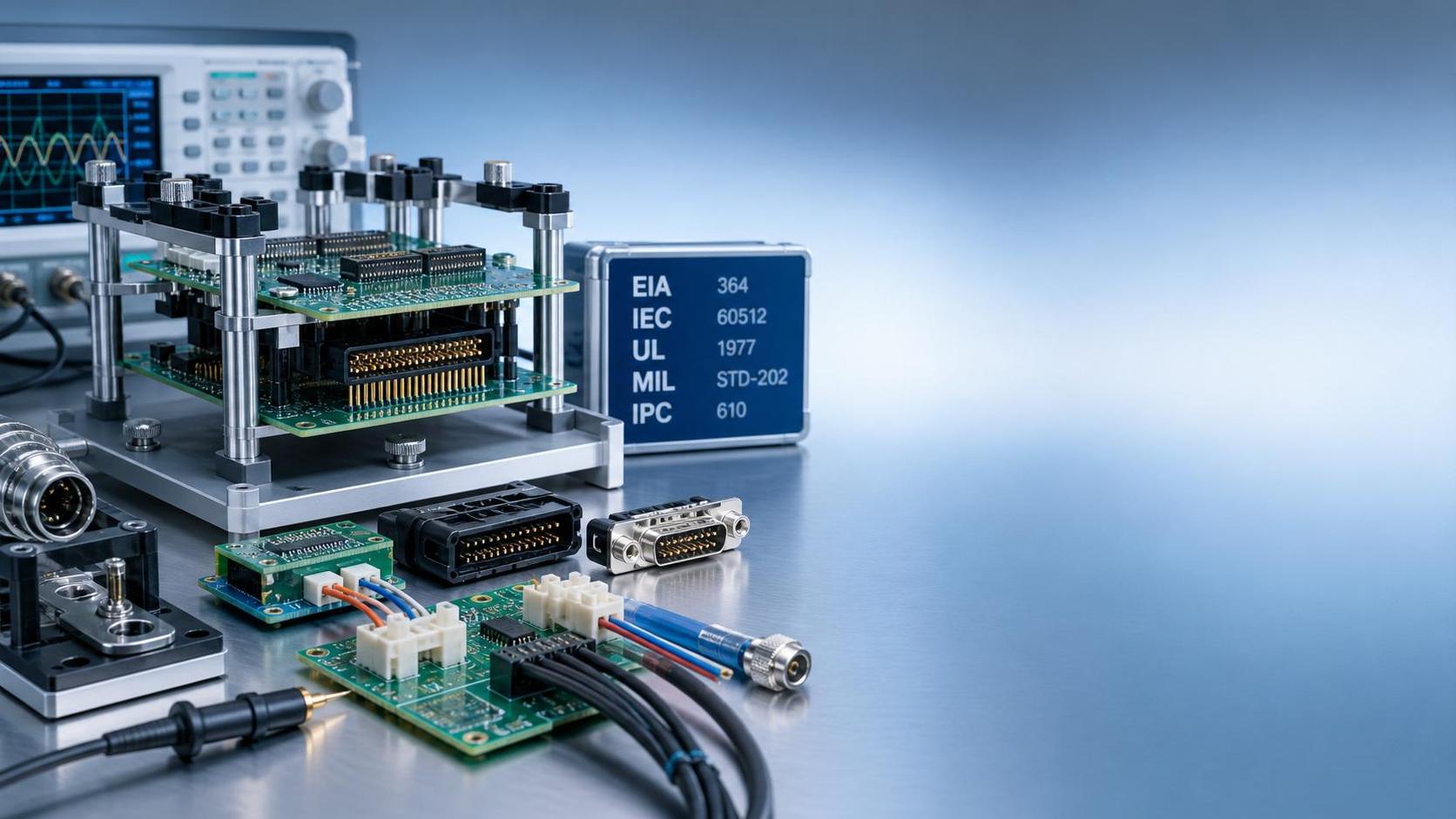
EIA and IEC standards commonly define dimensional consistency, performance tests, and terminology. They create a common language for comparing circular, rectangular, board-to-board, and wire-to-board interfaces.
When a datasheet cites IEC testing, the key question is not whether a logo appears. The more important point is which exact test conditions were used, including temperature, cycles, and load limits.
UL and safety-oriented compliance
UL recognition often matters in power distribution, industrial control, and appliance-linked assemblies. It supports insulation, flammability, and safe operating assumptions within broader system certification paths.
For U.S. deployment, UL alignment can shorten downstream approval work. It does not replace design validation, but it reduces uncertainty in regulated applications.
MIL and harsh-environment expectations
MIL-based connector references remain influential even outside defense programs. They are frequently used as shorthand for durability under shock, vibration, moisture, and repeated mating stress.
An electronics guide USA should treat MIL references carefully. A rugged housing alone is not enough if contact resistance drift, plating wear, or seal degradation is not documented.
IPC and assembly compatibility
IPC standards become critical once connectors enter PCB and SMT workflows. Coplanarity, solderability, board stress, and inspection criteria affect yield just as much as connector design intent.
For high-reliability builds, IPC-Class 3 expectations can influence pad design, process windows, and acceptance thresholds. That makes connector evaluation a manufacturing issue, not only a component issue.
What technical review should actually focus on
Many connector problems begin with incomplete reading of the test context. A passing statement is only meaningful when tied to measurable conditions.
The strongest connector selections are usually supported by test evidence that matches the intended operating profile. Published maximum values, without context, often hide the real margin.
Where standards affect real applications
Connector standards become more important as assemblies move into denser, faster, and more thermally constrained platforms.
High-speed and data-dense boards
Board-to-board and mezzanine connectors must preserve impedance and limit insertion loss. In these cases, standard references need to be read alongside actual S-parameter data and stack-up assumptions.
Power electronics and thermal stress
Power connectors are often evaluated by current rating alone. A better electronics guide USA approach checks temperature rise, derating curves, contact material, and enclosure heat accumulation together.
Industrial and outdoor installations
Sealing claims, corrosion resistance, and vibration survival become central. Here, environmental test standards should align with the actual contamination and maintenance profile of the deployment.
Precision assemblies in EMS workflows
In contract manufacturing, small connector tolerances can create outsized production variability. Independent data on placement precision, coplanarity, and solder joint reliability helps prevent false equivalence between similar-looking parts.
Common mistakes behind connector misqualification
Most failures are not caused by a complete lack of standards awareness. They come from treating standards as a checklist instead of a decision framework.
- Assuming rated current applies at all ambient temperatures and harness conditions.
- Accepting mating cycle numbers without checking plating thickness and wear conditions.
- Using safety approvals as a substitute for signal or durability validation.
- Ignoring assembly-stage variables such as reflow exposure, board warp, or cleaning chemistry.
- Comparing supplier claims without confirming identical test revisions and procedures.
These gaps explain why some connectors pass incoming inspection yet underperform in life testing. Standards help, but only when mapped to the real use case.
A practical review model for U.S. sourcing and qualification
A practical electronics guide USA does not stop at naming standards. It connects them to a review sequence that reduces technical and sourcing surprises.
Start with interface risk
Map the connector to its failure consequence. A debug port, battery interface, and high-speed backplane do not need the same evidence package.
Match the standard to the stress profile
Select tests that reflect heat, vibration, contamination, insertion frequency, and expected service life. Generic compliance language is not enough.
Check manufacturing fit early
Review land patterns, coplanarity, packaging method, and reflow limits before final approval. This is especially important when multiple EMS sites are involved.
Use independent data where claims diverge
When supplier reports are difficult to compare, third-party benchmarking can clarify dielectric behavior, placement consistency, and long-term reliability under stress.
That approach reflects a broader shift in the market. Hardware decisions increasingly depend on transparent, normalized metrics rather than headline specifications.
How to use this electronics guide USA going forward
The best next step is to build a short connector review matrix around the intended application. Include the governing standards, required test conditions, assembly constraints, and acceptable drift limits.
If sourcing spans different regions or substitute parts are likely, require traceable reports tied to the same test revisions. This makes future comparisons faster and far more defensible.
Used this way, an electronics guide USA becomes more than reference content. It becomes a working filter for selecting connectors that align with performance targets, compliance demands, and supply chain resilience.
Recommended News
- ConnectorsHow to compare connector suppliers when quoted prices differSupplier comparison price guide for connector sourcing: compare technical fit, landed cost, quality, lead times, and supplier risk to make confident purchasing decisions.
- ConnectorsHow to assess connector quality when sourcing electronic components in SingaporeElectronic components Singapore sourcing guide: assess connector quality, traceability, plating, mechanical reliability, and supplier controls to reduce costly failures.
- ConnectorsHow to prevent connector corrosion in aquaculture installationsAquaculture installations need reliable connectors. Discover practical ways to prevent corrosion with smart sealing, material selection, cable routing, and maintenance.
- ConnectorsHow to select automotive connector systems for high-vibration environmentsAutomotive connector systems for high-vibration environments: learn how to evaluate contact stability, sealing, locking, harness support, and qualification evidence.
- ConnectorsWhen should you source from a connector systems wholesaler?connector systems wholesaler: learn when wholesale sourcing reduces supply risk, controls total cost, and protects production with qualified, reliable availability.
- ConnectorsHow to select connector systems for telecom exposed to vibrationConnector systems for telecom exposed to vibration demand more than basic specs. Learn how to protect signal integrity, retention, and reliability with smarter selection criteria.