
What Drives Application Note Cost in Custom Electronics Projects?
DETAILS
Start by separating writing effort from engineering effort
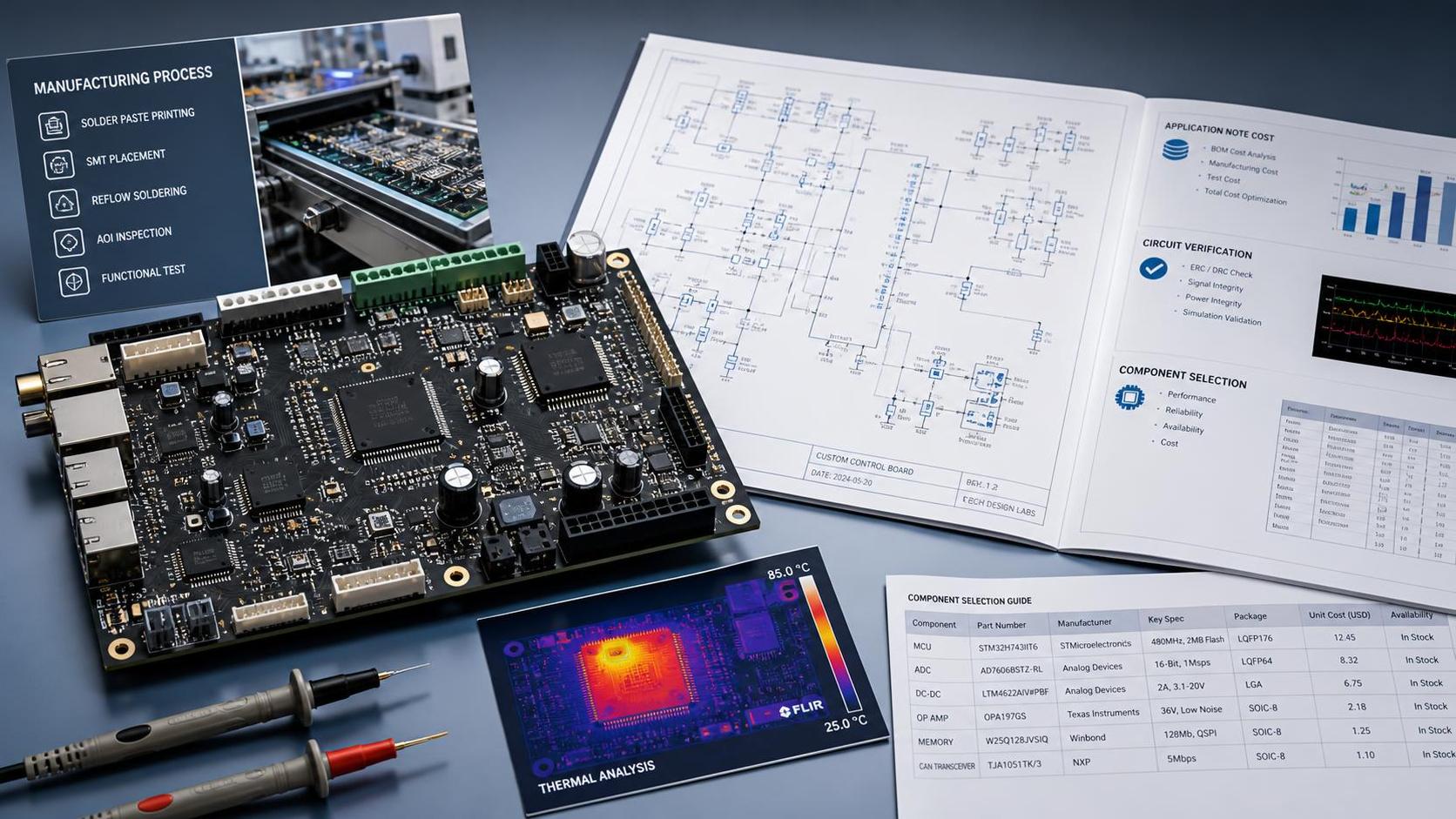
When teams compare quotes for application note cost, they often assume they are paying for a polished PDF, a reference schematic, and a few setup notes. In custom electronics work, that is rarely what drives the number. The real cost sits behind the document: circuit validation, component tradeoff work, signal and thermal checks, manufacturing adaptation, and the amount of project-specific engineering required before anyone is willing to put guidance in writing.
If you are evaluating suppliers, the first useful question is simple: what portion of this quote is documentation labor, and what portion is technical development? If the supplier cannot explain that split, you do not yet know whether the application note is a lightweight usage guide or a condensed engineering package.
That distinction matters because a low quote can mean one of two very different things. Either the design is mature and easily adapted, or the supplier is excluding the expensive work that usually prevents field failures, respins, and qualification delays.
Check how much design interpretation is needed
Application notes get expensive when the source design is not directly portable. A custom electronics project usually starts with an existing IC, module, power stage, interface, or subsystem that was proven under different constraints. Turning that into usable guidance for your board means someone has to interpret your voltage rails, load profile, ambient conditions, connector scheme, stack-up assumptions, mechanical envelope, and target compliance path.
Look for these signals in the supplier discussion:
- Are they adapting an existing reference design, or creating guidance from a partially defined concept?
- Do they already understand your operating environment, or will they need discovery sessions just to define the application envelope?
- Are your requirements stable enough for one pass, or is the application note likely to be rewritten as the design evolves?
The more interpretation work required up front, the higher the cost. This is one of the easiest items to underestimate because it does not look like engineering until the review cycles start.
Do not ignore circuit validation scope
A serious application note is usually backed by validation. Not always full qualification, but enough evidence to support the recommendations. That means bench work, simulation, or both. If a supplier is advising on decoupling strategy, power sequencing, clock routing, high-speed interfaces, thermal paths, or protection circuits, the document has value only if those recommendations were checked against something more rigorous than prior habit.
Ask what validation work is included before treating the quote as comparable across vendors. One supplier may include schematic review only. Another may include SI review, thermal estimation, tolerance analysis, and limited prototype validation. Those are not the same product, even if both are labeled “application note.”
A common purchasing mistake is pushing the document price down while quietly accepting that validation will happen later, somewhere else, under schedule pressure. That almost always costs more.
Component selection work can dominate the quote
In many custom projects, the application note is really a decision record for component choices. That is where cost rises quickly. If the supplier needs to compare alternate MOSFETs, capacitors, magnetics, sensors, clock sources, passives, or thermal interface materials, the work goes beyond listing approved part numbers.
The expensive part is the analysis behind the list:
- Electrical margin across your actual load and temperature range
- Availability of second sources and package variants
- Assembly compatibility with your board density and reflow profile
- Reliability concerns under vibration, humidity, cycling, or sustained power dissipation
If your team wants the note to support sourcing decisions, not just design intent, expect more cost. You are paying for reduced ambiguity during procurement and fewer arguments later between engineering and supply chain.
High-speed and power-dense designs raise the price fast
Some custom electronics can tolerate broad guidance. Others cannot. Once the design involves tighter signal integrity limits, controlled impedance, fast edge rates, switching noise, dense BGA fan-out, thermal hotspots, or micro-tolerance assembly concerns, the application note becomes much more than a usage memo.
This is where technical evaluators should inspect the hidden assumptions inside the quote. Does the supplier expect a standard PCB stack-up, or will stack-up optimization be part of the work? Are thermal constraints handled with generic heatsinking advice, or with board-level heat spreading and package interaction in mind? If placement precision, via strategy, dielectric behavior, or return-path control matter to performance, the application note cost rises because the design window is narrower and the cost of being wrong is higher.
Cheap documentation is easy to produce. Useful guidance for a design with signal and thermal sensitivity is not.
Manufacturing-specific adaptation is a real cost driver
One of the biggest gaps between quote and reality appears when the application note needs to match a specific manufacturing path. If the final board will be built under IPC-Class 3 expectations, with tight SMT placement limits, demanding rework restrictions, or unusual package interactions, the guidance has to reflect those conditions.
That adaptation may include pad recommendations, stencil considerations, keep-out logic, thermal relief choices, derating advice, acceptable substitutes, assembly risk notes, and inspection priorities. It may also require alignment with supplier quality documents, manufacturing capability statements, or compliance records tied to ISO 9001 processes.
If your purchasing team compares a generic application note against one written for your actual EMS environment, the generic option will look cheaper every time. It will also leave more unanswered questions where failures tend to start: at the handoff from design to build.
Review how many interfaces and edge cases must be covered
A single-rail analog front end and a mixed-signal board with multiple digital interfaces do not generate the same application note cost. Every external dependency expands the work. Power rails, buses, firmware assumptions, reset behavior, startup sequences, EMC-sensitive lines, connector pinouts, and protection schemes all create edge cases that someone needs to capture clearly.
Here is a quick way to judge whether your quote is likely understated:
Version control and review cycles add cost quietly
Some of the most expensive application notes are not technically extreme. They are unstable. Requirements move, mechanical constraints shift, procurement changes preferred parts, and each update ripples back through the document. If the note is expected to support internal design review, supplier alignment, and sourcing approval at the same time, every stakeholder adds comments and the editing burden multiplies.
Before accepting a quote, check whether it assumes one review cycle or several. Ask how revisions are triggered. If the supplier has to revisit calculations, redraw reference circuits, or revisit layout guidance after each change, application note cost will rise even when the final document length barely changes.
Watch for quotes that exclude test evidence and release criteria
An application note is much easier to price when the acceptance boundary is vague. Trouble starts later when your team assumes the document includes proof points that were never part of the scope. For technical evaluation, this is where many comparisons go wrong.
Check whether the quote defines:
- Which tests, simulations, or reviews support the recommendations
- Which operating conditions were considered
- Whether manufacturing notes are advisory or validated against a real process window
- What constitutes a completed deliverable
Without that, the cheaper quote may simply be leaving out the evidence you need for a sourcing decision.
A practical way to compare suppliers
When reviewing application note cost, compare scope in this order:
- Define the intended use of the note: design enablement, sourcing approval, manufacturing transfer, or field reliability support.
- List the technical areas that must be covered: electrical, thermal, SI, component selection, assembly, compliance-related documentation, or all of them.
- Ask what existing reference material the supplier can reuse and what must be developed from scratch.
- Map the quote to evidence: calculations, simulations, lab work, review records, or manufacturing inputs.
- Count revision paths before the document is released.
This usually reveals why one bid is higher. Sometimes the premium is unnecessary. Sometimes it is the only quote that actually covers the engineering work your team assumed was included.
Use cost as a signal, not just a number
For technical evaluators, application note cost is useful when treated as a scope indicator. A higher price may reflect deeper validation, tighter manufacturing alignment, stronger component analysis, or more responsibility taken by the supplier. A lower price may be perfectly reasonable for a mature, low-risk adaptation. It may also mean critical engineering is still unfunded.
The cleanest buying process is to review the note the same way you would review a design package: define operating conditions, identify the riskiest interfaces, verify what evidence sits behind the recommendations, and check how well the guidance matches your actual build environment. Do that before you negotiate price, not after. That is usually where the avoidable cost sits.
Recommended News
- MCU & ChipsetsWhat Drives Application Note Cost in Custom Electronics Projects?Application note cost depends less on document length and more on engineering scope, validation, component decisions, and manufacturing fit. Learn what truly drives pricing before you compare suppliers.
- MCU & ChipsetsIoT Embedded System Components: Selection Guide for Performance, Power, and ConnectivityIoT embedded system components selection guide covering performance, power, and connectivity. Learn how to reduce risk, improve reliability, and choose smarter for long-term IoT success.
- MCU & ChipsetsWhat Drives Electronics Content Cost in Modern Device DesignElectronics content cost is shaped by component volatility, PCB complexity, SMT precision, thermal design, and compliance. Learn the real cost drivers and make smarter device approval decisions.
- MCU & ChipsetsMCU Vendor Evaluation: 7 Criteria That Matter Beyond Unit PriceMCU vendor evaluation made practical: discover 7 criteria beyond unit price, from supply continuity and quality control to lifecycle support and total cost risk.
- MCU & ChipsetsHow to Use an Electronics Research Platform for Faster Component ScreeningElectronics research platform best practices for faster component screening: compare specs, validate reliability, reduce sourcing risk, and make smarter engineering decisions faster.
- MCU & ChipsetsActive Components Pricing: What Drives Cost Swings in 2026Active components pricing in 2026 is driven by AI demand, wafer access, energy, and compliance. See what causes cost swings and how to protect margins early.